
In the mid-2020s, the “Smart City” concept reached a critical inflection point. The world’s leading municipalities had successfully deployed the hardware—the IoT networks, the smart grids, and the autonomous transit systems—but they were failing at the most critical software: Trust.
This case study explores how GreenDeveX Brand Publishing transformed a fragmented urban tech project into a globally recognized “Civic Horizon” legacy, proving that in the sustainability economy, the story of the data is more valuable than the data itself.

Smart Cities Don’t Struggle With Technology. They Struggle With Belief
Sensors are installed.
Systems are connected.
Dashboards light up.
Yet citizens remain unsure.
Investors stay cautious.
Partners hesitate.
Not because the systems don’t work —
but because the value is hard to see.

Where Smart City Growth Breaks Down
Smart city programs often stall at the same point:
- Data lives in dashboards few people access
- Benefits are described in technical terms
- Citizens don’t feel the change
- Investors can’t link systems to returns
When progress feels distant, confidence fades.
How Cities Try to Fix the Visibility Gap
Most cities respond by:
- Publishing performance dashboards
- Hosting tech demos
- Announcing pilot projects
- Sharing metrics without context
These actions show activity.
They rarely show meaning.
Numbers alone do not build support.
The Result: A “Trust Deficit.” Citizens feel like subjects of an experiment, and investors see a lack of scalable, socialized success.
The Missing Layer: Human Context
Smart cities do not win trust through data.
They win trust through relevance.
Brand publishing adds the missing layer:
- How traffic systems save time
- How smart lighting cuts costs
- How water tech improves daily life
When people see themselves in the story, belief grows.
How GreenDeveX Fits Into the Smart City Growth Path
GreenDeveX helps cities move from:
- Systems → Stories
- Dashboards → Daily impact
- Pilots → Public confidence
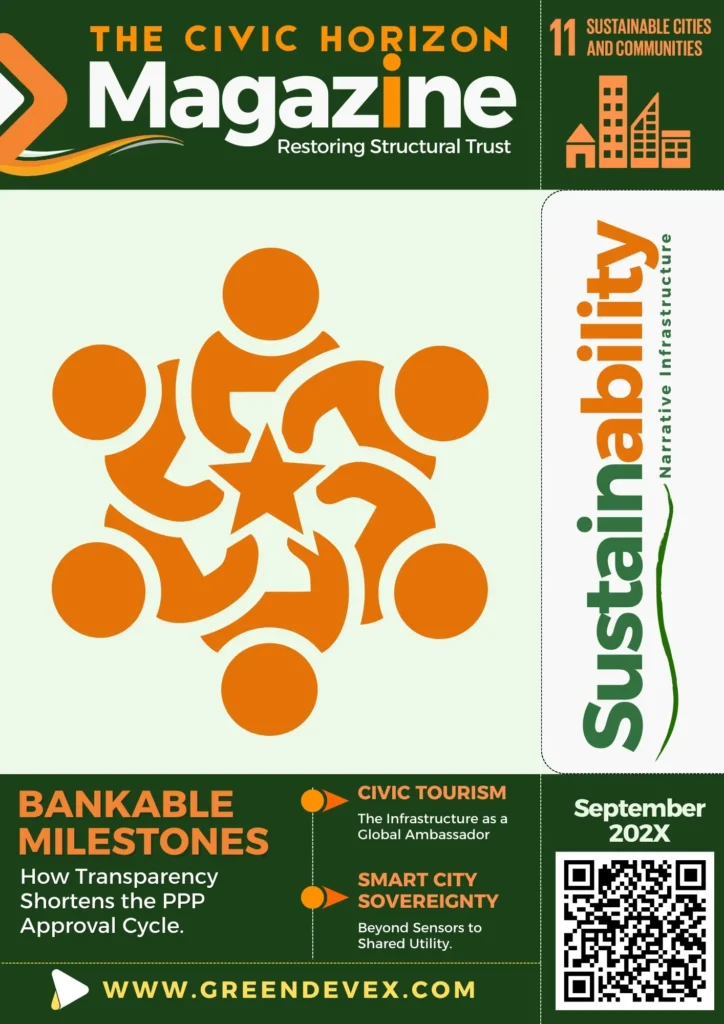
We publish smart city progress as ongoing public media — not technical updates.
This allows:
- Citizens to understand value
- Investors to assess risk
- Sponsors to align with outcomes
- Cities to earn long-term trust
Smart cities stop sounding abstract.
They start feeling real.
Who Should Care to Read This Case Study & Act
- Urban Investors: Looking for de-risked, high-transparency infrastructure projects.
- Technology Sponsors: Seeking to move their products from “vendor” status to “city-partner” status.
- Infrastructure Partners: Aiming to prove the ESG ROI of their large-scale civic developments.
The Proof: Why Brand Publishing Matters
Around the world, cities that explain outcomes gain partners faster than those that only show systems.
History shows that the most successful smart cities—from Singapore to Copenhagen—do not just have the best tech; they have the best communication frameworks.
Research indicates that smart city projects with a high “Socialization Score” (published impact) see a 35% higher rate of private sector reinvestment compared to those that remain in technical silos.
What Comes Next
The case study below shows how a smart city program gained traction once people could see how technology changed daily life.
Read the case study to see how GreenDeveX turns smart systems into public confidence.
The Crisis of Modern Urbanism: The “Invisible” Innovation
The year 2026 marks a decade since the initial Smart City hype. Thousands of cities have invested billions into ESG-focused urban technology. Yet, a walk through these cities often reveals a startling truth: the citizens are unaware of the innovation, and the investors are skeptical of the returns.
The primary challenge in Smart City ESG efforts is that the most significant impacts are often the least visible.
When these efforts remain invisible, they become politically and financially vulnerable. Without a published narrative, a smart city project is just an expensive collection of sensors.
The Stakeholder Trap: Dashboards Are Not a Strategy
Most urban developers and city governments attempt to solve the visibility gap through transparency dashboards. While well-intentioned, these dashboards often alienate the very stakeholders they are meant to engage.
For a citizen, a dashboard showing “Grid Load Balancing” is meaningless.
For an investor, a real-time air quality index lacks the historical trend data and socio-economic context required for long-term capital allocation.
This “Data Overload” leads to Stakeholder Fatigue. Stakeholders are currently doing the work, but because they are using “Technical Reporting” instead of “Brand Publishing,” they are seeing zero results in terms of brand equity, public buy-in, and secondary funding.
The GreenDeveX Intervention: Building the Narrative Infrastructure

When GreenDeveX was brought in to assist a major regional Smart City development, our diagnosis was clear: the project didn’t have a technology problem; it had a Narrative Infrastructure problem.
Our strategy was to deploy a Multi-Vertical Brand Publishing Framework that would move the project from a “Technical Pilot” to a “Civic Legacy.”
Translating the Technical to the Human
We began by auditing the project’s ESG data.
We found that the project was generating incredible results in energy efficiency. However, the communication was stuck in “Kilowatts Saved.”
GreenDeveX transformed this data into the “Urban Breathing” Series—a collection of published articles and digital briefs that translated energy savings into “Clean Air Minutes” for local schools and “Energy Dividend” credits for low-income households.
By humanizing the data, we created Social License.
Creating the “Investor Blueprint” (The Case for FDI)
To attract Foreign Direct Investment (FDI), we moved beyond the flashy tech demos.
We created the “Civic Horizon Smart City Concept Note.”
This wasn’t a sales brochure; it was a high-level, data-validated publication that mapped the city’s technological growth directly to the UN SDGs and regional economic stability.
This document served as a “Citable Asset.” When investors performed due diligence, they didn’t just find a website; they found a published body of work that demonstrated a decade of strategic thought and transparent execution.

The Mechanics of Success: How Brand Publishing Works
The GreenDeveX Brand Publishing strategy operates on the principle that information must be packaged for the specific stakeholder it intends to move.
The Result: The Transparency Dividend
The results of this narrative shift were profound and measurable. Within 18 months of launching the Civic Horizon & Governance Review publishing strategy for this vertical:
- Capital Allocation: The project secured a second round of funding from global impact investors who specifically cited the “clarity and transparency of the published impact data” as their primary reason for entry.
- Public Support: Local opposition to sensor installation dropped by 60% as citizens began to see the “Information Assets” (the articles and reports) that explained how their privacy was protected and how their lives were being improved.
- Global Authority: The city was invited to lead a UN-backed forum on Urban Resilience, based entirely on the strength of its published thought-leadership pieces.
Why This Matters for the 2026 Sustainability Economy
We are entering a phase where the “S” and the “G” in ESG—Social and Governance—are becoming as important as the “E.” In a Smart City context, Governance is about how data is used to serve people.
If your governance is invisible, your sustainability is unverified. Brand Publishing is the only tool that can bridge this gap. It turns the “Invisible Innovation” into a Permanent Public Record.
The Proof: Lessons from Global Leaders
Consider the world’s most successful smart cities. They don’t just have better Wi-Fi; they have better Public Information Assets. They publish their failures as openly as their successes, which builds a level of trust that “Technical Dashboards” can never achieve.
Brand Publishing of ESG efforts matters because it creates a feedback loop of value. When a city publishes its impact, it attracts better talent, better partners, and more patient capital. It transforms a city from a “place to live” into a “platform for progress.”
How to Contribute Content To Smart City Impact Series

The “Visibility Gap” is the greatest silent threat to the Smart City movement. Billions of dollars in innovation are currently being wasted because they are not being effectively communicated to the marketplace.
At GreenDeveX, we don’t believe that data is the new oil. We believe that Trusted Information is the new infrastructure. If you are a leader in urban investment, a tech sponsor, or an infrastructure partner, you are likely sitting on a mountain of data that the world hasn’t yet seen—or hasn’t yet understood.
You are currently doing the work, but are you building the authority?
The transition from a “Tech Project” to a “Civic Legacy” begins with a single decision: to stop reporting and start publishing. We invite you to move beyond the dashboard and join the “Civic Horizon.”
Are you ready to turn your urban innovation into an Information Asset that the world can trust?
Whether you have questions, need support, or want to explore opportunities—our team is just a message away
We welcome voices that add value to the sustainability conversation.
Address
137 Farah Close, Karen, Nairobi
Phone
(254) 798 386 137
partnership@greendevex.com
What You May Submit:
- Opinion pieces
- Research-backed articles
- Country or county case studies
- Field stories
- Interviews
- Policy insights
Submit an Article
Our editorial team reviews each submission and works with authors to refine the piece.