

10 Interconnected Clusters. 5 Thematic Engines. One Operating System.
Most economic development programs treat sectors as isolated silos.
Agriculture does not talk to energy.
Education does not coordinate with employment.
Health does not integrate with urban planning.
Media does not align with trade policy.
The cost? Fragmented policies. Wasted resources. Missed opportunities for synergy. Your message is interpreted in isolation, not as part of how the economy actually moves.
GreenDeveX’s Ecosystem Clusters change this.
We organize the economy into 10 interconnected clusters. Each cluster maps to one of five Thematic Engines. Each cluster has its own friction map, author archetype cluster, and publishing infrastructure.
The outcome? You see how clusters interact. You identify leverage points. You align your narrative with how the economy actually moves.
“Clusters are not boxes. They are nodes in a network. The value is not in the node. It is in the connections.”— Victor Isyamba
How the 10 Ecosystem Clusters Interact
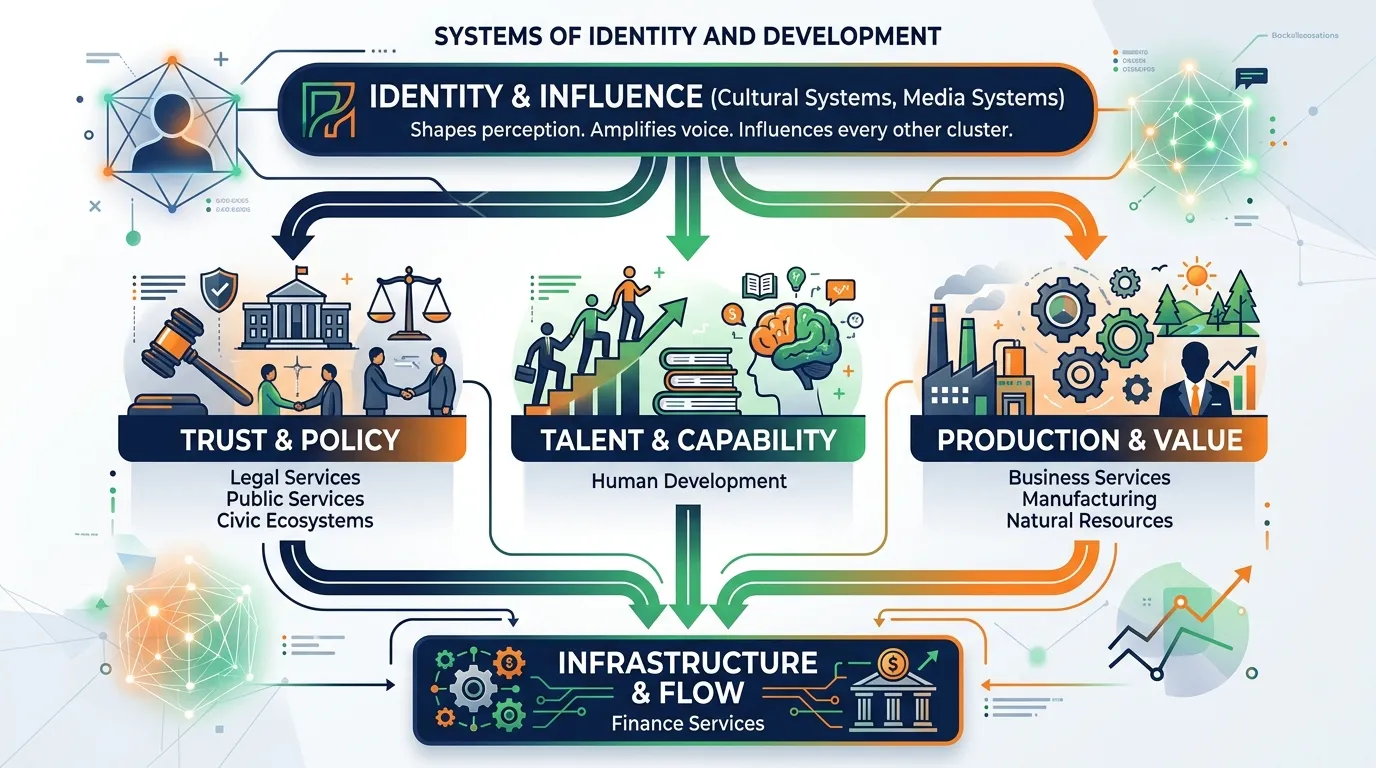
Before we dive into each cluster, understand how they connect.
The interactions explained:
| Connection | Why It Matters |
|---|---|
| Identity & Influence → All Clusters | Media and culture shape how every other cluster is perceived. A strong manufacturing sector is invisible without media coverage. A legal reform is useless if citizens do not know about it. |
| Trust & Policy → Production & Value | Legal clarity enables business. Contracts need enforcement. Regulations need predictability. Without Trust & Policy, Production & Value stalls. |
| Talent & Capability → Production & Value | Human development produces the skilled workforce that manufacturing and business services need. Without talent, production cannot scale. |
| Production & Value → Infrastructure & Flow | Economic activity generates demand for finance, logistics, and digital rails. Growth in manufacturing drives growth in financial services. |
| Infrastructure & Flow → All Clusters | Finance is the circulatory system. Capital flows enable everything else. Without financial rails, no cluster scales. |
“You cannot optimize one cluster in isolation. The system connects them. Lead the system, not the silo.”— Victor Isyamba
What Lives Under This Pillar
| Subpage | What It Covers |
|---|---|
| Human Development Systems | Education, health, human-centred sectors. Maps to Talent & Capability Engine. |
| Legal Services Ecosystem | Law firms, legal tech, regulatory advisory, justice systems. Maps to Trust & Policy Engine. |
| Natural Resources Systems | Climate, energy, land, water, extractive industries. Maps to Production & Value Engine. |
| Finance Services Ecosystems | Banking, investment, insurance, capital markets. Maps to Infrastructure & Flow Engine. |
| Business Services Ecosystems | Consulting, professional services, B2B expertise. Maps to Production & Value Engine. |
| Manufacturing Ecosystems | Industrial production, supply chains, operational excellence. Maps to Production & Value Engine. |
| Public Services Ecosystems | Government agencies, public administration, citizen service delivery. Maps to Trust & Policy Engine. |
| Civic Ecosystems | Community organizations, public participation, democratic engagement. Maps to Trust & Policy Engine. |
| Cultural Systems | Arts, heritage, cultural institutions, creative industries. Maps to Identity & Influence Engine. |
| Media Systems | Journalism, broadcasting, publishing, digital content. Maps to Identity & Influence Engine. |
The 10 Ecosystem Clusters (Mapped to Thematic Engines)
| # | Ecosystem Cluster | Thematic Engine | Core Friction | Primary Archetypes |
|---|---|---|---|---|
| 01 | Human Development Systems | Talent & Capability | Impact Credibility, Behaviour Change | The Storyteller, The Philosopher, The Community Builder |
| 02 | Legal Services Ecosystem | Trust & Policy | Expertise Opacity, Trust Deficit | The Sage, The Translator, The Diplomat |
| 03 | Natural Resources Systems | Production & Value | Investment Confidence, Transition Complexity | The Futurist, The Economist, The Diplomat |
| 04 | Finance Services Ecosystems | Infrastructure & Flow | Trust Deficit, Complexity, Risk Perception | The Economist, The Sage, The Translator |
| 05 | Business Services Ecosystems | Production & Value | Differentiation, Expertise Opacity | The Contrarian, The Sage, The Field Guide |
| 06 | Manufacturing Ecosystems | Production & Value | Operational Complexity, Quality Opacity | The Operator, The Cartographer, The Field Guide |
| 07 | Public Services Ecosystems | Trust & Policy | Trust Deficit, Service Complexity | The Diplomat, The Investigator, The Translator |
| 08 | Civic Ecosystems | Trust & Policy | Participation Gaps, Trust Fragility | The Community Builder, The Diplomat, The Storyteller |
| 09 | Cultural Systems | Identity & Influence | Relevance Decay, Audience Fragmentation | The Cultural Decoder, The Storyteller, The Curator |
| 10 | Media Systems | Identity & Influence | Trust Erosion, Content Overload | The Investigator, The Curator, The Contrarian |
How Each Cluster Connects to the Others
Human Development Systems connects to:
| Connected Cluster | Nature of Connection |
|---|---|
| Business Services | Provides talent that business services need. Without skilled workers, consulting and professional services cannot scale. |
| Manufacturing | Provides workforce with technical skills. Without human development, manufacturing lacks operators. |
| Public Services | Education and health are public services themselves. They depend on public infrastructure and funding. |
| Civic Ecosystems | Human development requires community participation. Schools need engaged parents. Health programmes need community buy-in. |
“A nation cannot build what it cannot staff. Human Development is the talent engine for every other cluster.”— Victor Isyamba
Legal Services Ecosystem connects to:
| Connected Cluster | Nature of Connection |
|---|---|
| Finance Services | Every financial transaction requires legal contracts. Banking, investment, and insurance depend on legal clarity. |
| Business Services | Consulting engagements require contracts. Intellectual property needs protection. Disputes need resolution. |
| Manufacturing | Supply chain contracts, liability protection, regulatory compliance all require legal services. |
| Public Services | Government regulations, permits, and compliance are legal services. Public administration is legal infrastructure. |
| Civic Ecosystems | Civic participation requires legal rights. Voting, organizing, and protesting are legally protected activities. |
“Law is not a cost centre. Law is the operating system of the economy. Without legal clarity, no transaction happens.”— Victor Isyamba
Financial Services Ecosystems connects to:
| Connected Cluster | Nature of Connection |
|---|---|
| Every Cluster | Finance is the circulatory system. Every economic activity requires capital. Every business needs banking. Every project needs investment. |
“Finance is not a sector. Finance is the infrastructure of every sector. Without it, nothing scales.”— Victor Isyamba
Natural Resources Systems connects to:
| Connected Cluster | Nature of Connection |
|---|---|
| Manufacturing | Natural resources are inputs to manufacturing. Minerals, energy, water, and land are raw materials. |
| Finance Services | Resource projects require capital. Mining, energy, and agriculture need investment. |
| Infrastructure & Flow | Resources need transport. Pipelines, ports, railways, and roads move resources to markets. |
| Public Services | Resource extraction requires permits, environmental regulation, and community agreements. |
“Natural resources are not wealth. They are potential wealth. The clusters that process, finance, and transport them create the actual value.”— Victor Isyamba
Business Services Ecosystems connects to:
| Connected Cluster | Nature of Connection |
|---|---|
| Manufacturing | Manufacturers need consultants, accountants, IT services, and logistics providers. Business services enable manufacturing efficiency. |
| Finance Services | Banks need auditors, legal advisors, and management consultants. Business services enable financial institutions. |
| Public Services | Governments need IT consultants, project managers, and policy advisors. Business services enable public administration. |
| Human Development | Schools need education consultants. Hospitals need healthcare advisors. Business services enable human development. |
“Business services are the lubricant of the economy. They make every other cluster run more smoothly.”— Victor Isyamba
Manufacturing Ecosystems connects to:
| Connected Cluster | Nature of Connection |
|---|---|
| Natural Resources | Manufacturing consumes resources. Minerals, energy, water, and agricultural products are inputs. |
| Business Services | Manufacturers need logistics, IT, consulting, and maintenance services. |
| Finance Services | Factories need capital. Equipment financing, working capital loans, and investment banking enable manufacturing. |
| Human Development | Manufacturers need skilled workers. Vocational training, technical education, and apprenticeship programmes supply talent. |
“Manufacturing is the value-adding engine. It transforms raw materials into useful products. Every other cluster serves this transformation.”— Victor Isyamba
Public Services Ecosystems connects to:
| Connected Cluster | Nature of Connection |
|---|---|
| Legal Services | Public services operate within legal frameworks. Regulations, permits, and compliance are legal infrastructure. |
| Civic Ecosystems | Public services serve citizens. Civic participation shapes public service priorities. |
| Human Development | Education and health are public services. They are both clusters themselves. |
| Infrastructure & Flow | Public services depend on infrastructure. Schools need buildings. Hospitals need power. Courts need records systems. |
“Public services are not overhead. They are the platform on which everything else is built.”— Victor Isyamba
Civic Ecosystems connects to:
| Connected Cluster | Nature of Connection |
|---|---|
| Public Services | Civic participation shapes public service delivery. Community input determines priorities. |
| Cultural Systems | Civic identity is cultural identity. Community organisations express cultural values. |
| Human Development | Civic engagement builds social capital. Participating communities have better health and education outcomes. |
| Legal Services | Civic rights are legal rights. Voting, organising, and protesting are protected by law. |
“Civic ecosystems are the immune system of democracy. When they are healthy, the body politic thrives. When they are weak, the whole system is vulnerable.”— Victor Isyamba
Cultural Systems connects to:
| Connected Cluster | Nature of Connection |
|---|---|
| Business Services | Provides talent that business services need. Without skilled workers, consulting and professional services cannot scale. |
| Manufacturing | Provides workforce with technical skills. Without human development, manufacturing lacks operators. |
| Public Services | Education and health are public services themselves. They depend on public infrastructure and funding. |
| Civic Ecosystems | Human development requires community participation. Schools need engaged parents. Health programmes need community buy-in. |
“Culture is not decoration. Culture is the story a nation tells itself. That story shapes every decision.”— Victor Isyamba
Media Systems connects to:
| Connected Cluster | Nature of Connection |
|---|---|
| Every Cluster | Media shapes perception of every cluster. A successful manufacturing sector is invisible without media coverage. A legal reform is useless if citizens do not know about it. A cultural asset does not exist until it is shared. |
“Media is not a sector. Media is the nervous system of the economy. It carries signals between every other cluster.”— Victor Isyamba
The Three Operating Models Across All Clusters
| Operating Model | How It Applies to Ecosystem Clusters |
|---|---|
| Co-Creating Model | A Cartographer author co-creates a Cluster Map as a signature asset for investment promotion or policy development |
| Fractional Publishing Model | Engage a Diplomat author on retainer to facilitate cross-cluster coordination and stakeholder alignment |
| Rent-and-Rank Narrative Model | Place cluster intelligence briefings within existing industry platforms to build credibility and attract investment |
How This Pillar Connects to Others
| Connected Pillar | How They Work Together |
|---|---|
| Ecosystem Overview | The Ecosystem Overview defines the model. Ecosystem Clusters apply it to specific economic sectors. |
| Author Ecosystems | Each cluster has a cluster of author archetypes. Author Ecosystems supplies the classified authors. |
| Brand Ecosystems | Ecosystem Clusters define the industry context. Brand Ecosystems deploys the publishing infrastructure. |
| Thematic Engines | Ecosystem Clusters map directly to the five Thematic Engines. Each cluster lives within an engine. |
| Playbooks | Playbooks provide strategic intelligence for each cluster. Ecosystem Clusters apply it to real industries. |
Ready to map your cluster?
Identify your ecosystem cluster, map its connections, and deploy the right operating model and thematic engine.
→ Find Your Ecosystem Cluster
Or dive deeper into a specific cluster:
→ Human Development Systems (Talent & Capability Engine) →
→ Legal Services Ecosystem (Trust & Policy Engine) →
→ Natural Resources Systems (Production & Value Engine) →
→ Finance Services Ecosystems (Infrastructure & Flow Engine) →
→ Business Services Ecosystems (Production & Value Engine) →
→ Manufacturing Ecosystems (Production & Value Engine) →
→ Public Services Ecosystems (Trust & Policy Engine) →
→ Civic Ecosystems (Trust & Policy Engine) →
→ Cultural Systems (Identity & Influence Engine) →
→ Media Systems (Identity & Influence Engine) →