
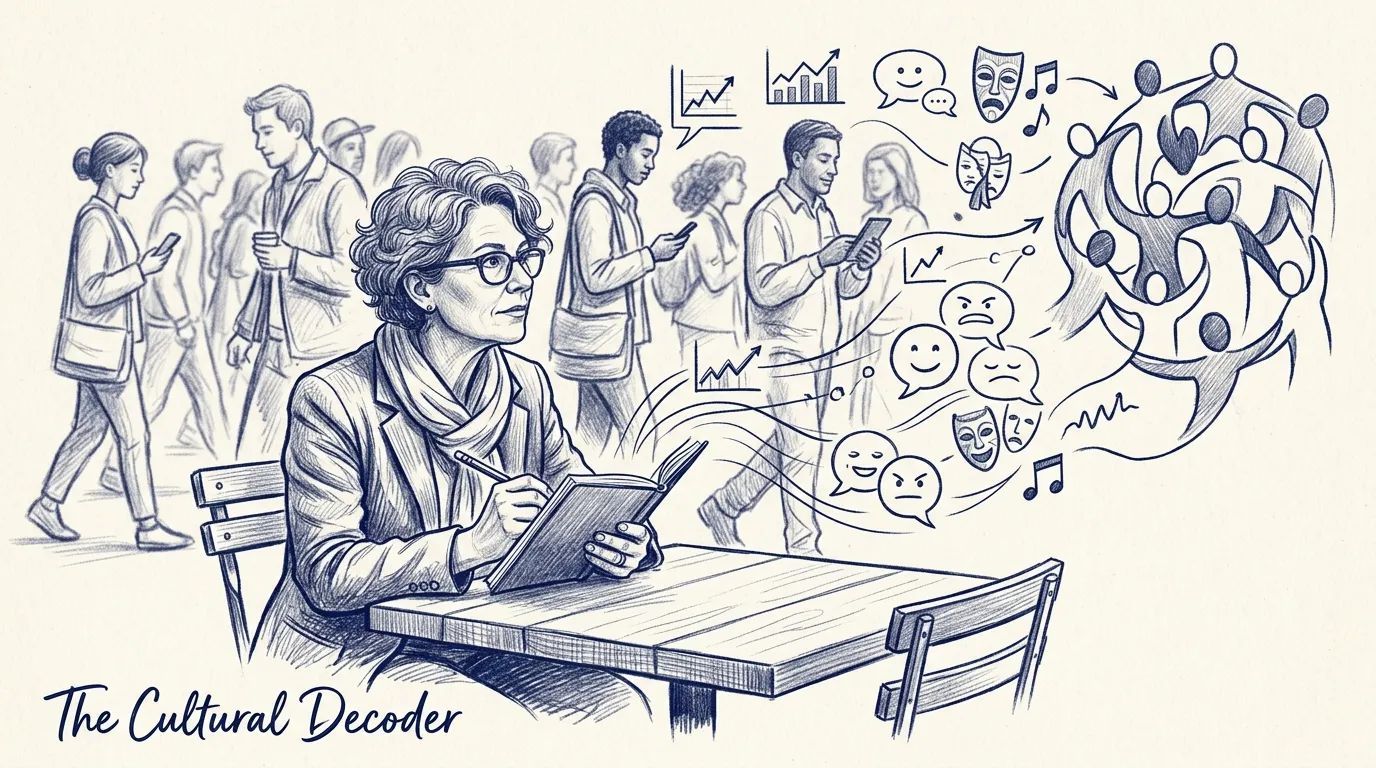
What The Economist Does
Core Question: What are people really responding to?
The Cultural Decoder resolves cultural blindness by interpreting human behavior, explaining social dynamics, and translating the unwritten rules that govern how markets actually work.
Where brands fail because they project their own cultural assumptions onto audiences they do not truly understand, the Cultural Decoder provides the insight that makes genuine resonance possible.
Cultural Decoders are not anthropologists who study remote tribes (though some are). They are observers of the everyday—the rituals, the status signals, the unspoken agreements that shape how people in a given culture decide, trust, and act.
The Cultural Decoder does not impose meaning. The Cultural Decoder reveals the meaning that is already there.
GreenDeveX classifies authors who embody the Cultural Decoder to help brands achieve genuine resonance.
The outcome? Your brand speaks the local language—not just linguistically, but culturally.
7 Ideal Characteristics of The Cultural Decoder
What Makes This Author Archetype Capable of Resolving Cultural Blindness
| # | Characteristic | What It Looks Like |
|---|---|---|
| 1 | Deep Observation | Notices what others overlook. Sees patterns in behavior that most people take for granted. |
| 2 | Insider-Outsider Fluency | Can explain a culture to outsiders without betraying it. Translates without colonizing. |
| 3 | Humility About Their Own Culture | Knows that their own cultural assumptions are not universal. Does not mistake local for logical. |
| 4 | Pattern Recognition Across Contexts | Spots recurrences: the same status dynamics, the same rituals, the same taboos, wearing different clothes. |
| 5 | Non-Judgmental Curiosity | Interested in why people do what they do, not in judging whether it is right. |
| 6 | Courage to Name Taboos | Willing to discuss what cultures do not discuss. Surfaces the invisible. |
| 7 | Gift for Accessible Explanation | Makes complex cultural dynamics understandable to non-experts. No jargon. |
Real-Life Example:
Chimamanda Ngozi Adichie
While Chimamanda Ngozi Adichie is a Storyteller, she is also a powerful Cultural Decoder. Her work illuminates not just individual lives but the cultural systems those lives inhabit.
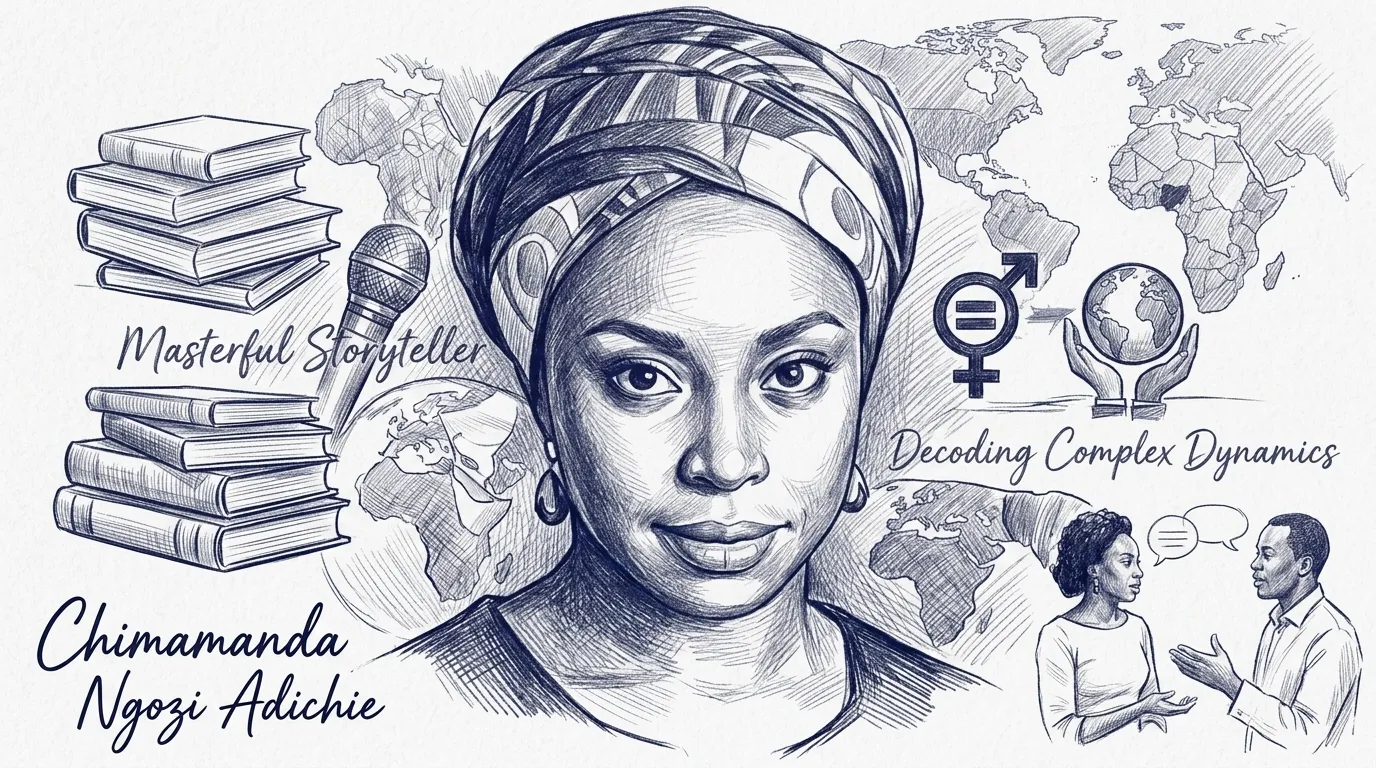
Why does she embody The Cultural Decoder:
| Characteristic | How Chimamanda Ngozi Adichie Demonstrates It |
|---|---|
| Deep Observation | Her novels are thick with cultural detail—the texture of hair, the weight of a passport, the smell of a market stall. She observes what others overlook because they take it for granted. |
| Insider-Outsider Fluency | She explains Nigerian and American cultures to each other—and to the rest of the world. She is fluent in both and translates without reducing either. |
| Humility About Her Own Culture | She is critical of Nigerian culture when criticism is due. She does not romanticize. She sees clearly because she loves truly. |
| Pattern Recognition Across Contexts | Her work reveals how patriarchy operates similarly across cultures—while wearing different clothes. She spots the pattern beneath the surface. |
| Non-Judgmental Curiosity | Her characters are complex, flawed, and human. She does not judge them. She tries to understand them. |
| Courage to Name Taboos | She writes about abortion, female desire, domestic violence, and political corruption—taboos in many cultures—without sensationalism. |
| Gift for Accessible Explanation | Her essays and speeches explain complex cultural dynamics to millions. “The Danger of a Single Story” is a masterclass in decoding. |
How Adichie resolves cultural blindness:
Before her TED Talk, many people understood that stereotypes exist. After “The Danger of a Single Story,” they understood how stereotypes work—how they flatten, reduce, and dehumanize. She decoded the cultural mechanism.
The insight changed how millions see their own assumptions.
The GreenDeveX Insight:
Brands that partner with Cultural Decoders like Chimamanda Ngozi Adichie do not need to guess what will resonate. The Decoder has already done the fieldwork.
The brand simply needs to listen.
Other Notable Cultural Decoders for Inspiration
| Cultural Decoder | Domain | Why They Qualify |
|---|---|---|
| Desmond Morris | Human Behavior | Author of The Naked Ape. He looked at humans as a zoologist would study an animal. His decoding of human rituals—greetings, courtship, body language—was revolutionary. |
| Mary Douglas (1921-2007) | Cultural Anthropology | Author of Purity and Danger. She decoded how cultures classify things as clean or unclean, sacred or profane. Her work explains disgust, taboo, and ritual purity. |
| David Brooks | Social Commentary | His writing decodes the “social lives” of Americans—how status works, how community forms, how values shift. He explains what people are really responding to beneath the surface. |
| Tressie McMillan Cottom | Sociology & Culture | Her work decodes race, class, gender, and technology. She explains how institutions reproduce inequality—and how individuals navigate those systems. |
| Clotaire Rapaille | Marketing Anthropology | Developed “archetypes” for brands based on cultural decoding. His work helped global brands understand what different cultures actually want (not what they say they want). |
| Robin Dunbar | Evolutionary Psychology | Decoded the social brain. “Dunbar’s number” (150) explains the natural limit of human relationships. He decoded why communities form and why they break. |
The Cultural Blindness Friction
What the friction looks like:
Markets cannot move when they misread culture. Campaigns land flat. Products are rejected. Messages are misunderstood—not because they are wrong, but because they are culturally tone-dea
The cost of this friction:
How The Cultural Decoder resolves it:
The Cultural Decoder does not impose meaning. The Cultural Decoder reveals the meaning that is already there. Through deep observation, insider-outsider fluency, and non-judgmental curiosity, the Decoder provides the insight that makes genuine resonance possible.
The mechanism: Resonance transfer.
The Decoder understands what the culture actually values, fears, and desires. That understanding attaches to the brand that listens to the Decoder.
Questions The Cultural Decoder Helps Markets Answer
| # | Question |
|---|---|
| 1 | What are the unwritten rules here? What can you do—and what cannot be done? |
| 2 | What do people actually value? Not what they say they value—what their behavior reveals? |
| 3 | Why do our campaigns work in some markets and fail in others? What cultural signal are we missing? |
| 4 | Who has status here? How is status earned, displayed, and lost? |
| 5 | What taboos are we violating without knowing it? |
Publishing Formats for The Cultural Decoder
| Format | Why It Works for The Cultural Decoder |
|---|---|
| Ethnographic Field Notes | Documents observation. Brings the reader into the culture. |
| Cultural Trend Reports | Decodes emerging shifts before they become obvious. |
| Ritual Explanations | Makes the strange familiar—and the familiar strange. |
| Status Maps | Charts who matters, how they got there, and how to tell. |
| Cross-Cultural Guides | Helps outsiders navigate cultures they do not understand. |
| Behavioral Analysis Essays | Explains why people do what they do—not just what they do. |
Ideal Industries / Sectors
| Sector | Why The Cultural Decoder Thrives Here |
|---|---|
| Consumer Goods | Products that ignore culture fail. Decoders reveal what people actually want. |
| Marketing & Advertising | Campaigns that misread culture waste millions. Decoders provide the insight that makes campaigns land. |
| Global Expansion | Entering new markets requires cultural fluency. Decoders prevent costly mistakes. |
| Human Resources | Workplace culture is culture. Decoders help organizations understand their own dynamics. |
| Politics & Advocacy | Movements require cultural resonance. Decoders explain what people are actually responding to. |
| Nonprofit & Development | Interventions that ignore local culture fail. Decoders design for cultural fit. |
Ideal Brand Partnerships
| Brand Type | Why They Need The Cultural Decoder |
|---|---|
| Global brands entering new markets | Need to avoid costly cultural mistakes. Decoders provide the map. |
| Consumer brands losing relevance | Have lost touch with cultural shifts. Decoders explain what changed. |
| Marketing agencies | Need cultural insight to create campaigns that land. Decoders are secret weapons. |
| Multinational organizations | Operate across cultures. Decoders help headquarters understand local offices. |
| Nonprofits working in communities | Need to design for cultural fit, not just need. Decoders prevent imposition. |
5 Frequently Asked Questions About The Economist
FAQ 01: Is The Cultural Decoder just a trend forecaster?
Trend forecasters predict what will happen. Cultural Decoders explain why it is happening—and what it means.
One is predictive; one is interpretive. They work well together.
FAQ 02: Does The Cultural Decoder need to be from the culture they are decoding?
Not necessarily. Outsiders often see patterns that insiders miss—because insiders take their own culture for granted. But outsiders must do the work. Superficial observation is not decoding.
FAQ 03: How does The Cultural Decoder differ from The Translator?
The Translator makes complex technical information accessible.
The Cultural Decoder makes cultural dynamics visible. One deals with knowledge; one deals with meaning. They are natural partners.
FAQ 04: Can a brand be its own Cultural Decoder?
Yes, but rarely well. Brands are inside their own culture. They take it for granted. An external Cultural Decoder sees what insiders cannot—because insiders are swimming in it.
FAQ 05: What is the risk of cultural decoding?
The risk is reductionism—explaining away the mystery. The best Cultural Decoders maintain wonder. They decode without colonizing. They explain without reducing.
Example in Action
Scenario:
A global beverage brand wants to launch a new product in West Africa.
Their Western marketing team creates a campaign that works in London and New York: individualism, rebellion, youth breaking free from tradition.
The Cultural Decoder intervention:
A Decoder who understands West African cultures explains: “Here, family and community are central. Rebellion against tradition is not aspirational—it is dangerous. Respect for elders is not oppression; it is love. Your campaign will offend because it celebrates what this culture fears.”
Outcome:
The brand scraps the campaign.
The Decoder helps design a new one centered on community progress, shared success, and intergenerational respect.
The product launches successfully.
The brand is welcomed, not rejected.
Does your brand need The Cultural Decoder?
If cultural blindness is making your campaigns miss the mark, The Cultural Decoder archetype may be your match.
GreenDeveX classifies and connects Cultural Decoders to brands that need insight, resonance, and authentic connection.
Your ecosystem transition starts here.
→ Join the Early Access Waitlist
→ Find Your Cultural Decoder Match
Now that you understand The Cultural Decoder, explore The Economist — the archetype that explains the incentives driving market behavior.
→ Explore All Author Archetypes