
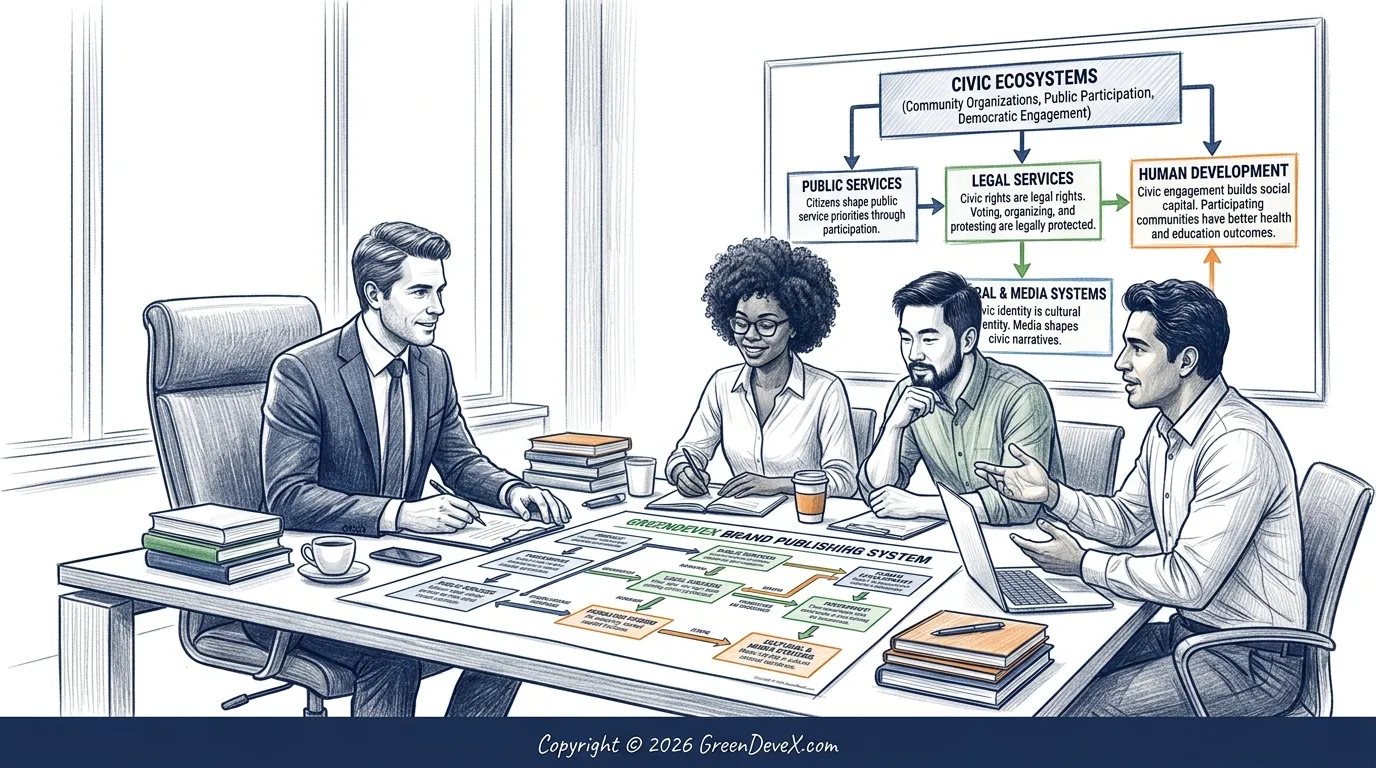
Ecosystem Cluster — Trust & Policy Engine
Thematic Engine: Trust & Policy
Core Question: Why do policies not translate into visible impact?
Primary Frictions: Participation Gaps, Trust Fragility, Community Fragmentation, Voice Inequity, Civic Literacy
Primary Archetypes: The Community Builder, The Diplomat, The Storyteller
Connected Clusters: Public Services, Legal Services, Human Development, Cultural Systems, Media Systems
How This Cluster Connects to Others
Connection to Public Services (Trust & Policy):
Citizens shape public service priorities through participation. Civic engagement determines what services are needed and how they are delivered. Without Civic Ecosystems, public services are disconnected from citizens.
Connection to Legal Services (Trust & Policy):
Civic rights are legal rights. Voting, organizing, and protesting are legally protected activities. Without Legal Services, civic participation has no legal foundation.
Connection to Human Development (Talent & Capability):
Civic engagement builds social capital. Participating communities have better health, education, and economic outcomes. Civic Ecosystems enable Talent & Capability.
Connection to Cultural Systems (Identity & Influence):
Civic identity is cultural identity. Shared stories create shared values that shape civic participation. Without Cultural Systems, civic identity fragments.
Connection to Media Systems (Identity & Influence):
Media shapes civic narratives. How citizens understand issues, leaders, and each other is mediated by media. Without Media Systems, civic discourse is distorted.
“Civic ecosystems are the immune system of democracy. When they are healthy, citizens participate, trust is high, and the body politic thrives. When they are weak, the whole system is vulnerable to distrust, disinformation, and fragmentation.”— Victor Isyamba
What Is the Civic Ecosystems Cluster?
Civic Ecosystems encompasses organizations and initiatives focused on community engagement, public participation, and democratic infrastructure. This cluster is the immune system of democracy — when it is healthy, citizens trust and participate; when it is weak, the whole system fragments.
This cluster includes:
- Community-based organizations (CBOs) and neighbourhood associations
- Civic engagement and voter participation initiatives
- Public participation and citizen advisory bodies
- Community development corporations
- Civic technology and digital democracy platforms
- Participatory budgeting programmes
- Civil society organizations and advocacy groups
- Community foundations and civic philanthropy
- Youth civic engagement programmes
- Conflict resolution and peacebuilding organizations
The core challenge: Participation is voluntary. Trust is fragile. Communities are fragmented. Voices are inequitably heard. Civic literacy is low.
The cluster’s role in the broader economy: This cluster is the foundation of democratic legitimacy. When Civic Ecosystems fail, citizens lose trust in institutions, participation collapses, and the social contract frays. Every other cluster suffers.
“You cannot have effective public services without citizen participation. You cannot have the rule of law without civic trust. You cannot have a functioning economy without social cohesion. Civic ecosystems are not optional. They are the foundation.”— Victor Isyamba
Unique Frictions in Civic Ecosystems
| # | Friction Type | What It Looks Like | Cost of Inaction |
|---|---|---|---|
| 01 | Participation Gaps | Only the usual suspects participate — older, wealthier, more educated. Young people stay home. Marginalized voices are absent. | Decisions do not reflect community diversity. Legitimacy suffers. Outcomes miss those who need them most. |
| 02 | Trust Fragility | Civic institutions are distrusted. Community members assume their input will be ignored. | Low turnout. Cynicism. Disengagement becomes entrenched. |
| 03 | Community Fragmentation | Different neighbourhoods, ethnic groups, or interest groups do not communicate. They do not see shared interests. | Gridlock. Conflict. Missed opportunities for collective action. |
| 04 | Voice Inequity | Some voices dominate. Others are silenced by language, access, or confidence barriers. | Decisions reflect the loudest, not the most affected. Inequity persists. |
| 05 | Civic Literacy | Community members do not understand how decisions are made, how to participate, or why their voice matters. | Participation remains low. Frustration grows. The system feels opaque. |
Author Archetypes for Civic Ecosystems
| Friction | Primary Archetype | What They Do | Publishing Format |
|---|---|---|---|
| Participation Gaps | The Community Builder | Creates belonging and lowers barriers to participation | Participation Guides, Welcome Kits |
| Trust Fragility | The Investigator | Builds transparency through accessible process documentation and outcomes tracking | Transparency Reports, Process Documentation |
| Community Fragmentation | The Cartographer | Maps community assets, relationships, and divides | Community Asset Maps, Relationship Audits |
| Voice Inequity | The Diplomat | Creates frameworks for equitable voice and inclusive decision-making | Inclusion Frameworks, Participation Protocols |
| Civic Literacy | The Translator | Makes civic processes accessible to all community members | Plain Language Guides, Civic Handbooks |
| Civic Motivation | The Storyteller | Creates emotional connection to civic participation and community outcomes | Community Stories, Impact Narratives |
Publishing Formats for Civic Ecosystems
| Format | Purpose | Example | Operating Model |
|---|---|---|---|
| Participation Guides | Lower barriers to entry for community members | “Your Voice Matters: A Guide to Participating in Neighbourhood Decisions” | Co-Creating (signature guide) |
| Welcome Kits | Create belonging for new or marginalized participants | “Welcome to Our Community: How to Get Involved, Be Heard, and Make a Difference” | Co-Creating (shared IP with community partners) |
| Transparency Reports | Build trust through accessible documentation of how input was used | “You Spoke, We Listened: How Community Input Shaped This Decision” | Fractional Publishing (periodic series) |
| Community Asset Maps | Visualize community strengths, relationships, and opportunities | “Our Community Assets: People, Places, and Partnerships That Make Us Strong” | Co-Creating (signature asset) |
| Inclusion Frameworks | Ensure equitable voice in decision-making processes | “The Inclusive Participation Framework: Principles and Protocols” | Co-Creating (co-developed with community) |
| Civic Handbooks | Build civic literacy across the community | “How Your Local Government Works: A Citizen’s Handbook” | Rent-and-Rank Narrative (placement in community platforms) |
| Community Stories | Amplify the voices and experiences of community members | “Our Neighbourhood, Our Stories: Voices from the Community” | Rent-and-Rank Narrative (placement in local media) |
Success Markers for Civic Ecosystems
| Marker | What It Looks Like |
|---|---|
| Broadened Participation | Participation demographics reflect community diversity. New voices join. Marginalized groups are represented. |
| Trust Recovery | Community members believe their input matters. Turnout increases. Cynicism decreases. |
| Community Cohesion | Different groups see shared interests. Collaboration increases. Conflict decreases. |
| Equitable Voice | Decision-making processes actively include marginalized voices. Dominant voices do not crowd out others. |
| Civic Literacy | Community members understand how to participate. They know why their voice matters. |
| Community Power | Community input shapes decisions. Outcomes reflect community priorities. |
Case Example
Organization: A community foundation serving a diverse urban neighbourhood
Primary Friction: Participation Gaps + Voice Inequity
GreenDeveX Approach:
- Matched The Community Builder to create Welcome Kits and Participation Guides in multiple languages
- Matched The Investigator to publish Transparency Reports showing how input shaped decisions
- Matched The Storyteller to amplify voices of marginalized community members
Outcome:
- Participation in community forums increased 150% within 12 months
- Demographics of participants shifted to reflect neighbourhood diversity
- Trust scores improved from 34% to 67%
- Community-driven budget process adopted by local government
How This Cluster Uses the Three Operating Models
| Operating Model | Application for Civic Ecosystems |
|---|---|
| Co-Creating Model | A Community Builder author co-creates a signature Welcome Kit and Participation Guide with your organization. The guides carry both names. Community members trust them because the author’s belonging expertise transfers. |
| Fractional Publishing Model | Engage an Investigator author on retainer to produce quarterly Transparency Reports and annual Community Impact Summaries. Consistent documentation builds trust over time. |
| Rent-and-Rank Narrative Model | Place Community Stories and Civic Handbooks within existing community platforms (e.g., neighbourhood portals, local media, community notice boards). Immediate visibility within trusted community ecosystems. |
→ Find Your Community Builder Match | Find Your Diplomat Match | Find Your Storyteller Match
Interlinking to Related Clusters
| Related Cluster | Why They Connect |
|---|---|
| Public Services Ecosystems | Citizens shape public service priorities through participation. Civic engagement determines what services are needed. Civic Ecosystems enables Trust & Policy. |
| Legal Services Ecosystems | Civic rights are legal rights. Voting, organizing, and protesting are legally protected activities. Civic Ecosystems depends on Trust & Policy. |
| Human Development Systems | Civic engagement builds social capital. Participating communities have better health and education outcomes. Civic Ecosystems enables Talent & Capability. |
| Cultural Systems | Civic identity is cultural identity. Shared stories create shared values that shape civic participation. Civic Ecosystems connects to Identity & Influence. |
| Media Systems | Media shapes civic narratives. How citizens understand issues, leaders, and each other is mediated by media. Civic Ecosystems connects to Identity & Influence. |
Thematic Engine Connection: Trust & Policy
Civic Ecosystems is a core cluster within the Trust & Policy Engine.
| Engine Question | How This Cluster Answers It |
|---|---|
| “Why do policies not translate into visible impact?” | Because policies are designed without citizen input, communicated without civic literacy, and implemented without trust. Without participation, policies fail. |
| “What is the Interpretation Gap?” | Citizens do not know how to participate. They do not trust that their voice matters. They cannot see how input shapes outcomes. |
| “How does GreenDeveX close the gap?” | Through Community Builders (belonging), Diplomats (alignment), and Storytellers (resonance). Lower barriers to participation. Build trust through transparency. Amplify marginalized voices. Make civic processes understandable. |
“The Trust & Policy Engine is only as strong as its Civic Ecosystems cluster. Without citizen participation, policies have no legitimacy. Without trust, implementation fails. Without belonging, communities fragment. Make civic participation accessible. Democracy depends on it.”— Victor Isyamba
Ready for Your Ecosystem Transition?
Ready to strengthen civic participation and rebuild trust?
Map your friction, match your authors, and deploy through the right operating model.
→ Start Your Ecosystem Journey
→ Public Services Ecosystems (Trust & Policy Engine) →
→ Legal Services Ecosystems (Trust & Policy Engine) →
→ Human Development Systems (Talent & Capability Engine) →
Next Recommended Step
Now that you understand Civic Ecosystems, explore how Cultural Systems shapes the identity and shared stories that underpin civic participation.