
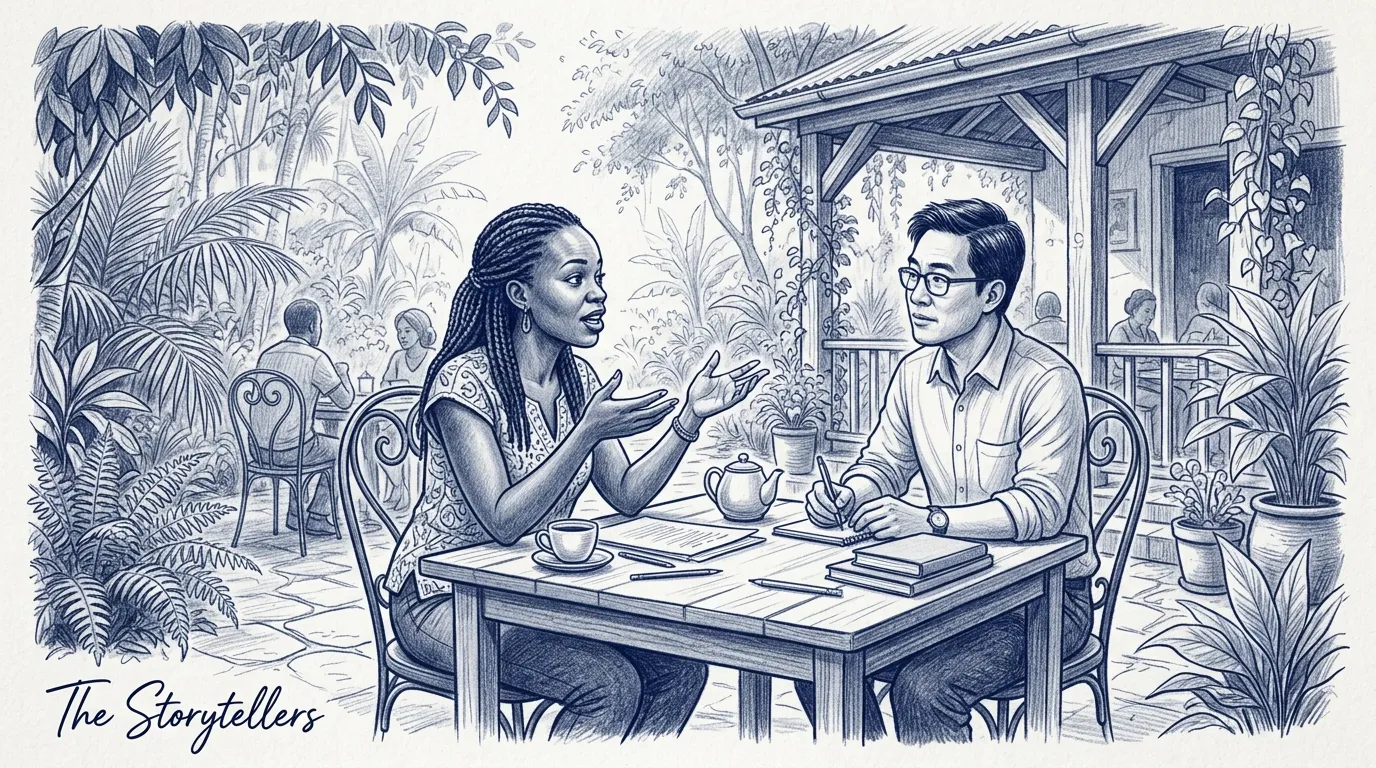
What The Storyteller Does
Core Question: Why should I care?
The Storyteller archetype is designed to address low engagement by making abstract value emotionally tangible, creating connection through narrative, and transforming information into experience.
In situations where markets cannot connect because data alone does not move hearts, the Storyteller creates the narrative that transforms information into experience.
Storytellers do not fabricate. They do not manipulate. They find the human element that already exists and amplify it. They turn statistics into stories, features into benefits, and information into meaning.
The Storyteller does not add decoration. The Storyteller reveals why anyone should care.
7 Ideal Characteristics of The Storyteller
What Makes This Author Archetype Capable of Resolving the Complexity
| # | Characteristic | What It Looks Like |
|---|---|---|
| 1 | Human Finder | Sees the person inside the data. Finds the protagonist in every situation. Never loses sight of who is affected. |
| 2 | Emotional Intelligence | Understands what moves people. Knows the difference between sentiment and sentimentality. Never manipulates. |
| 3 | Structure Sense | Understands narrative arc: setup, conflict, resolution. Knows why some stories grip and others bore. |
| 4 | Detail Instinct | Notices the specific, concrete detail that makes the abstract real. Knows that “a woman” is abstract; “a 67-year-old widow who gardens” is a story. |
| 5 | Audience Empathy | Knows who they are speaking to. Crafts stories for that specific audience, not for everyone. |
| 6 | Authenticity Radar | Spots fabricated emotion instantly. Refuses to tell stories that are not true. Knows that audiences detect inauthenticity faster than anything. |
| 7 | Economy of Language | Uses precisely the right words. No more, no less. Knows that what you leave out is as important as what you include. |
Real-Life Example:
Chimamanda Ngozi Adichie
Chimamanda Ngozi Adichie, the award-winning novelist, essayist, and speaker, is a definitive example of The Storyteller archetype in action.
Why does she embody The Storyteller:
| Characteristic | How Chimamanda Ngozi Adichie Demonstrates It |
|---|---|
| Human Finder | Her stories center on the specific, lived experiences of individuals—never abstractions. Whether in novels (Half of a Yellow Sun, Americanah) or essays (“We Should All Be Feminists”), she finds the universal through the particular. |
| Emotional Intelligence | Her work navigates complex emotional terrain—love, loss, identity, belonging—without sentimentality. She makes readers feel without manipulating them. |
| Structure Sense | Her TED Talk, “The Danger of a Single Story” (one of the most-viewed of all time), is a masterclass in narrative structure: personal story, expansion to universal insight, return to personal, call to action. |
| Detail Instinct | She describes the texture of hair, the weight of a passport, the smell of a market stall—specific details that make the abstract (identity, displacement, longing) unbearably real. |
| Audience Empathy | She speaks differently to different audiences—academic lectures differ from popular talks, novels from essays—but always honors her listener’s intelligence. |
| Authenticity Radar | Her voice is unmistakably her own. She refuses to write what she does not believe. Her authenticity is why millions trust her perspective. |
| Economy of Language | Every sentence earns its place. She is quoted constantly because her phrasing is precise, memorable, and repeatable. |
How Adichie resolves low engagement:
Before her TED Talk, many people understood “stereotypes are bad.” After “The Danger of a Single Story,” they felt why. The abstract concept became a lived experience through her storytelling.
Audiences did not just learn—they were transformed.
The GreenDeveX Insight:
Brands that partner with Storytellers like Chimamanda Ngozi Adichie do not need to convince audiences that their product or mission matters. The Storyteller has already created the emotional connection.
The brand simply becomes part of a story the audience already cares about.
Other Notable Storytellers for Inspiration
| Storyteller | Domain | Why They Qualify |
|---|---|---|
| Ken Burns | Documentary Film | Turned American history into national memory. His documentary style—slow zoom, emotional interviews, personal letters read aloud—creates resonance that facts alone cannot achieve. |
| Maya Angelou (1928-2014) | Poetry & Memoir | Her autobiography, I Know Why the Caged Bird Sings, transformed trauma into art and then into social movement. She made readers feel racism’s reality, not just understand it intellectually. |
| Ta-Nehisi Coates | Journalism & Memoir | Between the World and Me is a letter from a father to a son—a format that turns policy arguments into personal stakes. He makes abstract systemic forces feel immediate and urgent. |
| Ruth Bader Ginsburg (1933-2020) | Law & Justice | Turned legal briefs into stories of real people. Her dissents were legendary not for legal reasoning alone but for their narrative power—she made the abstract stakes of law feel personal. |
| John le Carré (1931-2020) | Spy Fiction | Made espionage about moral complexity, not gadgets. His stories endure because they are not about plot—they are about people torn between duty and conscience. |
| Brene Brown | Vulnerability Research | A researcher who became a storyteller. She took academic findings on shame and vulnerability and turned them into stories audiences could see themselves in. She made data feel like confession. |
The Low Engagement Friction
What the friction looks like:
Markets cannot move when they do not care. Data exists. Evidence is clear. Arguments are sound. But hearts are unmoved. People nod politely and do nothing. Your audience forgets you the moment you stop speaking.
The cost of this friction:
How The Storyteller resolves it:
The Storyteller does not add decoration. The Storyteller reveals why anyone should care. Through narrative structure, emotional intelligence, and authentic human connection, the Storyteller transforms information into experience and features into meaning.
The mechanism: Emotional transfer.
When a Storyteller makes an audience feel something—longing, hope, recognition, determination—that feeling attaches to the brand, idea, or product the Storyteller is amplifying.
Questions The Storyteller Helps Markets Answer
| # | Question |
|---|---|
| 1 | Why should I care about this? How does it affect someone like me? |
| 2 | What is the human story behind the data? Who is affected? |
| 3 | Why should I remember this when there are a thousand other messages competing for my attention? |
| 4 | How does this fit into the larger story of my life, my work, my community? |
| 5 | What will I tell others about this? What is the story I will share? |
Publishing Formats for The Storyteller
| Format | Why It Works for The Storyteller |
|---|---|
| Narrative Case Studies | Turns customer success into compelling story. Follows arc: struggle, intervention, transformation. |
| Personal Essays | Uses the author’s own experience to illuminate universal truth. Authenticity is the asset. |
| Video Stories | Combines image, sound, and narrative. The most emotionally potent format. |
| Podcast Episodes | Voice carries emotion that text cannot. Intimate format builds connection. |
| Keynote Speeches | Live presence is irreplaceable. Audience feels the story in real time. |
| Photo Essays | Images tell stories words cannot. A single photograph can carry infinite narrative. |
Ideal Industries / Sectors
| Sector | Why The Storyteller Thrives Here |
|---|---|
| Nonprofit & Social Impact | Donors give to stories, not statistics. Storytellers turn impact reports into giving decisions. |
| Consumer Brands | People buy identities, not products. Storytellers create brands people want to belong to. |
| Healthcare & Patient Advocacy | Patients need to feel seen. Storytellers transform medical information into human experience. |
| Education & Training | Learning is emotional. Storytellers make information stick through narrative. |
| Travel & Hospitality | Destinations are not places; they are stories waiting to happen. Storytellers sell the story. |
| Politics & Advocacy | Movements are built on stories, not platforms. Storytellers turn policy into purpose. |
Ideal Brand Partnerships
| Brand Type | Why They Need The Storyteller |
|---|---|
| Nonprofits seeking donations | Data does not open wallets. Stories do. Storytellers turn impact reports into giving. |
| Consumer brands launching identity products | People buy what a product says about them. Storytellers create the meaning that attaches. |
| Healthcare organizations | Patients need to feel understood. Storytellers transform clinical information into human connection. |
| Educational institutions | Prospective students choose identity, not curriculum. Storytellers sell the journey, not the classes. |
| Tourism boards | Destinations are stories waiting to be told. Storytellers make places unforgettable. |
Example in Action
Scenario:
A nonprofit organization working on clean water access. They have data: 10,000 wells drilled, 500,000 people served, 40% reduction in waterborne illness.
Donors nod and give small amounts.
The Storyteller intervention:
The Storyteller spends a week in the field. She interviews a mother whose child no longer gets sick. She photographs the daily walk to the well—once dangerous, now safe.
She writes a story: “Before the well, Amina walked two hours each morning, her daughter on her hip, praying the water would not make them sick. Today, her daughter drinks from the tap at their doorstep. The time she spent walking, she now spends teaching.”
Outcome:
Donations increase 300%. New donors cite “Amina’s story” as the reason they gave. The Storyteller did not change the facts. She made the facts matter.
5 Frequently Asked Questions About The Storyteller
FAQ 01: Is The Storyteller just making things up?
No. The best Storytellers are truth-tellers. They find the story that is already there—the human element, the emotional stakes, the meaning—and amplify it. Fabrication is manipulation; amplification is revelation.
FAQ 02: How does The Storyteller differ from a journalist?
Journalists report facts. Storytellers reveal meaning. Both value truth. Both pursue accuracy. But the journalist asks “what happened?” The Storyteller asks “why does it matter?” There is overlap, but the intent differs.
FAQ 03: Does every brand need a Storyteller?
Not every brand. Commodity brands competing only on price may not benefit from storytelling. But any brand that wants emotional connection, customer loyalty, or premium positioning needs a Storyteller.
FAQ 04: Can The Storyteller also be a Sage?
Yes. A Storyteller who is also a Sage has both wisdom and the gift of narrative. This combination is rare and extraordinarily valuable—deep expertise communicated with emotional power.
FAQ 05: What if my product is “boring” — can a Storyteller still help?
There are no boring products, only boring stories. The Storyteller finds the human element in every industry. A roll of tape becomes the story of a package arriving safely at Christmas. An accounting firm becomes the story of a small business owner’s dream realized. The Storyteller sees the story you miss.
Does your brand need The Storyteller?
If low engagement is leaving your message unheard, The Storyteller archetype may be your match.
GreenDeveX classifies and connects Storytellers to brands that need resonance and connection.
Your ecosystem transition starts here.
→ Join the Early Access Waitlist
→ Find Your Storyteller Match
Now that you understand The Storyteller, explore The Evangelist — the archetype that builds belief and advocacy
→ Explore All Author Archetypes