
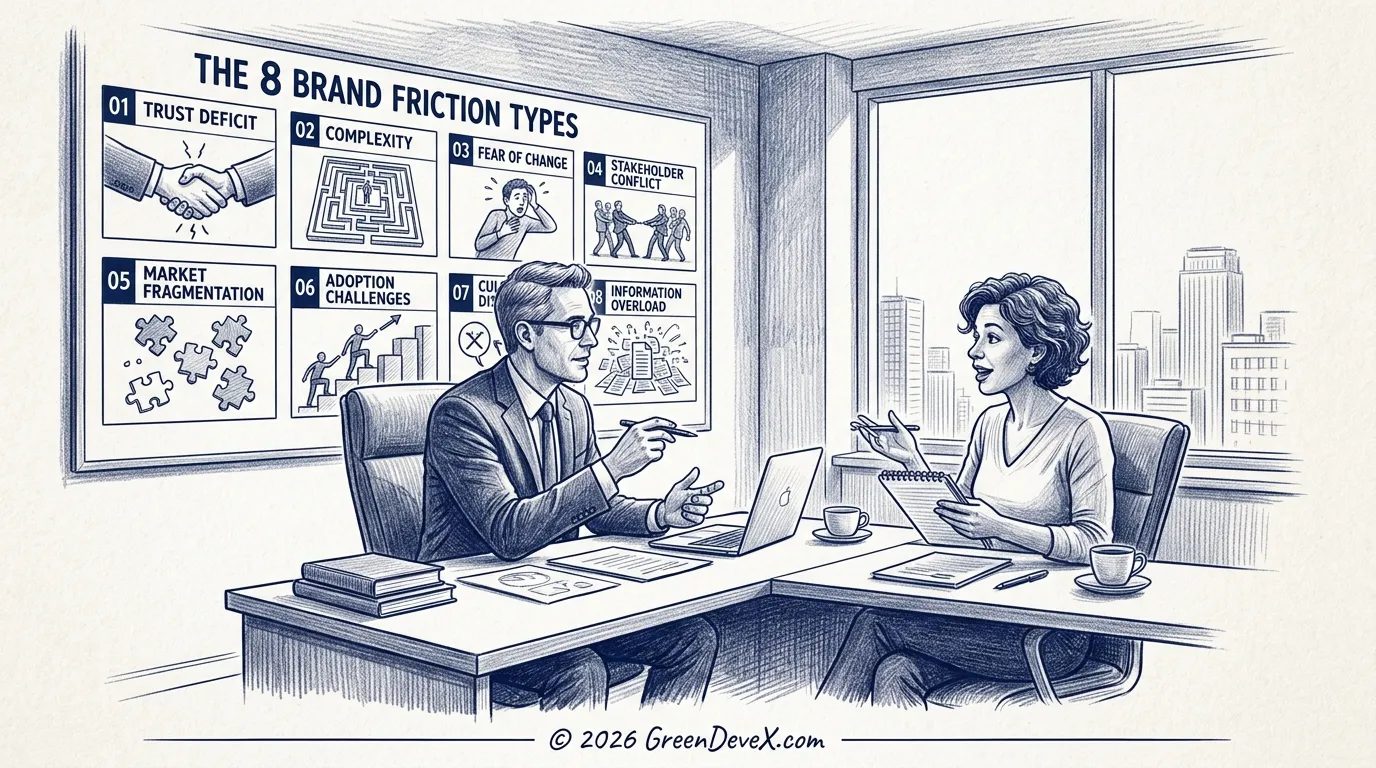
Diagnose What Is Slowing Your Market
Your growth is slowing. You have tried more campaigns, more channels, more spend. Nothing works.
The cost? You keep treating symptoms while the root cause stays hidden. Every dollar spent on campaigns delivers less return. Your team is exhausted. Your brand feels invisible.
GreenDeveX’s Brand Friction Mapping changes this.
We identify the specific frictions costing your brand velocity — not generic challenges, but precise interpretation gaps.
- Fear of Change.
- Stakeholder Conflict.
- Market Fragmentation.
- Adoption Challenges.
- Cultural Disconnect.
- Information Overload.
Each friction has a matching author archetype built to resolve it.
The outcome? You stop treating symptoms and start removing structural friction — permanently. You know exactly which market questions remain unanswered and which authors can answer them.
How to Diagnose Your Brand Friction
Brand friction is anything that slows your market’s ability to understand, trust, and act on your brand’s value.
Friction is structural, not incidental. It is the predictable output of specific conditions in your market ecosystem.
When friction is high:
- Investors hesitate
- Partnerships stall
- Customers need more convincing
- Your authority does not compound
- Growth slows despite increased effort
Growth begins when friction is reduced — not when features are announced or campaigns are launched.
The 8 Brand Friction Types
| # | Friction Type | What It Looks Like | Signs You Have It | Best Archetype Match |
|---|---|---|---|---|
| 01 | Trust Deficit | Markets cannot act on what they cannot trust. Authority gaps delay decisions and stall deals. | Prospects ask for excessive references. Sales cycles are long. You compete on price despite quality. | The Sage, The Investigator |
| 02 | Complexity | When the market cannot quickly explain your value, adoption slows — regardless of product quality. | Your best customer cannot explain your value in two sentences. Sales spends most of their time educating. | The Translator, The Field Guide |
| 03 | Fear of Change | Uncertainty about transition costs and unknowns blocks even well-funded organizations from moving. | Qualified prospects understand your value but still decline. “It is not the right time” is your most common objection. | The Historian, The Futurist |
| 04 | Stakeholder Conflict | Misaligned narratives among decision-makers create internal gridlock that kills momentum. | Internal disagreements delay or derail partnerships. Different stakeholders give different feedback. | The Diplomat, The Philosopher |
| 05 | Market Fragmentation | Disconnected stakeholders, siloed knowledge, and fragmented media prevent collective market movement. | Key stakeholders are not talking to each other. Your value proposition never reaches the full audience. | The Cartographer, The Community Builder |
| 06 | Adoption Challenges | New behaviors, technologies, and systems face resistance when supporting narrative architecture is absent. | Qualified prospects who understand your value still fail to convert. Implementation is seen as risky. | The Evangelist, The Operator |
| 07 | Cultural Disconnect | Products and ideas that ignore cultural context fail to achieve resonance — even when core value is strong. | Your message resonates differently across regions. Local partners say “that is not how we do things here.” | The Cultural Decoder, The Storyteller |
| 08 | Information Overload | Too much content and too little curation causes markets to lose the signal. Your best content goes unseen. | Your best content is not being found. Decision-makers are overwhelmed. You are competing with noise. | The Curator, The Contrarian |
How to Diagnose Your Brand Friction
Ask yourself these diagnostic questions:
| Question | If Yes → Likely Friction |
|---|---|
| How long does it take a new prospect to trust your claims without external validation? | Trust Deficit |
| Can your best customer explain your value to a peer in two sentences? | Complexity |
| What are the top three reasons qualified prospects decline to move forward? | Fear of Change |
| How often does internal disagreement delay or derail a partnership or purchase decision? | Stakeholder Conflict |
| Are the key stakeholders in your market talking to each other? Do they share a common language? | Market Fragmentation |
| What percentage of qualified prospects who understand your value still fail to convert? | Adoption Challenges |
| Does your market narrative resonate differently across cultural or regional contexts? | Cultural Disconnect |
| Is your best content being found and read by the decision-makers who need it most? | Information Overload |
The Cost of Unaddressed Brand Friction
| Friction | Short-Term Cost | Long-Term Cost |
|---|---|---|
| Trust Deficit | Longer sales cycles | Inability to command premium pricing |
| Complexity | More explanations needed | Commoditization of your offer |
| Fear of Change | Prospect hesitation | Market inertia works against you |
| Stakeholder Conflict | Internal gridlock | Missed partnership windows |
| Market Fragmentation | Inefficient outreach | Competitors consolidate while you fragment |
| Adoption Challenges | High support costs | Low retention and advocacy |
| Cultural Disconnect | Wasted marketing spend | Reputation damage in key markets |
| Information Overload | Content goes unseen | Your signal buried in noise |
The cumulative cost of unaddressed friction is market irrelevance.
The Friction Mapping Process
| Step | Action | Output |
|---|---|---|
| 01 | Friction Interview — A 15–30 minute structured conversation mapping the specific points where market velocity is slowest. | Friction transcript |
| 02 | Taxonomy Application — We map your friction points against the eight-type taxonomy, identifying primary friction (the biggest drag) and secondary frictions. | Primary & secondary friction identification |
| 03 | Archetype Recommendation — We translate the friction map into a precise archetype recommendation — identifying which of the 18 Author Archetypes are best positioned to resolve your specific friction profile. | Matched archetype list |
| 04 | Infrastructure Brief — We produce a publishing infrastructure brief that recommends the formats, cadence, and distribution architecture most likely to compound your authority fastest. | Publishing infrastructure brief |
How Friction Maps to Author Archetypes
| Your Primary Friction | Authors You Need | What They Will Do |
|---|---|---|
| Trust Deficit | The Sage, The Investigator | Build credibility. Surface hidden dynamics. Create confidence. |
| Complexity | The Translator, The Field Guide | Make the complex simple. Provide step-by-step clarity. |
| Fear of Change | The Historian, The Futurist | Provide context. Show what comes next. Reduce uncertainty. |
| Stakeholder Conflict | The Diplomat, The Philosopher | Align competing parties. Establish principles for decisions. |
| Market Fragmentation | The Cartographer, The Community Builder | Map relationships. Create belonging. Connect silos. |
| Adoption Challenges | The Evangelist, The Operator | Build belief. Create systems that scale. |
| Cultural Disconnect | The Cultural Decoder, The Storyteller | Interpret social dynamics. Create resonance. |
| Information Overload | The Curator, The Contrarian | Filter signal from noise. Challenge assumptions. |
Ready to map your brand friction?
Diagnose the specific frictions slowing your growth and get a matched author archetype recommendation.
→ Join the Early Access Waitlist
Now that you have mapped your brand friction,
| To Go Deeper | Explore This Page |
|---|---|
| Build your full brand ecosystem | → Brand Ecosystem Strategy |
| Match authors to your friction profile | → Brand–Author Matching |
| Build the publishing formats you need | → Thought Leadership Infrastructure |
| Explore partnership models | → Partnership Opportunities |