
jj
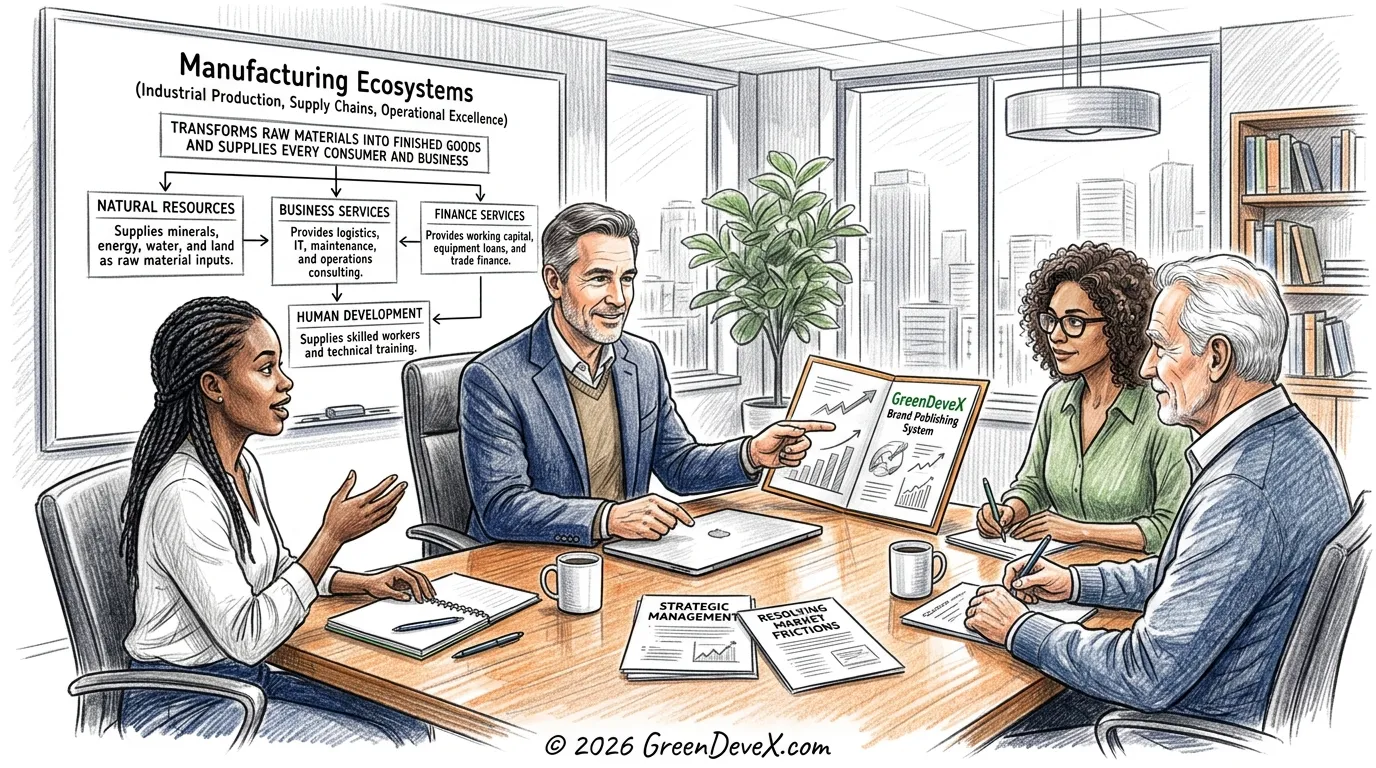
Ecosystem Cluster — Production & Value Engine
Thematic Engine: Production & Value
Core Question: Why do strong sectors grow invisibly?
Primary Frictions: Operational Complexity, Supply Chain Fragmentation, Quality Opacity, Innovation Invisibility, Workforce Transition
Primary Archetypes: The Operator, The Cartographer, The Field Guide
Connected Clusters: Natural Resources, Business Services, Finance Services, Human Development, Infrastructure & Flow
How This Cluster Connects to Others
Connection to Natural Resources (Production & Value):
Manufacturing consumes natural resources as inputs. Minerals, energy, water, and agricultural products are transformed into finished goods. Without Natural Resources, Manufacturing cannot operate.
Connection to Business Services (Production & Value):
Manufacturers need logistics consultants, IT services, maintenance providers, and operations experts. Business Services improves manufacturing efficiency and reliability.
Connection to Finance Services (Infrastructure & Flow):
Manufacturers need working capital, equipment financing, trade finance, and risk insurance. Finance enables Manufacturing to scale.
Connection to Human Development (Talent & Capability):
Manufacturers need skilled workers, technicians, and operators. Vocational training and technical education supply the workforce. Human Development enables Manufacturing productivity.
Connection to Infrastructure & Flow:
Manufacturers need reliable transport (roads, rail, ports), energy, and digital infrastructure to move goods to markets. Infrastructure & Flow enables Manufacturing distribution.
“Manufacturing is the value-adding engine of the economy. It transforms raw materials into useful products. Every other cluster serves this transformation.”— Victor Isyamba
What Is the Manufacturing Ecosystems Cluster?
Manufacturing encompasses organizations that transform raw materials, components, and labour into finished goods. This cluster is the value-adding engine that creates physical products for consumers and businesses.
This cluster includes:
- Industrial manufacturing (heavy equipment, machinery, automotive)
- Consumer goods manufacturing (packaged goods, electronics, apparel)
- Food and beverage processing
- Pharmaceutical and medical device manufacturing
- Aerospace and defence manufacturing
- Chemical and materials manufacturing
- Additive manufacturing (3D printing)
- Contract manufacturing and OEM
- Quality systems and certification bodies
The core challenge: Manufacturing is capital-intensive, operationally complex, and margin-sensitive. Excellence is invisible to outsiders. Innovation is hard to communicate.
The cluster’s role in the broader economy: This cluster creates the physical goods that every other cluster and every consumer depends on. When Manufacturing fails, supply chains break, and economies slow.
“You cannot have a modern economy without manufacturing. Services alone cannot create broad-based prosperity. Manufacturing creates jobs that cannot be outsourced. It builds skills that transfer across sectors. It is the engine of middle-class prosperity.”— Victor Isyamba
Unique Frictions in Manufacturing
| # | Friction Type | What It Looks Like | Cost of Inaction |
|---|---|---|---|
| 01 | Operational Complexity | Your production systems are sophisticated. Outsiders cannot understand your operational excellence. | Customers choose lower-cost competitors who cannot match your quality. Your advantage is invisible. |
| 02 | Supply Chain Fragmentation | Your supply chain involves dozens or hundreds of suppliers. They are not aligned. Quality varies. | Inconsistent quality. Production delays. High inspection and rework costs. |
| 03 | Quality Opacity | Your quality systems are rigorous. Customers cannot see or verify your quality advantage. | You compete on price, not quality. Your investment in quality does not generate premium pricing. |
| 04 | Innovation Invisibility | Your R&D produces genuine innovation. Markets do not understand the sophistication of what you have built. | Competitors copy your features. You do not get credit for innovation. |
| 05 | Workforce Transition | Your workforce needs new skills for Industry 4.0, automation, and digital transformation. Training is expensive and slow. | Skills gaps widen. Productivity lags. You lose talent to competitors. |
Author Archetypes for Manufacturing
| Friction | Primary Archetype | What They Do | Publishing Format |
|---|---|---|---|
| Operational Complexity | The Operator | Creates systems thinking frameworks that make operational excellence legible | Operations Playbooks, Excellence Frameworks |
| Supply Chain Fragmentation | The Cartographer | Maps the entire supply chain ecosystem — suppliers, flows, dependencies, risks | Supply Chain Maps, Risk Assessments |
| Quality Opacity | The Investigator | Builds transparency through quality data, certification documentation, and third-party validation | Quality Reports, Certification Guides |
| Innovation Invisibility | The Storyteller | Translates technical innovation into customer-relevant value narratives | Innovation Case Studies, Technology Explainers |
| Workforce Transition | The Field Guide | Provides step-by-step guidance for upskilling and digital transformation | Training Playbooks, Skills Roadmaps |
| Future Readiness | The Futurist | Provides credible scenarios for industry evolution and technology adoption | Industry Outlooks, Technology Forecasts |
Publishing Formats for Manufacturing
| Format | Purpose | Example | Operating Model |
|---|---|---|---|
| Operations Playbooks | Make operational excellence frameworks accessible to all stakeholders | “The Lean Manufacturing Playbook: 10 Principles for Continuous Improvement” | Co-Creating (signature asset) |
| Supply Chain Maps | Visualize the entire supply chain ecosystem for internal and external stakeholders | “Our Global Supply Chain: Partners, Flows, and Risk Mitigation” | Co-Creating (shared IP with suppliers) |
| Quality Reports | Build transparency through accessible quality data and certification documentation | “2025 Quality Report: Our Commitment to Excellence by the Numbers” | Fractional Publishing (annual series) |
| Innovation Case Studies | Translate technical innovation into customer-relevant value | “How We Engineered a 40% Efficiency Gain Through Predictive Maintenance” | Rent-and-Rank Narrative (placement in industry platforms) |
| Technology Explainers | Make advanced manufacturing technologies accessible to non-engineers | “Additive Manufacturing Explained: What 3D Printing Means for Your Supply Chain” | Co-Creating (signature guide) |
| Training Playbooks | Enable workforce development and skills transition | “The Industry 4.0 Skills Roadmap: Preparing Your Workforce for Automation” | Fractional Publishing (ongoing updates) |
| Industry Outlooks | Build confidence through credible manufacturing forecasts | “The Future of African Manufacturing: 2025-2030 Outlook” | Co-Creating (shared IP with industry association) |
Success Markers for Manufacturing
| Marker | What It Looks Like |
|---|---|
| Quality Premium | Customers pay more because they understand and trust your quality advantage. |
| Supplier Alignment | Your suppliers share your quality frameworks and operational standards. |
| Operational Transparency | Stakeholders understand the sophistication of your operations. Your excellence is visible. |
| Innovation Credit | Your innovations are recognized by customers, partners, and industry peers. |
| Workforce Readiness | Your workforce has the skills for Industry 4.0. Training is systematized. |
| Sector Reference Status | Your facility is cited as an example of manufacturing excellence. Competitors study your methods. Toyota is universally cited as the premier global example of manufacturing excellence. |
Case Example
Organization: A mid-size manufacturer of industrial components
Primary Friction: Quality Opacity + Supply Chain Fragmentation
GreenDeveX Approach:
- Matched The Investigator to build Quality Report with third-party validation
- Matched The Cartographer to map supply chain and identify risks
- Matched The Operator to create Operations Playbook for internal and external stakeholders
Outcome:
- Customers cited Quality Report as factor in supplier selection
- Secured three new contracts at premium pricing (15% above competitors)
- Supply chain risk reduced through aligned supplier framework
- Featured in industry publication as “Model of Manufacturing Excellence”
How This Cluster Uses the Three Operating Models
| Operating Model | Application for Manufacturing |
|---|---|
| Co-Creating Model | An Operator author co-creates a signature Operations Playbook with your company. The playbook carries both names. Customers trust it because the author’s operational credibility transfers. |
| Fractional Publishing Model | Engage an Investigator author on retainer to produce quarterly Quality Reports and annual Supply Chain Risk Assessments. Consistent documentation builds transparency and trust. |
| Rent-and-Rank Narrative Model | Place Innovation Case Studies and Technology Explainers within existing industry platforms (e.g., manufacturing association portals, trade show publications, supplier networks). Immediate visibility within trusted manufacturing ecosystems. |
→ Find Your Author Archetype Match
Interlinking to Related Clusters
| Related Cluster | Why They Connect |
|---|---|
| Natural Resources Systems | Manufacturing consumes natural resources as inputs. Minerals, energy, water, and land are raw materials. Manufacturing depends on Production & Value. |
| Business Services Ecosystems | Manufacturers need logistics consultants, IT services, and operations experts. Business Services improves Production & Value. |
| Finance Services Ecosystems | Manufacturers need working capital, equipment loans, and trade finance. Finance enables Production & Value. |
| Human Development Systems | Manufacturers need skilled workers and technical training. Human Development supplies Talent & Capability. |
| Infrastructure & Flow Engine | Manufacturers need reliable transport, energy, and digital infrastructure. Infrastructure & Flow enables distribution. |
Thematic Engine Connection: Production & Value
Manufacturing Ecosystems is a core cluster within the Production & Value Engine.
| Engine Question | How This Cluster Answers It |
|---|---|
| “Why do strong sectors grow invisibly?” | Because manufacturing excellence is invisible. Quality systems are hidden. Innovation is not communicated. Supply chains are fragmented. Without visible excellence, strong manufacturers remain unknown. |
| “What is the Interpretation Gap?” | Customers cannot see quality advantages. Suppliers are not aligned. Workforce skills are outdated. Innovation goes unrecognized. |
| “How does GreenDeveX close the gap?” | Through Operators (systems clarity), Cartographers (supply chain visibility), and Field Guides (workforce development). Make operational excellence visible. Align supply chains. Communicate innovation. Develop workforce skills. |
“The Production & Value Engine is only as strong as its Manufacturing cluster. Without manufacturing, raw materials have no value. Without visible excellence, manufacturers compete on price. Without aligned supply chains, quality suffers. Make manufacturing visible. The economy depends on it.”— Victor Isyamba
Ready to make your manufacturing excellence visible?
Map your friction, match your authors, and deploy through the right operating model.
→ Natural Resources Systems (Production & Value Engine) →
→ Business Services Ecosystems (Production & Value Engine) →
→ Finance Services Ecosystems (Infrastructure & Flow Engine) →
Next Recommended Step
Now that you understand Manufacturing Ecosystems, explore how Natural Resources Systems supplies the raw materials and energy that manufacturing depends on.