
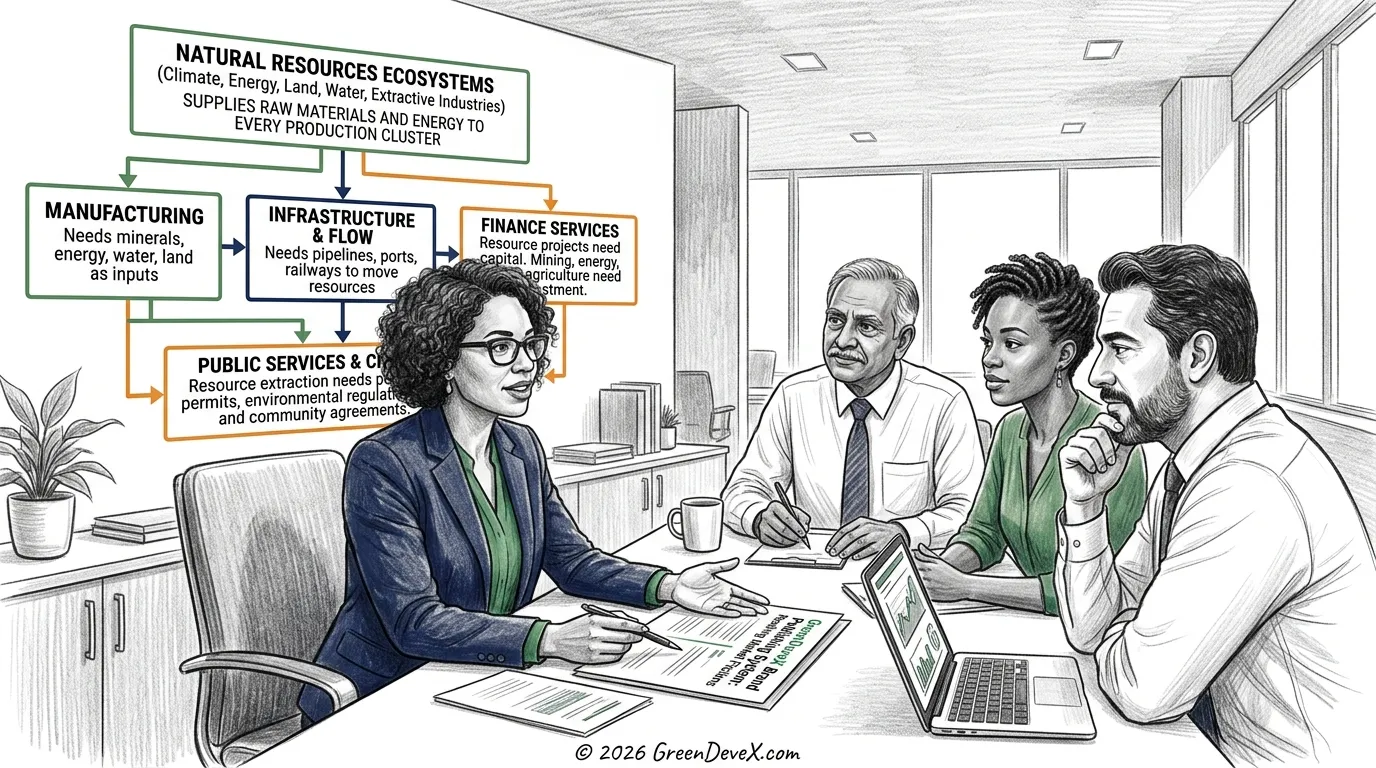
Natural Resources Ecosystems
Ecosystem Cluster — Production & Value Engine
Thematic Engine: Production & Value
Core Question: Why do strong sectors grow invisibly?
Primary Frictions: Investment Confidence, Transition Complexity, Stakeholder Resistance, Long-Horizon Trust, Community Engagement
Primary Archetypes: The Futurist, The Economist, The Diplomat
Connected Clusters: Manufacturing, Finance Services, Public Services, Civic Ecosystems, Infrastructure & Flow
How This Cluster Connects to Others
Connection to Manufacturing (Production & Value):
Natural resources are inputs to manufacturing. Minerals, energy, water, and land are raw materials that manufacturing transforms into finished goods. Without Natural Resources, Manufacturing cannot operate.
Connection to Infrastructure & Flow:
Resources need transport. Pipelines, ports, railways, and roads move resources to markets. Without Infrastructure & Flow, Natural Resources are stranded assets.
Connection to Finance Services (Infrastructure & Flow):
Resource projects require capital. Mining, energy, and agriculture need investment. Without Finance Services, Natural Resources cannot be developed.
Connection to Trust & Policy Engine:
Resource extraction requires permits, environmental regulation, and community agreements. Without legal clarity and institutional trust, projects stall.
“Natural resources are not wealth. They are potential wealth. The clusters that process, finance, and transport them create the actual value.”— Victor Isyamba
What Is the Natural Resources Systems Cluster?
Natural Resources Systems encompasses organizations and initiatives focused on the extraction, management, and transition of natural resources. This cluster supplies the raw materials and energy that every production cluster depends on.
This cluster includes:
- Climate technology and renewable energy
- Oil, gas, and mining (extractive industries)
- Forestry, agriculture, and land use
- Water management and marine resources
- Carbon markets and environmental finance
- Conservation and biodiversity
- Circular economy and waste management
The core challenge: Long investment horizons, high upfront capital requirements, complex stakeholder landscapes, and the urgent need for energy and resource transition.
The cluster’s role in the broader economy: Every production cluster — Manufacturing, Business Services, even Infrastructure — depends on this cluster for raw materials, energy, and water. When Natural Resources Systems fail, the entire production economy slows.
“You cannot manufacture without minerals. You cannot power factories without energy. You cannot grow food without water. Natural Resources is not a sector. It is the supply chain for every other production cluster.”— Victor Isyamba
Unique Frictions in Natural Resources Systems
| # | Friction Type | What It Looks Like | Cost of Inaction |
|---|---|---|---|
| 01 | Investment Confidence | Capital providers cannot assess risk accurately. Returns are long-dated. Uncertainty dominates. | Projects remain unfunded. Capital flows to lower-risk jurisdictions. Transition slows. |
| 02 | Transition Complexity | Moving from fossil to renewable systems is technically, economically, and politically complex. Stakeholders are confused. | Transition stalls. Incumbents maintain dominance. New entrants fail. |
| 03 | Stakeholder Resistance | Communities, regulators, and environmental groups resist new projects. Trust is low. | Projects delayed years or cancelled entirely. Reputational damage. |
| 04 | Long-Horizon Trust | Natural resource projects have 20-50 year timelines. Stakeholders must trust that promises will be kept for decades. | Short-term thinking dominates. Maintenance and closure obligations unfunded. |
| 05 | Community Engagement | Local communities are often excluded from decision-making. Their concerns are unheard until conflict erupts. | Protests. Legal challenges. Operational disruptions. Lost social license. |
Author Archetypes for Natural Resources Systems
| Friction | Primary Archetype | What They Do | Publishing Format |
|---|---|---|---|
| Investment Confidence | The Economist | Maps incentives, models returns, and communicates risk clearly to capital providers | Investment Memoranda, Risk Assessments, Market Outlooks |
| Transition Complexity | The Translator | Makes technical transition pathways accessible to non-specialist decision-makers | Transition Roadmaps, Plain Language Briefings |
| Stakeholder Resistance | The Diplomat | Aligns competing interests across industry, government, communities, and NGOs | Stakeholder Alignment Frameworks, Consensus Reports |
| Long-Horizon Trust | The Futurist | Provides credible, evidence-based long-term scenarios that build confidence | 20-Year Outlooks, Scenario Planning Reports |
| Community Engagement | The Cultural Decoder | Interprets local dynamics, builds cultural bridges, and centres community voice | Community Insight Reports, Participatory Assessments |
| Regulatory Navigation | The Field Guide | Provides step-by-step guidance through complex permitting and compliance processes | Permitting Guides, Compliance Checklists |
Publishing Formats for Natural Resources Systems
| Format | Purpose | Example | Operating Model |
|---|---|---|---|
| Investment Memoranda | Communicate risk and return clearly to capital providers | “Investment Case for the Great Rift Geothermal Project” | Co-Creating (shared IP with project developers) |
| Transition Roadmaps | Map the path from current to future state for all stakeholders | “East African Energy Transition: 2025-2050 Roadmap” | Co-Creating (signature asset) |
| Stakeholder Alignment Frameworks | Align competing interests around shared outcomes | “The Shared Agenda for Responsible Mining in Tanzania” | Co-Creating (co-developed with stakeholders) |
| Long-Horizon Outlooks | Build confidence through credible long-term scenarios | “The Future of Water Security: 20-Year Scenarios for the Nile Basin” | Fractional Publishing (quarterly/annual series) |
| Community Insight Reports | Surface and centre local community perspectives | “Voices from the Concession: Community Perspectives on Forest Management” | Rent-and-Rank Narrative (placement in community platforms) |
| Regulatory Compliance Guides | Simplify complex permitting and compliance processes | “The Carbon Markets Compliance Guide for African Project Developers” | Fractional Publishing (ongoing updates) |
| Ecosystem Maps | Visualize the resource system and its stakeholders | “The African Carbon Market Ecosystem Map” | Co-Creating (signature asset) |
Success Markers for Natural Resources Systems
| Marker | What It Looks Like |
|---|---|
| Capital Mobilized | Investment decisions accelerate. Due diligence cycles shorten. Capital flows to projects. |
| Stakeholder Alignment | Industry, government, communities, and NGOs share a common framework and language. |
| Regulatory Certainty | Permitting processes become predictable. Compliance is understood. |
| Community Trust | Communities are consulted early and often. Their concerns are addressed before conflict escalates. |
| Sector Reference Status | Your organization is consulted on policy, cited in industry reports, and invited to lead coalitions. |
Case Example
Organization: A geothermal energy developer in East Africa
Primary Friction: Investment Confidence + Stakeholder Resistance
GreenDeveX Approach:
- Matched The Economist to build investment case with clear risk-return analysis
- Matched The Diplomat to align government, local communities, and environmental groups
- Matched The Futurist to publish 20-year energy outlook building long-term confidence
Outcome:
- $50M in investment capital secured within eight months
- Community agreements signed without protest
- Permitting timeline reduced from 24 months to 10 months
- Project cited as model for responsible development
How This Cluster Uses the Three Operating Models
| Operating Model | Application for Natural Resources Systems |
|---|---|
| Co-Creating Model | A Futurist author co-creates a signature Long-Horizon Outlook with your organization. The report carries both names. Investors trust it because the author’s credibility transfers. |
| Fractional Publishing Model | Engage an Economist author on retainer to produce quarterly Resource Intelligence Briefings and annual Investment Memoranda. Consistent communication keeps capital providers engaged. |
| Rent-and-Rank Narrative Model | Place Transition Roadmaps and Community Insight Reports within existing climate and energy platforms (e.g., IRENA, World Bank Climate Portal, regional energy associations). Immediate visibility within trusted ecosystems. |
→ Find Your Match
Interlinking to Related Clusters
| Related Cluster | Why They Connect |
|---|---|
| Manufacturing Ecosystems | Natural resources are inputs to manufacturing. Minerals, energy, water, and land are raw materials. Natural Resources enables Production & Value. |
| Finance Services Ecosystems | Resource projects require capital. Mining, energy, and agriculture need investment. Natural Resources depends on Infrastructure & Flow. |
| Infrastructure & Flow Engine | Resources need transport. Pipelines, ports, railways, and roads move resources to markets. Natural Resources depends on Infrastructure & Flow. |
| Public Services Ecosystems | Resource extraction requires permits, environmental regulation, and community agreements. Natural Resources depends on Trust & Policy. |
| Civic Ecosystems | Local communities are directly affected by resource extraction. Civic engagement shapes project outcomes. Natural Resources connects to Trust & Policy. |
Thematic Engine Connection: Production & Value
Natural Resources Systems is a core cluster within the Production & Value Engine.
| Engine Question | How This Cluster Answers It |
|---|---|
| “Why do strong sectors grow invisibly?” | Because resource projects are long-term, capital-intensive, and stakeholder-complex. Without visible investment cases, clear transition roadmaps, and aligned stakeholders, resources remain undeveloped. |
| “What is the Interpretation Gap?” | Capital cannot assess risk. Stakeholders are misaligned. Communities are excluded. Long-term trust is missing. |
| “How does GreenDeveX close the gap?” | Through Futurists (long-term scenarios), Economists (incentive clarity), and Diplomats (stakeholder alignment). Make investment cases visible. Make transition pathways clear. Align communities, governments, and investors. |
“The Production & Value Engine is only as strong as its Natural Resources cluster. Without raw materials and energy, no production happens. Without investment confidence, no resources are developed.”— Victor Isyamba
Your Next Big Step
Ready to move capital and align stakeholders in Natural Resources?
Map your friction, match your authors, and deploy through the right operating model.
→ Start Your Ecosystem Journey
→ Manufacturing Ecosystems (Production & Value Engine) →
→ Finance Services Ecosystems (Infrastructure & Flow Engine) →
→ Public Services Ecosystems (Trust & Policy Engine) →
Next Recommended Step
Now that you understand Natural Resources Systems, explore how Manufacturing Ecosystems depends on this cluster for raw materials and energy.