
Author–Brand Matching Model
Most authors and brands that should work together never find each other.You publish. You build expertise. But the brands that need your knowledge cannot discover you.
GreenDeveX’s Author–Brand Matching Model fixes this with intelligence-led precision.
Intelligence-Led Matching. Three Clear Operating Models.
GreenDeveX’s Author–Brand Matching Model fixes this with intelligence-led precision — and three clear operating models that define how authors and brands work together once matched.
We match based on friction alignment, domain alignment, format fit, and archetype compatibility.
Then we deploy through Co-Creating (shared IP), Fractional Publishing (ongoing capacity), or Rent-and-Rank Narrative (immediate placement).
The outcome? You stop hoping to be discovered. You become precisely matched to the brands that need exactly what you know — with clear terms of engagement.
Why Most Author–Brand Matching Fails
| Problem | What It Looks Like | The Cost |
|---|---|---|
| Proximity Bias | Brands work with authors they know, not authors who best match their friction. | Intellectually comfortable but strategically misaligned relationships. |
| Platform Confusion | Matching on audience size rather than intellectual positioning. | Authors who can reach many people but cannot resolve your specific friction. |
| Archetype Blindness | Without a shared classification system, matching is guesswork. | Wasted time, wasted budget, missed market impact. |
| Model Ambiguity | No clear agreement on how authors and brands will work together. | Mismatched expectations. One side expects deep collaboration; the other expects transactional work. |
GreenDeveX fixes all four. The first three through classification. The fourth through operating models.
The Four Dimensions of Author–Brand Matching
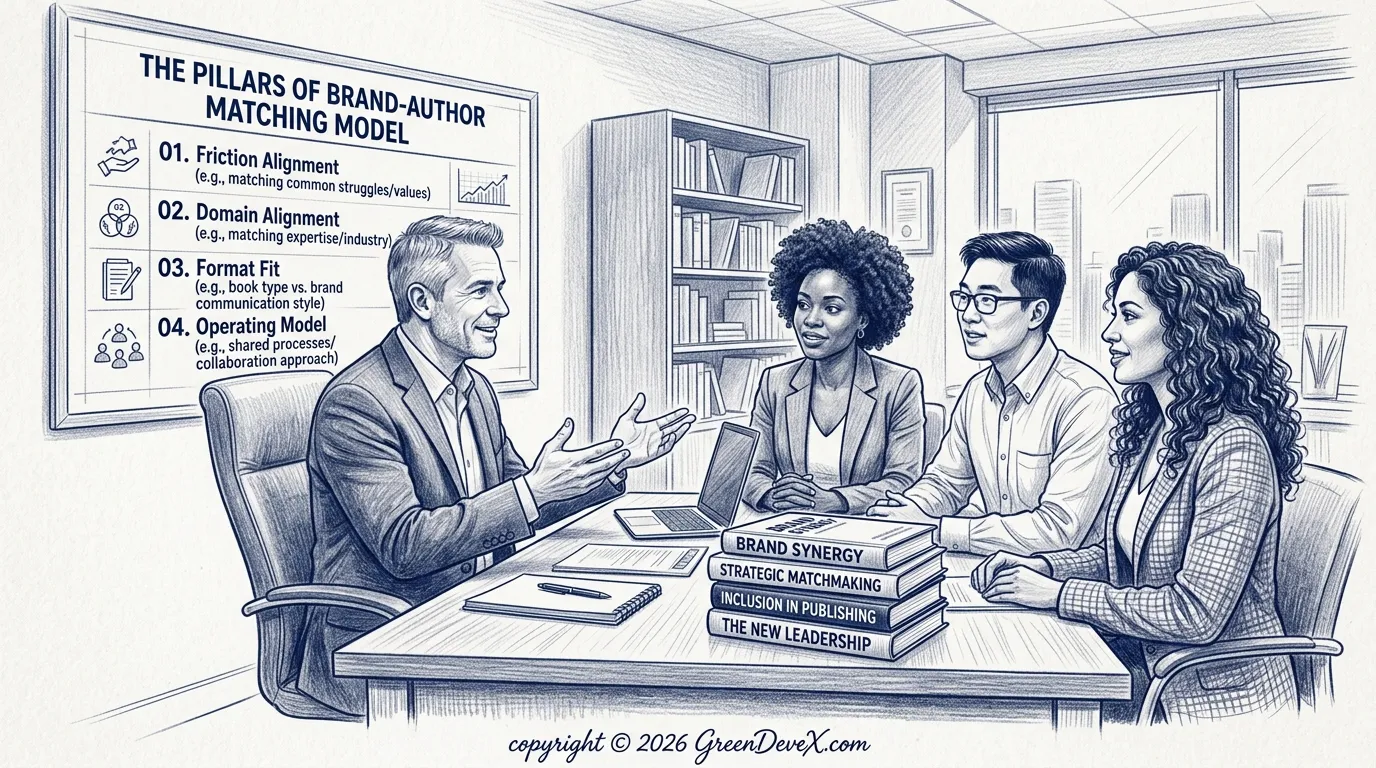
GreenDeveX matches authors to brands across four precision dimensions:
| Dimension | What It Means | For Authors | For Brands |
|---|---|---|---|
| 01. Friction Alignment | Does the author’s archetype resolve the brand’s market friction? | Matched to brands whose friction you are built to resolve | Matched to authors whose archetype addresses your market friction |
| 02. Domain Alignment | Does the author’s expertise fit the brand’s ecosystem domain? | Matched to brands in your domain (Trust & Policy, Talent & Capability, etc.) | Matched to authors with proven expertise in your domain |
| 03. Format Fit | Can the author publish in the formats the brand needs? | Matched to brands seeking your preferred formats | Matched to authors whose publishing style fits your infrastructure |
| 04. Operating Model | How will the author and brand work together? | Choose your preferred model: Co-Creating, Fractional, or Rent-and-Rank | Choose the model that fits your resources and objectives |
The Three Operating Models for Matched Partnerships

| Model | What It Does | Best For | Outcome |
|---|---|---|---|
| Co-Creating Model | Brands and authors collaborate to create original IP together | Deep partnerships, signature assets, category creation | Shared intellectual property that compounds |
| Fractional Publishing Model | Authors become part of a brand’s ongoing publishing engine | Consistent publishing, lean brand teams, steady author revenue | Ongoing deployment without constant matching |
| Rent-and-Rank Narrative Model | Authors get placed within existing trusted brand platforms | Faster market entry, brand testing, author visibility | Immediate exposure within engaged ecosystems |
Deep Dive Into The 3 Operating Models
Model #1: Co-Creating Model (Matched Partnership)
Creating Intellectual Property Together
When a brand and author are matched through the Co-Creating model, they collaborate to produce original narrative assets that neither could create alone.
What this looks like in practice:
Why this model works:
Best matched for:
→ Request Co-Creating Match
Model #2: Fractional Publishing Model (Matched Partnership)
Authors Become Part of a Brand’s Ongoing Publishing Engine
When a brand and author are matched through the Fractional Publishing model, the author becomes part of the brand’s ongoing publishing capacity — providing regular expertise, content, and authority without being an employee.
What this looks like in practice:
Why this model works:
Best matched for:
→ Request Fractional Publishing Match
Model #3: Rent-and-Rank Narrative Model (Matched Partnership)
Authors Get Placed Within Existing Brand Platforms
When a brand and author are matched through the Rent-and-Rank Narrative model, the author is placed within the brand’s existing trusted platforms — gaining immediate visibility while the brand gains fresh, credible voices.
What this looks like in practice:
Why this model works:
Best matched for:
→ Request Rent-and-Rank Match
The Five-Step Matching Process
| Step | Action | Output |
|---|---|---|
| 01 | Brand Friction Diagnosis — We map the brand’s specific market frictions using the GreenDeveX Friction Taxonomy. This determines which archetype categories are needed. | Brand Friction Map |
| 02 | Author Classification Review — We review the GreenDeveX author registry against the friction profile, shortlisting authors whose archetype matches the brand’s need. | Candidate Author List |
| 03 | Operating Model Alignment — We assess which operating model(s) fit both the brand’s resources/objectives and the author’s preferences/availability. | Model Recommendation |
| 04 | Domain and Format Filtering — We filter further by ecosystem domain and format fit to ensure precision. | Domain-Matched Shortlist |
| 05 | Ecosystem Match Recommendation — We present a curated Author–Brand Match recommendation with archetype fit, friction coverage, model recommendation, and expected outcomes. | Curated Match Recommendation |
How Operating Models Map to Partnership Outcomes
| For Brands | Co-Creating | Fractional Publishing | Rent-and-Rank Narrative |
|---|---|---|---|
| Investment Level | High | Medium | Low |
| Relationship Depth | Deep | Ongoing | Testing |
| Asset Produced | Shared IP | Ongoing content | Placed contributions |
| Time to Value | Months | Weeks | Days |
| Best for… | Signature assets | Consistent publishing | Testing the relationship |
| For Authors | Co-Creating | Fractional Publishing | Rent-and-Rank Narrative |
|---|---|---|---|
| Earning Model | Project + upside | Retainer / subscription | Per-piece |
| Relationship Depth | Deep collaboration | Embedded | Featured |
| Portfolio Asset | Signature IP | Ongoing work | Visibility |
| Time to Deployment | Weeks to months | Weeks | Days |
| Best for… | Career-defining work | Steady revenue | Audience growth |
Matching in Action: Examples by Model
Co-Creating Example:
| Matched Archetype | The Economist (incentive mapping), The Futurist (direction), The Sage (credibility) |
| Operating Model | Co-Creating — joint research, co-authorship, shared IP |
| Outcome | A signature report that carries both the brand’s and authors’ names. Investment follows. |
Fractional Publishing Example:
| Matched Archetype | The Operator (systems), The Translator (clarity), The Field Guide (implementation) |
| Operating Model | Fractional Publishing — ongoing retainer for quarterly reports and monthly briefings |
| Outcome | Consistent publishing engine. The brand gains authority; the authors gain steady revenue. |
Rent-and-Rank Narrative Example:
| Matched Archetype | The Storyteller (resonance), The Cultural Decoder (insight) |
| Operating Model | Rent-and-Rank Narrative — placement in the brand’s existing knowledge hub |
| Outcome | Immediate visibility. The brand tests the relationship; the author gains new audience. |
Author-Brand Matching in Action
These examples show how aligning the right author role with the right friction produces measurable results.
1. Stripe — Developer Ecosystem Expansion
Friction: Technical complexity and trust in payment infrastructure
Archetypes Used:
- Translator (technical documentation clarity)
- Sage (engineering authority)
- Operator (system reliability insights)
Execution: Stripe built a publishing ecosystem through engineering blogs, documentation, and developer-led insights.
Result: Stripe’s developer-first content approach contributed to widespread adoption, with millions of developers integrating its APIs globally.
2. Tesla — Market Education for Electric Vehicles
Friction: Consumer skepticism and future uncertainty
Archetypes Used:
- Futurist (vision of electric mobility)
- Evangelist (belief in sustainability mission)
- Contrarian (challenging legacy auto assumptions)
Execution: Public communication, product launches, and leadership narratives framed EVs as inevitable.
Result: Tesla shifted public perception, accelerating global EV adoption and influencing legacy manufacturers.
3. HubSpot — Category Creation (Inbound Marketing)
Friction: Lack of understanding of inbound methodology
Archetypes Used:
- Educator/Translator (method explanation)
- Storyteller (case studies)
- Community Builder (certifications and ecosystem)
Execution: HubSpot built a content ecosystem including blogs, certifications, and research reports.
Result: Inbound marketing became a recognized category, with HubSpot positioned as a category leader.
4. McKinsey & Company — Executive Influence Through Thought Leadership
Friction: Strategic uncertainty in enterprise decision-making
Archetypes Used:
- Sage (authority insights)
- Economist (market analysis)
- Cartographer (industry mapping)
Execution: Publishing reports, insights, and frameworks targeted at executives.
Result: McKinsey content is widely cited in boardrooms and policy discussions globally.
What a Successful Match Produces
| For Authors | For Brands |
|---|---|
| Strategic positioning within a brand’s ecosystem | Friction reduction through precision-matched expertise |
| Publishing infrastructure that scales your authority | Compound authority through consistent, classified publishing |
| Brand partnership pipeline aligned to your archetype | Shorter sales cycles and lower CAC |
| Ecosystem intelligence access | Stakeholder trust and alignment |
| Cross-archetype collaboration opportunities | Market understanding before the decision moment |
| Findability beyond personal networks | Access to pre-classified, deployable author expertise |
How Authors Become Match-Ready
To enter the matching pipeline, authors must:
→ Get Classified
Complete the author classification process to receive your formal archetype, domain fit, and friction profile.
→ Build Your Publishing Profile
Develop a portfolio of assets (reports, guides, interviews) that demonstrate your archetype in action.
→ Define Your Format Preferences
Identify which publishing formats you excel at — research reports, field guides, ecosystem maps, executive interviews, intelligence briefings.
→ Enter the Registry
Classified authors enter the GreenDeveX author registry, becoming visible to brands searching for their specific archetype and friction profile.
What GreenDeveX Looks For in Matches
Not all matches are created equal. GreenDeveX prioritizes:
- Precision over proximity:
The best match is not the author you know. It is the author whose archetype fits your friction. - Friction over follower count:
Audience size does not resolve market friction. Archetype capability does. - Domain depth over breadth:
Deep expertise in one ecosystem domain is more valuable than shallow expertise in many. - Infrastructure readiness:
The best match includes publishing infrastructure to deploy the relationship.
Ready to find your perfect match — with a clear operating model?
Get classified and enter the GreenDeveX author registry.
Brands searching for your archetype and friction profile will find you.
Request a match and tell us which operating model fits your objectives.
| To Go Deeper | Explore This Page |
|---|---|
| Diagnose your friction first | → Brand Friction Mapping |
| Get classified as an author | → Become an Author |
| Understand the archetypes | → Author Archetypes |
| Explore publishing formats | → Publishing Infrastructure |
Now that you understand the Author–Brand Matching Model, explore Publishing Infrastructure (the formats and systems that carry your matched expertise to market)
→ Explore Publishing Infrastructure