
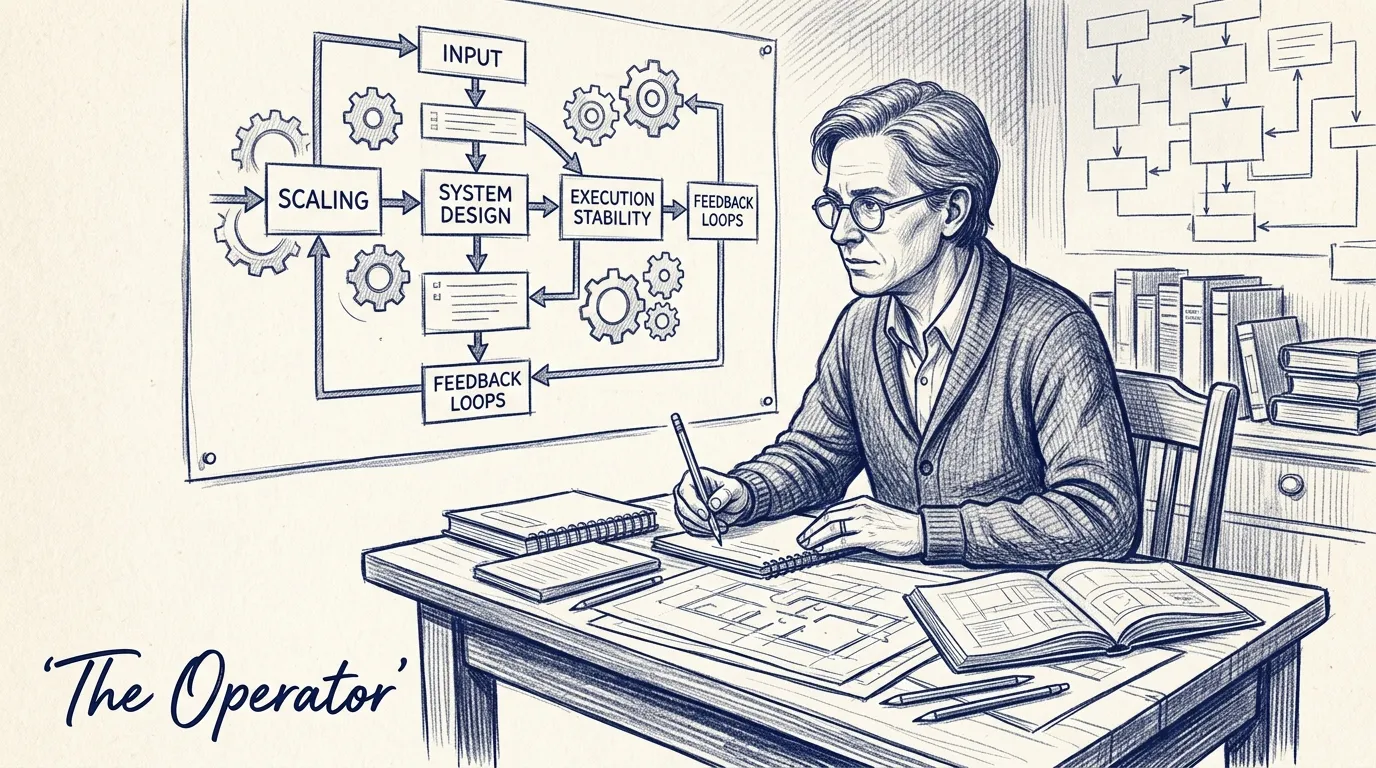
What The Operator Does
Core Question: How do we make this work at scale?
The Operator archetype is built to resolve operational complexity by creating systems that scale, processes that repeat, and infrastructure that lasts.
Where markets fragment because what works at small scale breaks at large scale, the Operator provides the processes, the infrastructure, and the repeatable frameworks that turn chaos into reliability.
Operators are not theorists. They are not strategists who have never executed. They have built, run, and fixed real operations. They know that strategy is easy; execution is hard. They know that what works for ten fails for a hundred—unless you have systems.
The Operator does not admire the problem. The Operator builds the system that solves it.
7 Ideal Characteristics of The Operator
What Makes This Author Archetype Capable of Resolving Operational Complexity
| # | Characteristic | What It Looks Like |
|---|---|---|
| 1 | Systems Orientation | Sees processes, not just outcomes. Knows that good results from good systems are repeatable; good results from heroics are not. |
| 2 | Scalability Instinct | Anticipates where current processes will break. Builds for the next order of magnitude, not just current volume. |
| 3 | Process Documentation Discipline | Writes it down. Creates playbooks. Ensures that knowledge is not trapped in heads. |
| 4 | Continuous Improvement | Never satisfied. Always tweaking, optimizing, refining. Knows that a system is never finished. |
| 5 | Failure Analysis | Does not just fix problems. Asks why the problem was possible. Builds systems that prevent recurrence. |
| 6 | Cross-Functional Bridge-Building | Connects silos. Ensures that handoffs between teams are designed, not accidental. |
| 7 | Metrics Orientation | Measures what matters. Knows that you cannot improve what you cannot measure. |
Real-Life Example:
Frances Frei
Frances Frei, a professor at Harvard Business School and expert on organizational culture and operational excellence, is a definitive example of The Operator archetype in action.
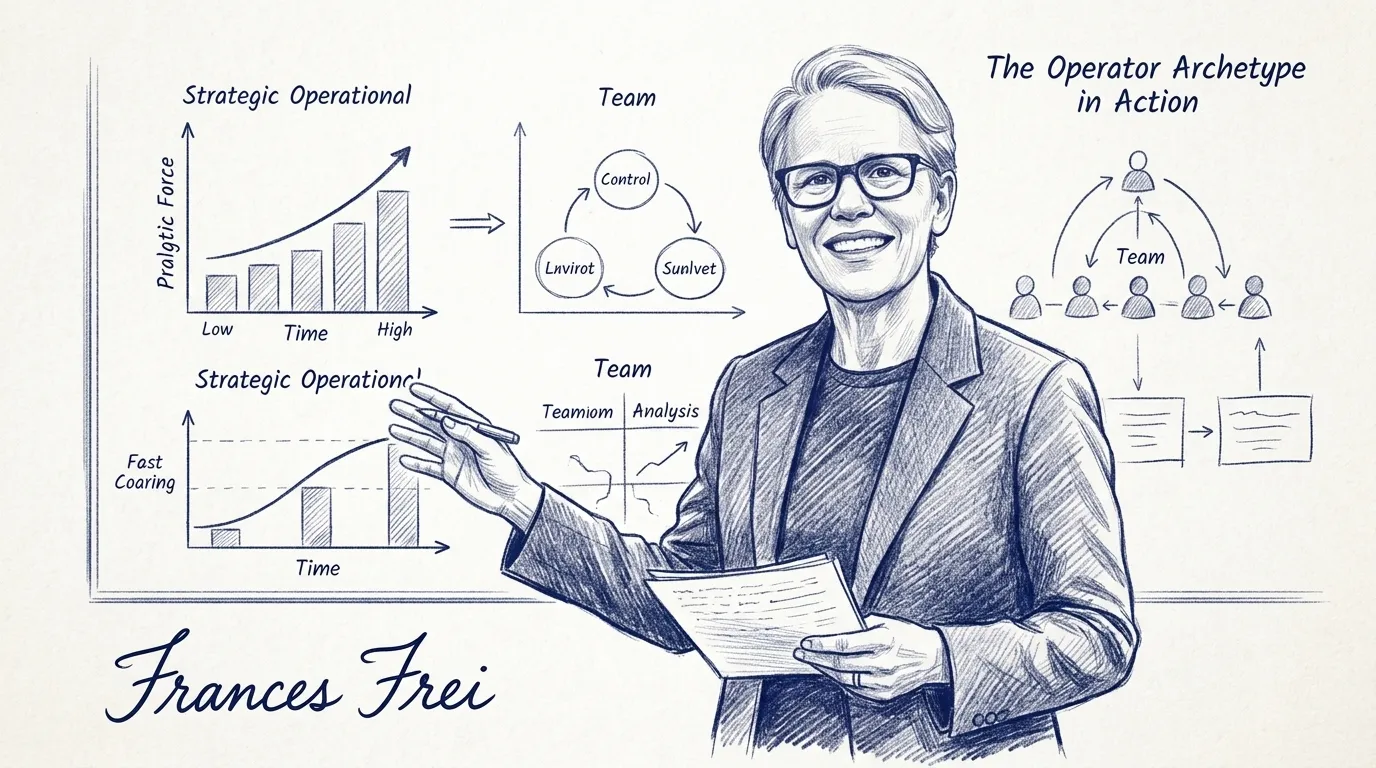
Why does she embody The Operator:
| Characteristic | How Frances Frei Demonstrates It |
|---|---|
| Systems Orientation | Her work focuses on three pillars for building trust: authenticity, empathy, and rigor (logic). She sees trust as a system, not a feeling. |
| Scalability Instinct | She has advised organizations from startups to Fortune 500s to governments. Her frameworks work across scales because they are systems, not anecdotes. |
| Process Documentation Discipline | Her teaching materials, frameworks, and books (Uncommon Service, Unleashed) are playbooks—designed to be used, not just read. |
| Continuous Improvement | She iterates her frameworks constantly. What she taught ten years ago has evolved based on what has worked and what has not. |
| Failure Analysis | Her best-known intervention was at Uber, where she helped diagnose and rebuild a broken organizational culture. She did not just recommend fixes; she analyzed why the system produced failure. |
| Cross-Functional Bridge-Building | Her work spans strategy, operations, culture, and human resources. She builds bridges between functions that typically operate in silos. |
| Metrics Orientation | Her frameworks come with diagnostic tools. Organizations can measure themselves against her pillars, identify gaps, and track improvement. |
How Frei resolves operational complexity:
When an organization is failing to scale—culture breaking, trust eroding, operations fragmenting—Frei does not just prescribe fixes. She builds systems. Her frameworks give organizations the tools to diagnose themselves, build their own solutions, and sustain improvement.
She does not solve the problem; she builds the system that solves the problem.
The GreenDeveX Insight:
Brands that partner with Operators like Frances Frei do not need to rely on heroic efforts from their teams. The Operator builds the systems that make heroics unnecessary.
Reliability becomes routine.
Other Notable Operators for Inspiration
| Operator | Domain | Why They Qualify |
|---|---|---|
| Ray Dalio | Investment Management | Founder of Bridgewater Associates. His Principles is a field guide to organizational systems. He documented the operating system of one of the world’s most successful hedge funds. |
| Sheryl Sandberg | Technology Operations | As COO of Facebook (now Meta), she scaled the organization from startup to global giant. She built the operational infrastructure that made growth possible. |
| Eric Ries | Lean Startup | Author of The Lean Startup. His Build-Measure-Learn feedback loop is an operational framework for innovation. He operationalized entrepreneurship. |
| Amy Edmondson | Psychological Safety | Her research on psychological safety is operational. She has built frameworks that teams can use to create the conditions for learning and innovation. |
| W. Edwards Deming (1900-1993) | Quality Management | His systems thinking transformed manufacturing. His 14 Points are an operating system for quality. He showed that quality is a system property, not an individual responsibility. |
| Tobi Lütke | E-commerce Operations | CEO of Shopify. He built the operating system for millions of merchants. His approach to “default alive” and “write things down” is pure Operator. |
The Operational Complexity Friction
What the friction looks like:
Markets cannot grow when operations break at scale. What works for ten customers fails for a hundred. What works for a hundred fails for a thousand. Growth is fragile. Every new customer introduces new risk.
The cost of this friction:
How The Operator resolves it:
The Operator does not admire the problem. The Operator builds the system that solves it. Through process documentation, scalability design, and continuous improvement, the Operator turns chaotic growth into reliable scaling.
The mechanism: System transfer.
The Operator builds the system that others can run. They do not need to be present for the system to work. The system runs itself.
Questions The Operator Helps Markets Answer
| # | Question |
|---|---|
| 1 | Why do things keep breaking as we grow? What is the pattern? |
| 2 | How do we make quality consistent, not dependent on who is working that day? |
| 3 | What systems do we need to build before we scale further? |
| 4 | How do we know if we are improving? What metrics actually matter? |
| 5 | What knowledge is trapped in people’s heads that should be in systems? |
Publishing Formats for The Operator
| Format | Why It Works for The Operator |
|---|---|
| Operations Playbooks | The core Operator format. Documents the system so others can run it. |
| Process Maps | Visualizes workflows. Shows dependencies, handoffs, and bottlenecks. |
| Standard Operating Procedures (SOPs) | Step-by-step instructions for repeatable tasks. Removes ambiguity. |
| Metrics Dashboards | Measures what matters. Makes system performance visible. |
| Failure Post-Mortems | Documents what went wrong and why. Builds the system to prevent recurrence. |
| Scaling Frameworks | Provides the architecture for growth. Shows what breaks at each stage—and how to prepare. |
Ideal Industries / Sectors
| Sector | Why The Operator Thrives Here |
|---|---|
| Technology & SaaS | Software operations at scale require systems. Operators build the infrastructure. |
| Manufacturing & Logistics | Physical operations are systems problems. Operators optimize flows. |
| Healthcare | Patient safety requires reliability. Operators build the systems that prevent errors. |
| Hospitality | Consistent experience is the product. Operators make excellence repeatable. |
| Professional Services | Quality varies by practitioner. Operators systematize excellence. |
| Nonprofit Operations | Mission requires efficiency. Operators build systems that maximize impact per dollar. |
Ideal Brand Partnerships
| Brand Type | Why They Need The Operator |
|---|---|
| Fast-growing startups | Growth is breaking operations. Operators build the systems to scale safely. |
| Turnaround situations | Operations are chaos. Operators bring order and reliability. |
| Franchise systems | Consistency across locations requires systems. Operators build the playbook. |
| High-volume service businesses | Margins depend on efficiency. Operators optimize the flow. |
| Organizations with high churn | Knowledge walks out the door. Operators systematize so churn does not kill quality. |
5 Frequently Asked Questions About The Operator
FAQ 01: How does The Operator differ from The Field Guide?
The Field Guide focuses on individual execution—step-by-step guidance for practitioners.
The Operator focuses on systemic execution—the processes, metrics, and infrastructure that enable reliable outcomes at scale.
One is for the doer; one is for the architect. They are natural partners.
FAQ 02: Does The Operator need to have built something at scale?
Not necessarily. Some Operators have deep theoretical knowledge of systems. But the best Operators have scars—they have built, broken, and rebuilt real operations. Lived experience at scale is hard to fake.
FAQ 03: Can The Operator also be a Cartographer?
Yes. The Cartographer maps systems.
The Operator builds them. Maps inform building; building creates new maps. They are natural partners.
FAQ 04: Is The Operator only for large organizations?
No. Small organizations need Operators too—often more urgently.
A small organization with good systems can outperform a large organization with chaos.
Systems are a competitive advantage at any scale.
FAQ 05: How do I know if I need an Operator?
If you find yourself saying “why does this keep happening” repeatedly, you need an Operator.
If your team is firefighting instead of building, you need an Operator.
If growth feels scary because you are not sure you can handle it, you need an Operator.
Example in Action
Scenario:
A fast-growing delivery startup has gone from 100 to 1,000 daily orders.
Customer support is overwhelmed. Orders are late. Drivers are confused. The founders are working 18-hour days.
Growth is breaking the company.
The Operator intervention:
The Operator spends two weeks mapping every process: order intake, dispatch, driver assignment, routing, customer communication, exception handling, refunds.
They identify bottlenecks, redundancies, and missing handoffs.
They build a dispatch system, a driver training playbook, and a customer support protocol.
They create metrics dashboards so the team can see—in real time—where the system is breaking.
Outcome:
The company scales to 10,000 daily orders without adding proportional headcount. Customer satisfaction scores improve.
The founders sleep.
The Operator did not just fix problems; they built the system that prevents problems.
Does your brand need The Operator?
If operational complexity is making growth fragile, The Operator archetype may be your match.
GreenDeveX classifies and connects Operators to brands that need systems, reliability, and scalable operations.
Your ecosystem transition starts here.
→ Join the Early Access Waitlist
→ Find Your Operator Match
Now that you understand The Operator, explore The Cultural Decoder — the archetype that interprets human behavior and social dynamics to explain what markets are responding to.
→ Explore All Author Archetypes