
From Category Leader to Market Shaper
Traditional marketing costs more every year.
You increase spend. You add channels. You launch more campaigns. Yet growth slows, CAC rises, and your brand feels invisible despite constant effort.
The cost? You are trapped in a system designed for diminishing returns — renting attention you never own.
GreenDeveX’s Brand Ecosystem Strategy offers a different path.
We give you three operating models that align incentives between brands and authors. Each model builds compound authority. Each turns publishing from a cost centre into an investment.
The outcome? Your brand becomes a reference point that markets consult, not ignore.
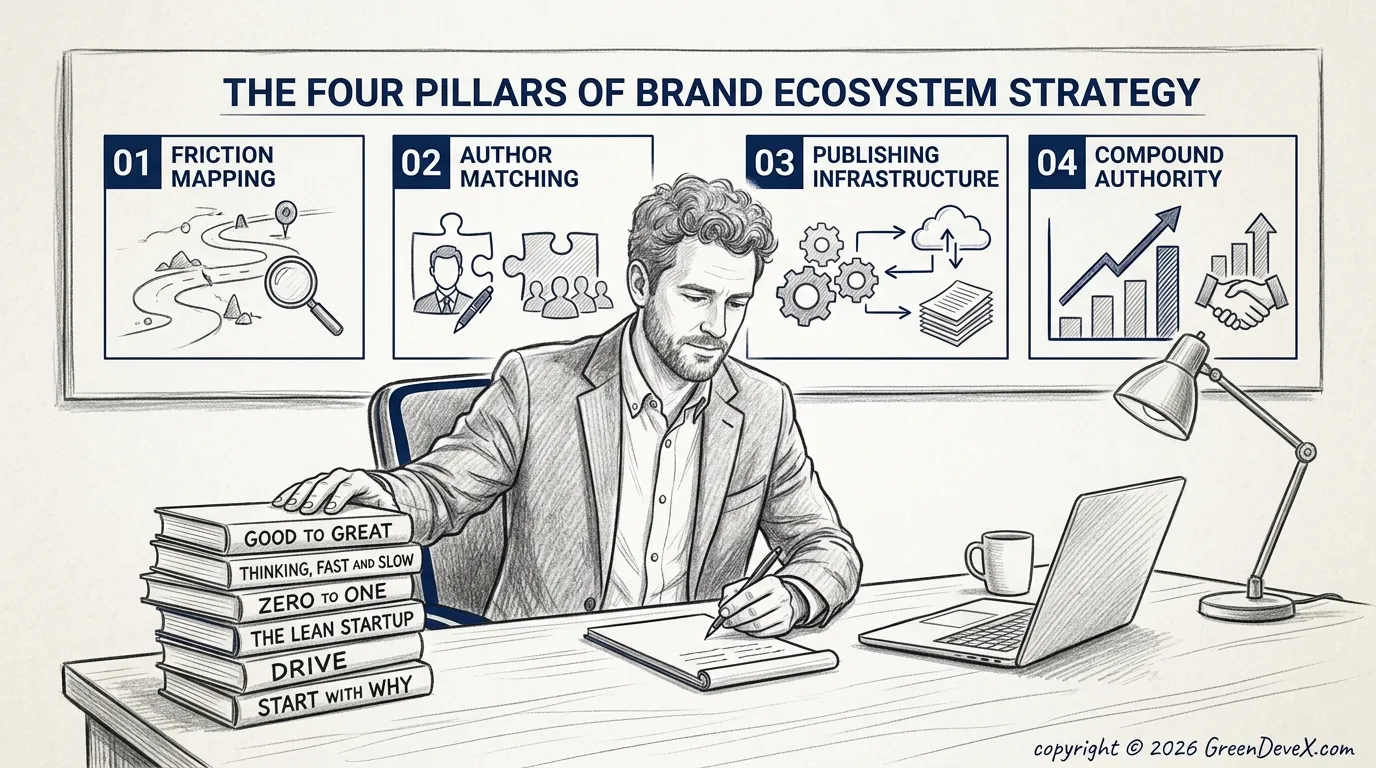
The Four Pillars of Brand Ecosystem Strategy
| Pillar | Action | Outcome |
|---|---|---|
| 01. Friction Mapping | Diagnose precisely which frictions are costing your brand velocity | A precise friction map telling you which market questions remain unanswered |
| 02. Author Matching | Match author archetypes to your specific interpretation gaps | A matched author ecosystem — each archetype deployed against its specific friction |
| 03. Publishing Infrastructure | Build the assets and distribution systems that carry author intelligence to market | A publishing layer that converts author intelligence into decision-ready understanding |
| 04. Operating Model Selection | Choose the collaboration model that fits your brand’s objectives and resources | Clear expectations. Shared incentives. Compound authority. |
The Three Operating Models for Brands
| Model | What It Does | Best For | Outcome |
|---|---|---|---|
| Co-Creating Model | Brands and authors collaborate to create original IP together | Authority-building, category creation, signature assets | Shared intellectual property that compounds |
| Fractional Publishing Model | Brands access GreenDeveX’s existing author ecosystem without building one | Growing brands, industry associations, lean teams | Consistent publishing engine without overhead |
| Rent-and-Rank Narrative Model | Brands participate in existing trusted author platforms | Faster market entry, trust building, and demand generation | Immediate visibility within engaged ecosystems |
Why Traditional Marketing Breaks
| Problem | What It Looks Like |
|---|---|
| Attention resets | When Ad spending stops, attention stops. Every period starts from zero. |
| Rising CAC | Channel saturation grows. Ad costs inflate year over year. |
| No residual assets | The campaign runs, the campaign ends, and nothing remains. |
| Trust must be repurchased | Repeatedly, at increasing cost, to each new audience segment. |
| Market understanding is transactional | It lasts only as long as the impression lasts. |
The result: A growth model with a ceiling — one that demands increasingly large spend to produce diminishing returns.
The Brand Ecosystem Alternative
| Campaign Model | Ecosystem Model |
|---|---|
| Attention resets when Ad spending stops | Authority compounds with every asset |
| Rising CAC year over year | Falling effective CAC as inbound quality improves |
| No residual asset | Permanent publishing assets accumulate as institutional IP |
| Trust must be repurchased | Trust transfers through the author network |
| Market understanding is transactional | Market understanding is structural — embedded before the decision moment |
The 12-Month Brand Publishing Journey
| Phase | Timeline | Focus | Solution Pack |
|---|---|---|---|
| Foundation | Months 1–3 | Identify market frictions. Align internal messaging. Build the clarity system. | Foundation Engine |
| Momentum | Months 3–6 | Launch publishing infrastructure. Match and deploy author archetypes. Build repeatable cadence. | Momentum Engine |
| Influence | Months 6–9 | Strengthen the positioning system. Shape how the market thinks about the category, not just your brand. | Influence Engine |
| Infrastructure | Months 9–12 | Publishing infrastructure becomes a permanent institutional asset. Compounding curve established. | Infrastructure Engine |
What Brand Ecosystem Strategy Produces
| Outcome | What It Means |
|---|---|
| Lower CAC | Prospects arrive pre-educated through your publishing assets. Sales explains less. Closes more. |
| Shorter Sales Cycles | Less market friction. Faster stakeholder decisions. Fewer stalls. |
| Premium Pricing | Trust reduces price sensitivity. Reference status commands premium. |
| Competitive Moat | Your ecosystem cannot be copied. Your author network is your advantage. |
| Predictable Growth | Assets work consistently, not sporadically. Growth decouples from ad spend. |
| Durable Authority | Influence compounds over time. Each year builds on the last. |
How to Choose Your Operating Model
| If your priority is… | Choose this model… | Because… |
|---|---|---|
| Building a signature asset (book, major report, definitive guide) | Co-Creating Model | You need deep collaboration and shared ownership of IP. |
| Consistent publishing without building infrastructure | Fractional Publishing Model | You need access to an existing ecosystem, not construction. |
| Immediate visibility within an existing trusted platform | Rent-and-Rank Narrative Model | You need speed and borrowed trust, not long-term asset building. |
Most brands evolve: Start with Rent-and-Rank for visibility. Move to Fractional Publishing for consistency. Graduate to Co-Creating for signature assets.
Ready to build your Brand Ecosystem?
Book a 15-minute strategy session to identify which model fits your brand’s objectives and resources.
Now that you understand Brand Ecosystem Strategy, explore the following:
| To Go Deeper | Explore This Page |
|---|---|
| Diagnose your specific market friction | → Brand Friction Mapping |
| Match authors to your friction profile | → Brand–Author Matching |
| Build the publishing formats you need | → Thought Leadership Infrastructure |
| Explore partnership models | → Partnership Opportunities |