

The Ecosystem-Thinking Model helps brands and authors move beyond isolated marketing activities and participate in larger systems where trust, ideas, and influence compound over time.
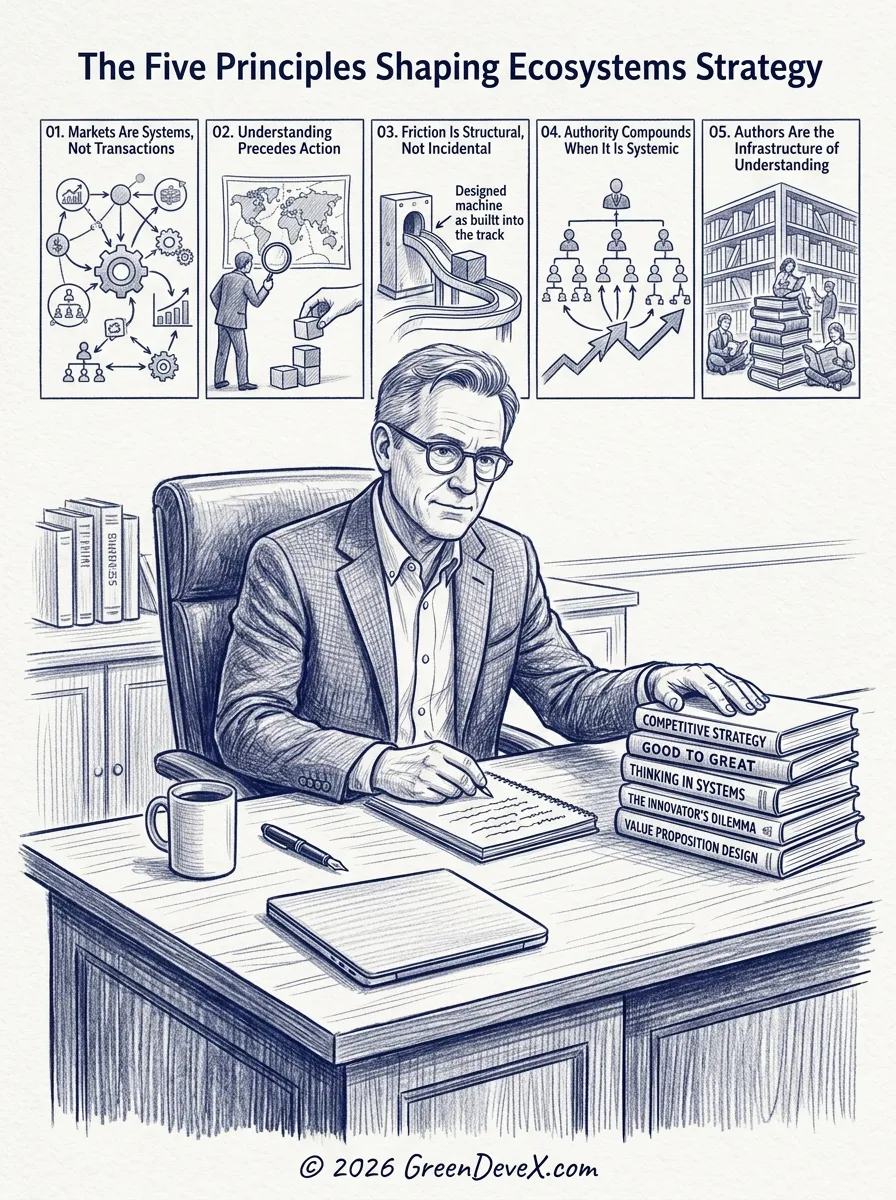
GreenDeveX’s Ecosystem-thinking Model offers a different path. Five principles guide market-shaping organizations:
- Markets are systems, not transactions
- Understanding precedes action
- Friction is structural, not incidental
- Authority compounds when it is systemic
- Authors are the infrastructure of understanding
The 7 Powerful Layers of an Ecosystem
1. Authors
The thinkers, educators, researchers, and storytellers shaping conversations.
2. Audiences
The communities learning from those authors.
3. Brands
Organizations providing products, services, and solutions.
4. Media Platforms
Channels that help ideas spread.
5. Institutions
Schools, associations, governments, and industry bodies.
6. Commercial Networks
Partners, suppliers, distributors, and investors.
7. Market Narratives
The shared beliefs that influence decisions across the ecosystem
The Shift: Vertical Thinking vs. Ecosystem Thinking
| Vertical Thinking | Ecosystem Thinking |
|---|---|
| Optimize your product, your sales team, your marketing spend | Shape how the market understands, trusts, and decides |
| Growth is capped by your own resources and reach | Growth compounds through author ecosystems and stakeholder trust |
| When you stop investing, growth stops | Influence outlasts any campaign |
| Competition is zero-sum | Markets expand when friction is removed |
| Authority resets each cycle | Authority compounds with every asset |
The shift is not about working harder. It is about seeing differently.
5 Principles That Separate Market-Shaping Brands from Category-Optimizing Ones
Principle 01: Markets Are Systems, Not Transactions
Every market is a complex system of relationships, frictions, incentives, and interdependencies.
Vertical thinking: Optimize individual transactions. Close the deal. Win the customer.
Ecosystem thinking: Understand the system. Map the relationships. Identify the leverage points.
Organizations that understand the system outperform those that optimize individual transactions.
→ Map the system before optimizing the part
Principle 02: Understanding Precedes Action
Markets cannot support what they do not understand.
Vertical thinking:
Launch first. Explain later. Let marketing clean up the confusion.
Ecosystem thinking:
Build understanding infrastructure before asking for commitment.
The most important investment before any market entry, product launch, or partnership is building the understanding infrastructure that enables stakeholders to act confidently.
→ Invest in interpretation before scaling execution
Principle 03: Friction Is Structural, Not Incidental
Market friction is not random resistance. It is the predictable output of specific structural conditions.
Vertical thinking:
Treat friction as a sales problem. Push harder. Discount more.
Ecosystem thinking:
Diagnose friction structurally. Remove it systematically.
Organizations that diagnose friction structurally can address it systematically rather than managing symptoms.
→ Diagnose friction before deploying solutions
Principle 04: Authority Compounds When It Is Systemic
Episodic thought leadership produces transient attention. Systemic authority infrastructure produces compounding market influence.
Vertical thinking:
Launch campaigns. Measure reach. Start over next quarter.
Ecosystem thinking:
Build infrastructure. Publish assets that accumulate. Each investment builds on the last.
The difference is whether each investment builds on the previous one or starts from scratch.
→ Build infrastructure, not campaigns
Principle 05: Authors Are the Infrastructure of Understanding
In every ecosystem, certain authors are the primary creators of the market understanding that enables trust, adoption, and decision-making.
Vertical thinking:
Hire influencers with large audiences. Pay for reach.
Ecosystem thinking:
Identify, classify, and deploy authors whose expertise matches your market’s specific friction.
Identifying, classifying, and deploying these authors is the highest-leverage investment in market velocity available.
→ Invest in author ecosystem before scaling distribution
The GreenDevex View
Markets are shaped by ideas before they are shaped by transactions.
Those ideas often originate from authors.
Authors help people:
This is why GreenDevex focuses on connecting brands with author ecosystems.
Where GreenDevex Fits
GreenDevex acts as the infrastructure layer connecting:
Brands ↔ Authors ↔ Audiences ↔ Markets
Our role is to help the right ideas reach the right ecosystems through:
The Ecosystem Advantage
Brands operating within author ecosystems can:
Authors benefit by:
What Ecosystem Thinking Produces
| Outcome | What It Means |
|---|---|
| Lower CAC | Prospects arrive pre-educated. Your sales team stops explaining basics. |
| Shorter sales cycles | Less friction. Faster decisions. Fewer stalls. |
| Premium pricing | Trust reduces price sensitivity. Reference status commands premium. |
| Competitive moat | Reference status cannot be copied. Your ecosystem is your advantage. |
| Predictable growth | Assets work consistently, not sporadically. Growth decouples from ad spend. |
| Durable authority | Influence compounds over time. Each year builds on the last. |
Frequently Asked Questions About
Ecosystem-Thinking Model
What is the Ecosystem-Thinking Model?
A framework that helps brands and authors understand and participate in larger systems of influence rather than focusing only on direct transactions.
How is ecosystem-thinking different from traditional marketing?
Traditional marketing focuses on customers. Ecosystem-thinking focuses on the wider network of stakeholders that shape customer decisions.
Why are authors important in an ecosystem?
Authors help shape beliefs, educate audiences, and influence market conversations.
How does GreenDevex support ecosystem-thinking?
GreenDevex connects brands with relevant author ecosystems and provides the infrastructure needed to create long-term narrative assets..
Who benefits from ecosystem-thinking?
Brands, authors, institutions, publishers, communities, and any organization seeking sustainable influence.

Build Influence Beyond Your Industry
Learn how GreenDevex helps brands and authors create stronger ecosystems, deeper trust, and lasting market influence.
Meet Our Team
Our team comprises passionate professionals with expertise in sustainability and the ESG space, committed to making a positive impact.

Maureene Mutai
Innovation

Sarah Mwenesi
ESG

Julia Kitavi
Sustainability

David Lemiso
Community
Founders’ Corner
Victor I’Syamba

“I founded GreenDevex to provide industry leaders and ‘overqualified’ individuals with a platform worthy of their work.
Too many strong ideas fail because they are not framed well, not understood, or not amplified.My work across Africa — from nation branding to ESG-related projects — taught me that good ideas need structure, a compelling story, and a solid distribution framework.
GreenDeveX is my commitment to help those ideas reach the tables where decisions are made.”
Advisory / Thought Partners

GreenDeveX works with experts who shape thinking across 6 Economic Sector.
This section will feature leaders such as:
This advisory group gives GreenDeveX depth, credibility, and strategic direction.