
What The Philosopher Does
Core Question: What principles guide us?
The Philosopher resolves moral uncertainty by establishing the principles that guide decisions.
Where markets freeze because no one knows what is right, where ethical lines are blurry, where decisions have no clear foundation, where inconsistency erodes trust. That is where the Philosopher provides the ethical framework that makes principled action possible.
Philosophers are not detached academics (though some are).
They are the people who ask: “What should we do?” not just “What can we do?”
They build the frameworks that turn values into decisions.
They give organizations the confidence to act when the right path is unclear.
The Philosopher does not tell you what to think. The Philosopher gives you the tools to think clearly about what matters.
GreenDeveX classifies authors who embody the Philosopher to help brands become principled.
The outcome? Decisions have a foundation. Trust is built through consistency. Your brand stands for something.
7 Ideal Characteristics of The Philosopher
What Makes This Author Archetype Capable of Resolving Moral Uncertainty
| # | Characteristic | What It Looks Like |
|---|---|---|
| 1 | First Principles Thinking | Does not accept assumptions. Asks “why?” until bedrock. Builds from foundations. |
| 2 | Ethical Fluency | Comfortable with moral philosophy frameworks (utilitarianism, deontology, virtue ethics, care ethics, etc.). Knows which framework applies when. |
| 3 | Clarity Without Dogma | Has convictions but holds them provisionally. Certain enough to act, humble enough to revise. |
| 4 | Trade-off Honesty | Knows that principles conflict. Does not pretend that hard choices are easy. |
| 5 | Systematic Reasoning | Builds arguments step by step. Can show the chain from premise to conclusion. |
| 6 | Respect for Disagreement | Engages with opposing views seriously. Does not dismiss. Assumes that reasonable people can disagree. |
| 7 | Practical Orientation | Cares about how philosophy applies to real decisions. Not just abstract—actionable. |
Real-Life Example:
Cornel West
Cornel West, the philosopher, political activist, and public intellectual, is a definitive example of The Philosopher archetype in action.
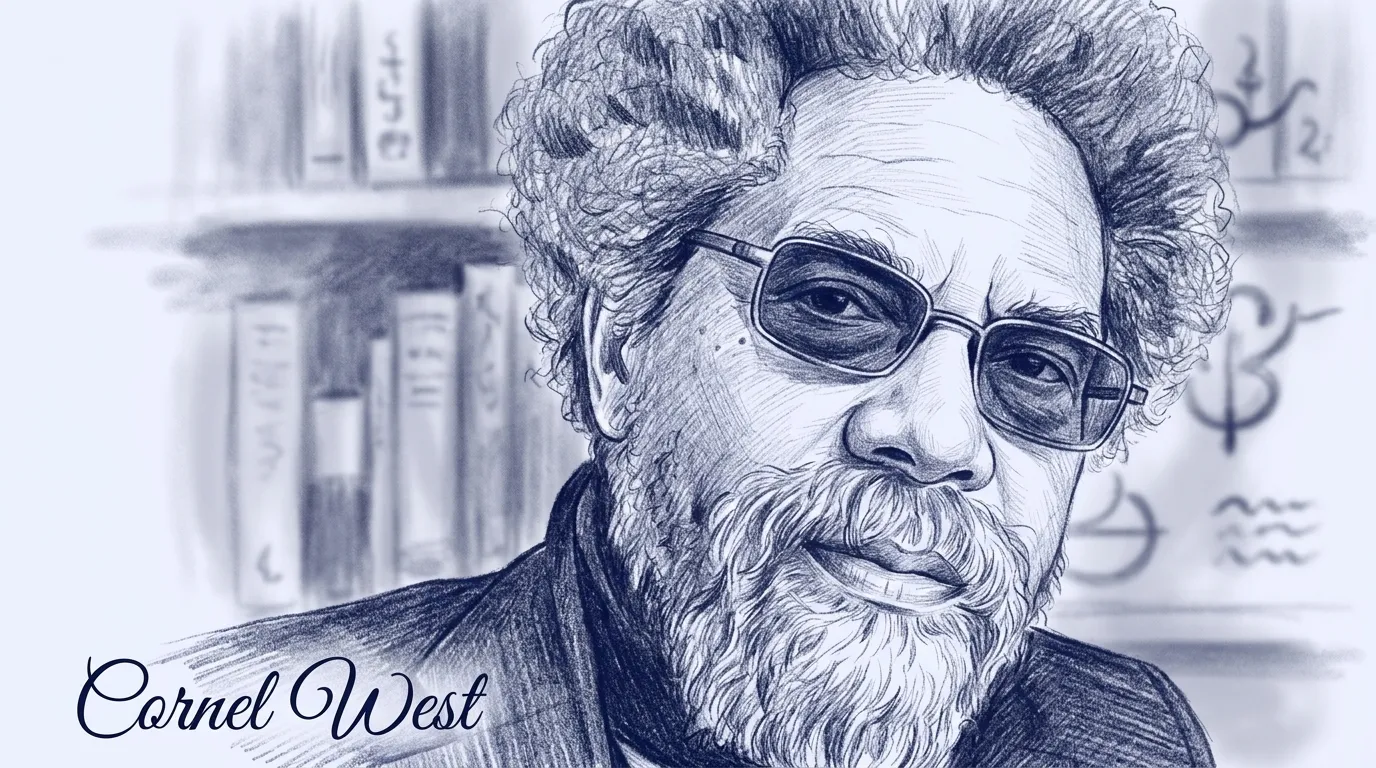
Why does he embody The Philosopher:
| Characteristic | How Cornel West Demonstrates It |
|---|---|
| First Principles Thinking | His work constantly returns to fundamental questions: What is justice? What does it mean to be human? What do we owe each other? He builds from first principles, never assuming the answer. |
| Ethical Fluency | Trained as a philosopher at Harvard and Princeton, he is fluent in pragmatism, existentialism, Christianity, and prophetic traditions. He draws from multiple ethical frameworks—and synthesizes them. |
| Clarity Without Dogma | He has clear convictions: racial justice, economic equality, and democratic participation. But he engages with opponents respectfully. He is certain enough to act, not so certain that he cannot listen. |
| Trade-off Honesty | He writes about the tragedy of the Black struggle—the impossible choices, the unavoidable losses. He does not pretend that progress is costless. |
| Systematic Reasoning | His arguments are built, not asserted. He traces the history, the philosophy, the politics, and the personal experience. The chain is visible. |
| Respect for Disagreement | He has debated and collaborated across ideological lines. He takes opponents seriously because he takes ideas seriously. |
| Practical Orientation | He is not an academic philosopher writing for other academics. He speaks, organizes, and protests. His philosophy is lived, not just written. |
How West resolves moral uncertainty:
When audiences are confused about what justice requires, when they are torn between competing values, West does not give them a simple answer. He gives them a framework.
He shows how to think about the question, what principles are at stake, and what is at risk. He does not remove the difficulty; he gives them the tools to navigate it.
The GreenDeveX Insight:
Brands that partner with Philosophers like Cornel West do not need to invent their values from scratch.
The Philosopher provides the ethical framework. The brand simply needs to live it.
Other Notable Philosophers for Inspiration
| Philosopher | Domain | Why They Qualify |
|---|---|---|
| Kwame Anthony Appiah | Ethics & Identity | His work on cosmopolitanism, identity, and moral revolutions provides frameworks for navigating difference. His “Ethicist” column applies philosophy to everyday dilemmas. |
| Martha Nussbaum | Capabilities Approach | Argues that justice requires enabling people to flourish. Her capabilities framework has influenced development policy, law, and education. |
| Michael Sandel | Political Philosophy | His course “Justice” has reached millions. He makes moral philosophy accessible—and urgent. He shows that hard choices require hard thinking. |
| Amia Srinivasan | Feminist Philosophy | Her work on the philosophy of sex and gender brings philosophical rigor to questions that are often dismissed as “personal.” She shows that the personal is philosophical. |
| Olúfẹ́mi O. Táíwò | Climate Justice | His work on climate justice synthesizes philosophy, politics, and activism. He provides frameworks for thinking about responsibility, reparations, and collective action. |
| Rebecca Goldstein | Philosophy & Literature | Shows how philosophy and literature illuminate each other. Her work on the problem of evil, free will, and moral progress is rigorous and accessible. |
The Moral Uncertainty Friction
What the friction looks like:
Markets cannot move when no one knows what is right. Ethical lines are blurry. Decisions have no clear principle to guide them. Organizations drift, reacting to pressure instead of acting on principle.
The cost of this friction:
How The Philosopher resolves it:
The Philosopher does not tell you what to think. The Philosopher gives you the tools to think clearly about what matters. Through first principles thinking, ethical fluency, and systematic reasoning, the Philosopher provides the framework that makes principled action possible.
The mechanism: Conviction transfer.
The Philosopher provides the principles. The brand lives them. Stakeholders trust the consistency. Conviction compounds.
Questions The Philosopher Helps Markets Answer
| # | Question |
|---|---|
| 1 | What do we stand for? What are our principles? |
| 2 | When principles conflict, how do we decide? |
| 3 | Is this decision consistent with who we say we are? |
| 4 | What do we owe our stakeholders? Where are our obligations? |
| 5 | How do we act when the right path is unclear? |
Publishing Formats for The Philosopher
| Format | Why It Works for The Philosopher |
|---|---|
| Manifestos | Declares principles. Provides a foundation that others can rally around. |
| Ethical Frameworks | Builds the system that guides decisions. Shows how values become action. |
| Principles Documents | States what the organization believes. Provides touchstones for decisions. |
| Case Studies in Moral Reasoning | Shows how principles apply to real dilemmas. Teaches ethical thinking by example. |
| Dialogue Transcripts | Shows disagreement handled well. Models respectful engagement with opposing views. |
| Philosophical Essays | Explores questions without demanding simple answers. Invites readers into the inquiry. |
Ideal Industries / Sectors
| Sector | Why The Philosopher Thrives Here |
|---|---|
| Healthcare & Medicine | Life-and-death decisions require ethical frameworks. Philosophers provide them. |
| Technology & AI | Algorithms make ethical decisions. Philosophers help design them. |
| Law & Justice | Justice requires principles. Philosophers provide the foundation. |
| Nonprofit & Social Impact | Mission-driven organizations need clarity on values. Philosophers provide it. |
| Education | Teaching ethics requires ethical frameworks. Philosophers build the curriculum. |
| Policy & Governance | Policies embody values—or should. Philosophers surface the underlying principles. |
Ideal Brand Partnerships
| Brand Type | Why They Need The Philosopher |
|---|---|
| Healthcare organizations | Need ethical frameworks for treatment decisions, resource allocation, and end-of-life care. |
| AI companies | Need principles for algorithmic decision-making, privacy, and accountability. |
| Mission-driven nonprofits | Need clarity on values to guide action when trade-offs are unavoidable. |
| Educational institutions | Need ethical frameworks for curricula, admissions, and institutional behavior. |
| Financial services firms | Need principles for ethical investing, risk management, and client relationships. |
5 Frequently Asked Questions About The Philosopher
FAQ 01: Is The Philosopher just for “moralizing”?
No. The Philosopher provides frameworks for thinking, not just moral pronouncements.
Organizations face hard choices every day—not just between good and evil, but between competing goods.
The Philosopher helps navigate those trade-offs systematically, not dogmatically.
FAQ 02: How does The Philosopher differ from The Diplomat?
The Diplomat aligns stakeholders around shared outcomes.
The Philosopher clarifies the principles that should guide those outcomes. One is about alignment; one is about foundation. They are natural partners.
FAQ 03: Does The Philosopher need to be a professional philosopher?
No. Many great Philosophers are not academics. They are leaders, writers, and practitioners who have thought deeply about first principles. What matters is the quality of the reasoning, not the credentials.
FAQ 04: Can The Philosopher also be a Contrarian?
Yes. Many Philosophers are Contrarians. They challenge assumptions—including moral assumptions that have gone unquestioned.
Socrates was the original Contrarian-Philosopher. The combination is powerful.
FAQ 05: What is the risk of having a Philosopher?
The risk is abstraction—principles without application.
The best Philosophers are practical.
They know that philosophy is not about being right in the abstract; it is about acting well in the real world.
Look for Philosophers who have skin in the game.
Example in Action
Scenario:
A healthcare system is facing a crisis: ventilators are scarce.
There are more patients than machines.
How do they decide who gets care and who does not?
The Philosopher intervention:
A Philosopher with expertise in medical ethics is brought in.
She does not just give an answer.
She provides a framework:
What principles should guide allocation? (Maximize lives saved?
Prioritize the sickest?
Give priority to healthcare workers?
Use lottery?)
She walks the leadership through the trade-offs. She helps them articulate their values and apply them consistently
Outcome:
The healthcare system makes a decision difficult but defensible. They can explain why they chose as they did.
Staff understand the reasoning.
Patients and families, even those who suffer, can see that the decision was principled, not arbitrary.
The Philosopher did not make the decision easier. She made it possible.
Does your brand need The Philosopher?
If moral uncertainty is making principled action impossible, The Philosopher archetype may be your match.
GreenDeveX classifies and connects Philosophers to brands that need conviction, consistency, and ethical clarity.
Your ecosystem transition starts here.
→ Join the Early Access Waitlist
→ Find Your Philosopher Match
Now that you understand The Philosopher, explore The Cartographer, the author archetype that maps ecosystems and reveals hidden connections
→ Explore All Author Archetypes