

The Formats That Carry Author Intelligence to Market — Deployed Through Three Operating Models
You are a classified author. You have a clear archetype. You know which market friction you resolve. But your expertise is still not reaching the decision-makers who need it most.
The cost? Your authority stays theoretical. Your influence stays shallow. The brands that could deploy your knowledge have no infrastructure to carry it to their stakeholders.
GreenDeveX’s Publishing Infrastructure solves this.
We build the formats and distribution systems that carry your intelligence to market: research reports, field guides, ecosystem maps, intelligence briefings, and executive interviews.
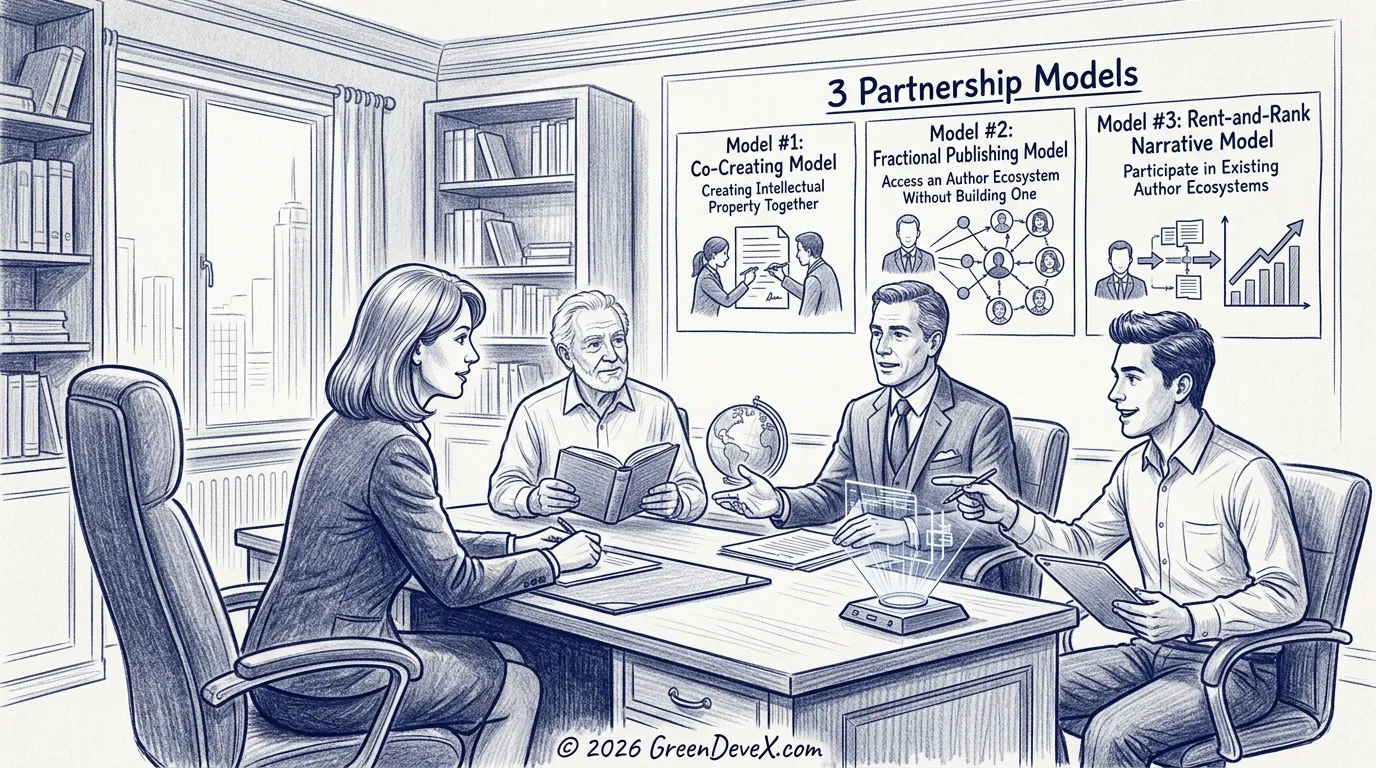
Then we deploy these assets through one of three operating models that determine how you collaborate with brands.
The outcome? Your expertise becomes deployable, scalable, and compoundable — embedded in the ecosystems that need it most.
The Difference Between Episodic Publishing and Publishing Infrastructure
| Episodic Publishing | Publishing Infrastructure |
|---|---|
| One-off white papers or articles | Systematic, coordinated publishing program |
| Each piece starts from zero | Each asset builds on the last |
| Influence resets after each publication | Authority compounds with every asset |
| Distribution is an afterthought | Distribution is designed into every asset |
| No feedback loop between assets | Continuous optimization across formats |
| Campaign thinking | Systems thinking |
The shift: Stop launching episodes. Start building infrastructure. And know exactly how you will work with brands.
The Three Operating Models for Publishing Infrastructure
| Model | How It Works | Best For | Outcome |
|---|---|---|---|
| Co-Creating Model | Brands and authors co-create publishing assets as shared IP | Signature reports, definitive guides, category-defining books | Shared intellectual property that compounds |
| Fractional Publishing Model | Authors become part of a brand’s ongoing publishing engine | Regular briefings, quarterly reports, monthly content series | Consistent deployment without constant matching |
| Rent-and-Rank Narrative Model | Author assets are placed within existing brand platforms | Sponsored knowledge hubs, co-branded content, industry resource centers | Immediate visibility within engaged ecosystems |
Model #1: Co-Creating Model (Publishing Infrastructure)
Building Shared Intellectual Property Together
In this model, brands and authors collaborate to create publishing assets that neither could produce alone. The asset carries both names. The authority is shared.
What this looks like:
- A brand with proprietary data partners with an author who can synthesize and narrate
- A research report is co-authored by the brand’s experts and the GreenDeveX author
- A field guide is developed jointly, with the brand providing operational context and the author providing framework
- A book is co-created, with the brand providing resources and distribution, the author providing expertise and narrative craft
Publishing formats best suited for this model:
- Research reports
- Books
- Industry guides
- Definitive white papers
Why this model works:
- The asset is differentiated — neither party could have created it alone
- Both parties have ownership and incentive to promote
- The asset compounds over time
Model #2: Fractional Publishing Model (Publishing Infrastructure)
Authors Become Part of a Brand’s Ongoing Publishing Engine
In this model, authors are embedded into a brand’s publishing infrastructure as fractional capacity — providing regular, ongoing content without being employees.
What this looks like:
- An author is engaged to produce quarterly intelligence briefings for a brand
- A subject matter expert contributes monthly field guide updates
- A Futurist provides annual outlook reports for a corporate client
- A Curator delivers weekly intelligence digests for an industry association
Publishing formats best suited for this model:
- Intelligence briefings (weekly, monthly, quarterly)
- Annual outlook reports
- Field guide updates
- Regular executive interviews
Why this model works:
- Brands get consistent publishing without hiring full-time staff
- Authors get predictable work and revenue
- The relationship deepens over time
Model #3: Rent-and-Rank Narrative Model (Publishing Infrastructure)
Author Assets Placed Within Existing Brand Platforms
In this model, author-created assets are placed within existing brand or media platforms where audiences are already engaged — accelerating visibility without requiring the author to build distribution from scratch.
What this looks like:
- An author’s research report is featured in a brand’s sponsored knowledge hub
- A field guide is hosted on an industry association’s resource center
- An executive interview series is distributed through a brand’s existing channels
- An ecosystem map is embedded in a corporate client’s strategic portal
Publishing formats best suited for this model:
- Research reports
- Executive interviews
- Ecosystem maps
- Intelligence briefings
Why this model works:
- Authors gain immediate visibility within engaged ecosystems
- Brands gain fresh, credible content for their platforms
- Low-risk entry point for testing longer-term collaboration
How to Choose Your Publishing Operating Model
| If your priority is… | Choose this model… | Because… |
|---|---|---|
| Creating a signature, differentiated asset | Co-Creating Model | You need deep collaboration and shared ownership. |
| Consistent, ongoing publishing without hiring | Fractional Publishing Model | You need embedded capacity, not one-off projects. |
| Immediate visibility within existing platforms | Rent-and-Rank Narrative Model | You need speed and placement, not long-term development. |
Most publishing programs evolve: Start with Rent-and-Rank to test content-market fit. Move to Fractional Publishing for consistency. Graduate to Co-Creating for signature assets.
How Formats Map to Operating Models
| Format | Co-Creating | Fractional Publishing | Rent-and-Rank |
|---|---|---|---|
| Research Reports | ✅ Best | ✅ Good | ✅ Good |
| Field Guides | ✅ Best | ✅ Good | ⚠️ Limited |
| Ecosystem Maps | ✅ Best | ⚠️ Limited | ✅ Good |
| Intelligence Briefings | ⚠️ Limited | ✅ Best | ✅ Good |
| Executive Interviews | ✅ Good | ✅ Good | ✅ Best |
| Author Networks | ✅ Best | ✅ Good | ⚠️ Limited |
The Six Publishing Formats
GreenDeveX builds publishing infrastructure across six core formats:

01. Research Reports
What they are: Long-form intelligence documents that establish an author’s expertise as the definitive resource in a market category.
Best for: Building institutional trust, investor engagement, policy influence
Best archetypes: The Sage, The Economist, The Investigator
Example output: “The State of Climate Finance in East Africa 2025”
02. Field Guides
What they are: Step-by-step operational resources that convert practical expertise into market-accessible intelligence.
Best for: Adoption facilitation, implementation confidence, partner enablement
Best archetypes: The Field Guide, The Operator, The Translator
Example output: “The Carbon Markets Field Guide: A Practitioner’s Playbook”
03. Ecosystem Maps
What they are: Frameworks and visualizations that make invisible market structures legible.
Best for: Strategic positioning, partnership development, platform-building programs
Best archetypes: The Cartographer, The Futurist, The Cultural Decoder
Example output: “The African Green Economy Ecosystem Map”
04. Intelligence Briefings
What they are: Curated, periodic publications that keep stakeholder networks informed and engaged with an author’s ongoing market perspective.
Best for: Recurring engagement, institutional audiences, subscriber relationships
Best archetypes: The Curator, The Economist, The Futurist
Example output: “The GreenDeveX Climate Intelligence Briefing (Quarterly)”
05. Executive Interview Series
What they are: Curated conversations between classified authors and market leaders that produce intelligence assets serving both brand authority and author platform simultaneously.
Best for: Borrowed trust, network expansion, thought leadership positioning
Best archetypes: The Sage, The Diplomat, The Storyteller
Example output: “Conversations with Market Shapers: Victor Isyamba interviews…”
06. Author Networks
What they are: Coordinated publishing programs across multiple classified authors — creating network effects where individual authority is amplified through collective intelligence.
Best for: Ecosystem-level positioning, cross-archetype collaboration, compounding influence
Best archetypes: All 18 archetypes in coordinated deployment
Example output: GreenDeveX Author Network — 18 archetypes publishing across 5 domains
Which Formats Fit Your Archetype?
| Archetype | Primary Formats | Secondary Formats | Examples |
|---|---|---|---|
| The Sage | Research Reports, Executive Interviews | Intelligence Briefings | Oprah Winfrey uses highly publicized book club selections, thematic magazine articles, deep-dive television/digital interviews, and expansive podcasts |
| The Field Guide | Field Guides, Intelligence Briefings | Research Reports | Mike Rowe utilizes a blend of storytelling, biographical history, and personal memoir. |
| The Futurist | Research Reports, Intelligence Briefings | Ecosystem Maps | Elon Musk primarily uses real-time social media microblogging and long-form digital essays on X (formerly Twitter) to publish his ideas. |
| The Translator | Field Guides, Intelligence Briefings | Research Reports | Neil deGrasse Tyson’s primary mediums include concise essay anthologies, narrated audiobooks, magazine/periodical columns, illustrated companion guides, and multimedia podcast/transmedia spin-offs |
| The Storyteller | Executive Interviews, Ecosystem Maps | Field Guides | Chimamanda Ngozi Adichie primarily utilizes long-form fiction, short story collections, TEDx-style manifestos, children’s books, and digital micro-blogging formats. |
| The Evangelist | Executive Interviews, Intelligence Briefings | Research Reports | Tony Robbins primarily utilizes multimedia publishing formats, including blockbuster audio programs, extensive physical and digital books, and interactive digital journals, to distribute his transformative messages. |
| The Contrarian | Research Reports, Executive Interviews | Intelligence Briefings | Rory Sutherland primarily uses unconventional, conversational, and episodic formats. Rather than traditional academic whitepapers, he leverages short-form columns, discursive essays, and multimedia to provoke unconventional thinking. |
| The Historian | Research Reports, Ecosystem Maps | Executive Interviews | Doris Kearns Goodwin typically publishes her exhaustive historical research through a highly recognizable set of formats designed, including Comprehensive Historical Biographies, Memoir & Autofiction, Audiobooks, eBooks & Boxed Sets, and Documentary Tie-Ins & Media Consultation |
| The Curator | Intelligence Briefings, Research Reports | Field Guides | Maria Popova, the mind behind The Marginalian, chooses publishing formats, including Long-Form Digital Essays, Multi-disciplinary Anthologies & Biographies, Science and Poetry Projects, Direct Curation and Archival Practices |
| The Community Builder | Executive Interviews, Ecosystem Maps | Intelligence Briefings | Priya Parker primarily uses experiential, educational, and narrative formats to share her community-building philosophy. |
| The Investigator | Research Reports, Intelligence Briefings | Executive Interviews | Catherine B. So focuses heavily on delivering deeply researched, highly analytical, and structured content. Formats include Non-Fiction Long-Form Books, Short-Form & Experimental Formats, and Digital Educational Ecosystems. |
| The Operator | Field Guides, Intelligence Briefings | Research Reports | Frances Frei‘s preferred publishing formats include co-authored books, peer-reviewed journals, interactive case studies, and digital audio/speaking platforms. |
| The Cultural Decoder | Ecosystem Maps, Intelligence Briefings | Research Reports | Desmond Morris primarily published through mass-market sociobiological paperbacks and illustrated field guides. His work translates complex zoological, evolutionary, and biomorphic concepts into accessible formats for global audiences. |
| The Economist | Research Reports, Intelligence Briefings | Ecosystem Maps | Michael Lewis relies on narrative-driven nonfiction, audio storytelling, and long-form journalism to translate dense, structural, or economic realities into accessible, character-led stories |
| The Philosopher | Research Reports, Executive Interviews | Intelligence Briefings | Martha Nussbaum bridges rigorous academic theory with accessible human experience; she relies on three main publishing formats, including Scholarly Monographs, Public Philosophy Books, and Literary/Thematic Essays. |
| The Cartographer | Ecosystem Maps, Research Reports | Intelligence Briefings | Christopher Alexander utilized specific, deeply structured publishing formats to organize his expansive ideas. |
| The Diplomat | Executive Interviews, Intelligence Briefings | Ecosystem Maps | As a global stateswoman and former UN High Commissioner for Human Rights, Mary Robinson champions climate justice and equitable governance. Her most common publishing formats include narrative-driven memoirs, open letters, policy briefs, and UN reports. |
| The Antagonist | Research Reports, Executive Interviews | Intelligence Briefings | Naomi Klein employs an adversarial, muckraking archetype to expose structural failures in global capitalism, disaster politics, and climate change. She distributes this socio-political critique through hardcover and paperback books, academic articles, documentary films, and major media columns |
→ Get Your Format Recommendation
How Publishing Infrastructure Scales Authority
Without infrastructure:
- You publish an article → Some people read it → Influence fades → Repeat
With infrastructure:
- You publish a research report → It builds institutional trust
- You publish a field guide → It enables implementation
- You publish an ecosystem map → It becomes a reference asset
- You publish intelligence briefings → Stakeholders return quarterly
- You participate in author networks → Your authority compounds through collective intelligence
Each asset makes the next asset more valuable.
What Publishing Infrastructure Includes
| Component | What It Means |
|---|---|
| Format Strategy | Which formats serve your archetype, friction, and operating model? |
| Asset Development | Production of the actual publishing assets — writing, design, data visualization |
| Distribution Architecture | Who needs to see each asset? When? Through which channels? |
| Operating Model Integration | Clear terms of engagement: Co-Creating, Fractional, or Rent-and-Rank |
| Stakeholder Mapping | Which decision-makers need which intelligence at which moment? |
| Measurement Framework | How do you track friction reduction and authority compounding? |
For Brands: What You Gain
→ Deployable Author Expertise
You access classified authors whose archetypes match your specific market friction — deployed through the model that fits your resources.
→ Consistent Publishing Infrastructure
No more starting from zero. Your publishing becomes systematic, not episodic.
→ Clear Operating Model
You know exactly how you will work with authors. No mismatched expectations.
→ Compound Authority
Each asset builds on the last. Your authority compounds.
→ Build Your Publishing Infrastructure
For Authors: What You Gain
→ Deployable Expertise
Your knowledge becomes packaged into formats that brands can actually use.
→ Clear Operating Model
You know exactly how you will work with brands — Co-Creating, Fractional, or Rent-and-Rank.
→ Scalable Influence
One research report reaches more decision-makers than ten speaking engagements.
→ Compound Authority
Each asset builds on the last. Your authority compounds beyond your personal platform.
What GreenDeveX Looks For in Matches
Not all matches are created equal. GreenDeveX prioritizes:
Ready to build your publishing infrastructure?
Choose your operating model, match with authors or brands, and deploy intelligence that compounds.
Next Recommended Step
Now that you understand Publishing Infrastructure, explore the full Ecosystem Transition — the four-step model that puts all of this into motion.
→ Explore Ecosystem Transition