
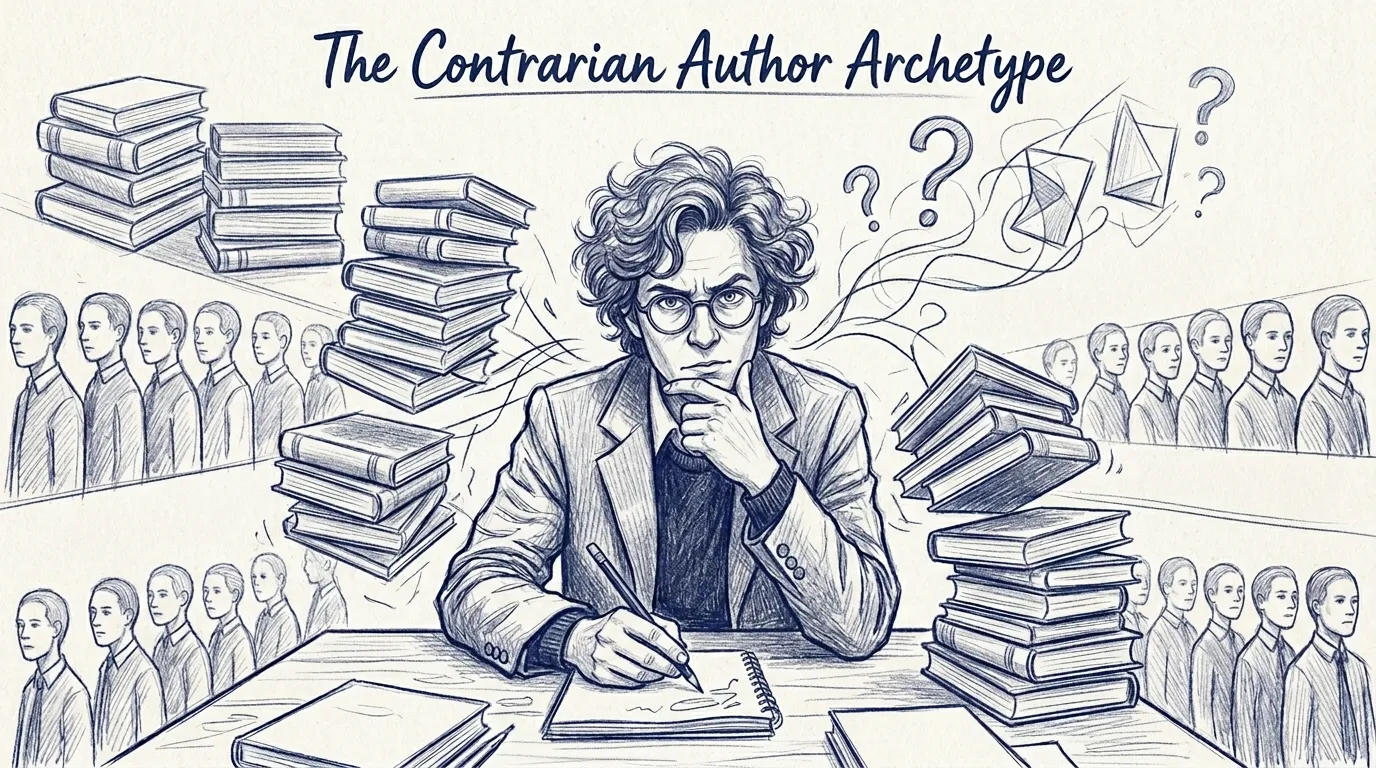
What The Contrarian Does
Core Question: What if everyone is wrong?
The Contrarian archetype is built to resolve market stagnation by challenging entrenched assumptions with rigor, naming what everyone else ignores, and forcing the conversation forward.
Where markets are frozen because everyone agrees on the wrong answer—or because no one is willing to ask the hard questions—the Contrarian names what others ignore, questions what others accept, and forces the conversation forward.
Contrarians are not naysayers. They are not negative for the sake of being negative. They disagree productively—pointing not just at what is wrong, but toward what could be right. They have earned the right to dissent through deep understanding of what they are challenging.
The Contrarian does not reject the consensus because it is popular. The Contrarian challenges the consensus because the evidence does not support it.
7 Ideal Characteristics of The Contrarian
What Makes This Author Archetype Capable of Resolving Market Stagnation
| # | Characteristic | What It Looks Like |
|---|---|---|
| 1 | Intellectual Courage | Willing to say what others are thinking but afraid to voice. Comfortable being the only one in the room with a different view. |
| 2 | Deep Understanding of the Consensus | Knows what they are challenging. Does not dismiss from ignorance. Could make the prevailing argument better than its proponents. |
| 3 | Evidence Orientation | Disagrees on the basis of evidence, not emotion or ego. “I think you are wrong, and here is why” beats “You are wrong.” |
| 4 | Comfort with Unpopularity | Does not need to be liked. Values being right over being popular. Takes the long view. |
| 5 | Productive Disagreement | Does not just criticize. Points toward alternatives. “Here is what is wrong, and here is what we could do instead.” |
| 6 | Pattern Recognition | Sees where the consensus is blind. Spots the assumptions everyone else takes for granted. |
| 7 | Timing Instinct | Knows when to challenge and when to wait. The best Contrarians are early, not wrong. |
Real-Life Example:
Niall Ferguson
Niall Ferguson, the historian, author, and commentator, is a definitive example of The Contrarian archetype in action.
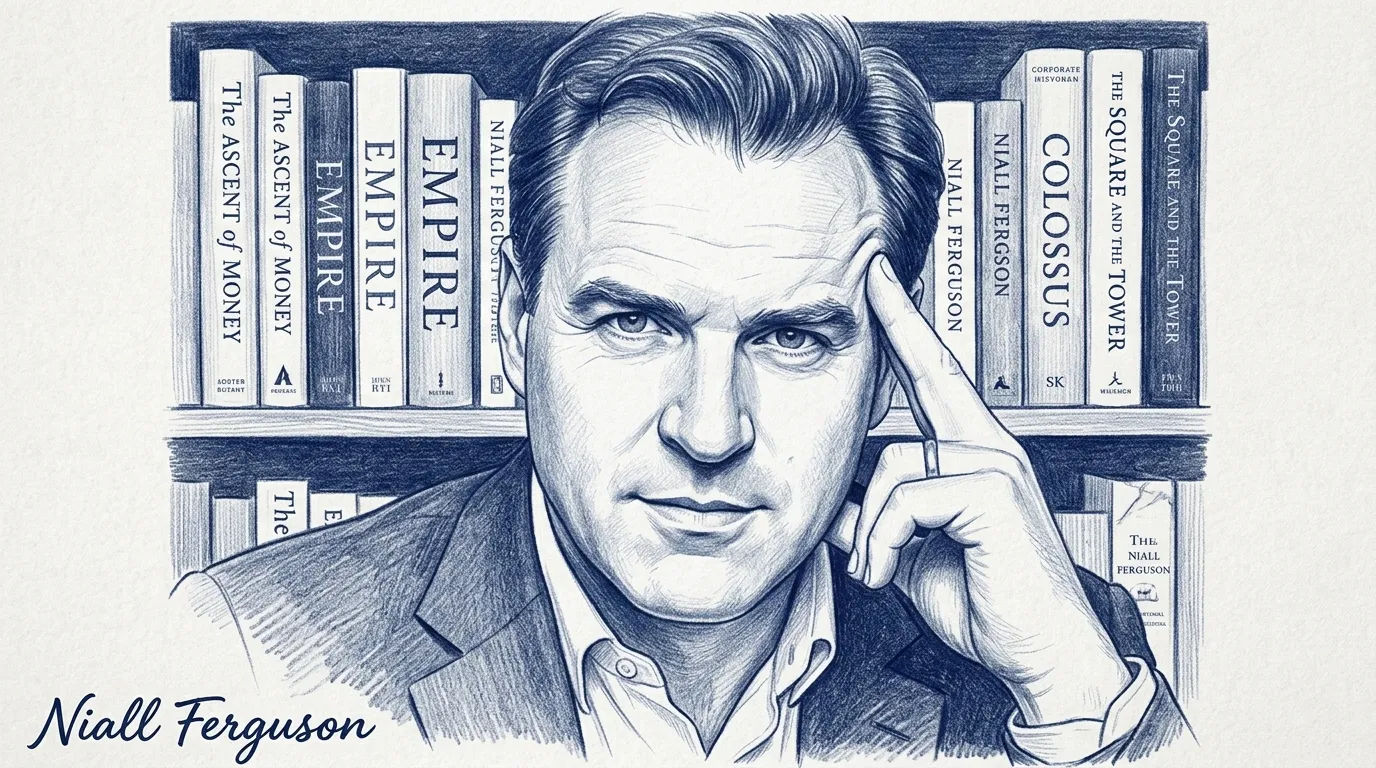
Why does he embody The Contrarian:
| Characteristic | How Niall Ferguson Demonstrates It |
|---|---|
| Intellectual Courage | He has consistently challenged prevailing historical and economic narratives—from the benefits of empire to the risks of debt-fueled growth. He writes what others whisper. |
| Deep Understanding of the Consensus | A chaired professor at Harvard and Stanford, he knows the mainstream arguments intimately. He does not dismiss them; he out-argues them on their own terms. |
| Evidence Orientation | His contrarianism is grounded in archival research and data. He disagrees with evidence, not ideology. His footnotes are as formidable as his prose. |
| Comfort with Unpopularity | He has been called every name in the book. He keeps writing. His sense of being right outweighs his need for approval. |
| Productive Disagreement | He does not just say “you are wrong.” He offers alternative frameworks. The Ascent of Money was a contrarian take on financial history—and a constructive one. |
| Pattern Recognition | He saw the 2008 financial crisis coming when most economists did not. He recognized the pattern of debt, leverage, and hubris from historical study. |
| Timing Instinct | He publishes controversial arguments at moments when they can shift debate—not when they are safe, but when they are needed. |
How Ferguson resolves market stagnation:
When markets are stuck in groupthink on issues like globalization, debt, or the trajectory of China, Ferguson provides the alternative view.
He does not just disagree; he provides a framework for understanding that the consensus has missed.
Stagnation breaks because the conversation cannot continue without addressing his challenges.
The GreenDeveX Insight:
Brands that partner with Contrarians like Niall Ferguson do not need to convince markets that the status quo is broken. The Contrarian has already named the problem.
The brand simply needs to offer the solution.
Other Notable Contrarians for Inspiration
| Contrarian | Domain | Why They Qualify |
|---|---|---|
| Nassim Nicholas Taleb | Risk & Probability | Author of The Black Swan. Challenged the entire financial risk management industry. Argued that we prepare for the last crisis, not the next one. His contrarianism has saved billions. |
| Peter Thiel | Technology & Venture Capital | “Competition is for losers.” Challenged the startup consensus that markets should be contested. Argued for monopolies. Backed Facebook, PayPal, and Palantir when others passed. |
| Rory Sutherland | Advertising & Behavior | Challenged the assumption that logic drives consumer behavior. Made the case for “psycho-logic”—the rational irrationality that actually moves markets. His TED Talks are contrarianism made entertaining. |
| Christopher Hitchens (1949-2011) | Politics & Religion | Challenged every consensus he encountered—from the Iraq War to Mother Teresa to organized religion. Loved argument for its own sake. Disagreed productively until his last breath. |
| Katherine Rundell | Literature & Conservation | A contrarian in a quiet register. Argues that “impossible” conservation goals (reintroducing wolves, restoring ancient forests) are not naive—they are necessary. Challenges the consensus of low ambition. |
| Thomas Sowell | Economics | Challenged economic orthodoxies from the left and the right. Argued that assumptions about race, class, and opportunity were dangerously wrong. Did the work. Cited the data. Was ignored—then vindicated. |
The Market Stagnation Friction
What the friction looks like:
Markets cannot move when everyone agrees on the wrong answer. Groupthink prevails. Assumptions go unchallenged. The status quo persists long after it stops working.
The cost of this friction:
How The Contrarian resolves it:
The Contrarian does not reject the consensus because it is popular. The Contrarian challenges the consensus because the evidence does not support it. Through deep understanding, rigorous evidence, and productive disagreement, the Contrarian forces the conversation forward.
The mechanism: Permission to dissent.
When a Contrarian with credibility challenges the consensus, others feel permission to do the same. The dam breaks. Stagnation ends.
Questions The Contrarian Helps Markets Answer
| # | Question |
|---|---|
| 1 | What if the consensus is wrong? What evidence would tell us? |
| 2 | What assumptions are we making that we have not tested? |
| 3 | What are we ignoring because it is uncomfortable to discuss? |
| 4 | Who benefits from the status quo—and what would they lose if we changed? |
| 5 | What would someone outside our industry see that we are blind to? |
Publishing Formats for The Contrarian
| Format | Why It Works for The Contrarian |
|---|---|
| Provocative Essays | Short-form argument that lands hard. Contrarians distill disagreements into sharable form. |
| Debate Appearances | Live disagreement demonstrates courage. Audiences see the Contrarian hold their ground. |
| Alternative Frameworks | Offers not just criticism but construction. “Here is what we should do instead.” |
| Devil’s Advocate Briefings | Structured disagreement. Forces organizations to consider alternatives. |
| Long-form Articles | Builds the evidence case. Contrarians need space to make the argument properly. |
| Podcast Interviews | Extended conversation allows Contrarians to surface nuance that headlines miss. |
Ideal Industries / Sectors
| Sector | Why The Contrarian Thrives Here |
|---|---|
| Finance & Investment | Consensus is often wrong. Contrarians identify bubbles and opportunities others miss. |
| Technology & Startups | The future is non-consensus. Contrarians see what others dismiss. |
| Policy & Governance | Groupthink is dangerous. Contrarians prevent catastrophic consensus. |
| Healthcare & Medicine | Medical dogma has killed. Contrarians challenge treatment orthodoxies with evidence. |
| Education | Pedagogy is riddled with untested assumptions. Contrarians ask “why do we do it this way?” |
| Corporate Strategy | Strategic drift is real. Contrarians force incumbents to question their assumptions. |
Ideal Brand Partnerships
| Brand Type | Why They Need The Contrarian |
|---|---|
| Incumbents facing disruption | Need someone to tell them the truth about their vulnerability. Contrarians provide the unvarnished view. |
| Challenger brands | Need permission to compete differently. Contrarians validate the alternative approach. |
| Innovation teams | Need air cover to propose uncomfortable ideas. Contrarians normalize dissent. |
| Turnaround situations | The old strategy is failing. Contrarians name why—and point toward what comes next. |
| Research organizations | Need to question their own assumptions. Contrarians prevent intellectual stagnation. |
5 Frequently Asked Questions About The Contrarian
FAQ 01: Is The Contrarian just disagreeable?
No. The best Contrarians are not disagreeable; they are productively different. They do not enjoy conflict for its own sake. They engage in disagreement because they believe the stakes are high and the consensus is wrong. There is a difference between being contrarian and being a contrarian for attention.
FAQ 02: How do you distinguish a valuable Contrarian from a performative one?
Track record. Valuable Contrarians have been right more often than they have been wrong. Performative Contrarians are contrarian about everything, which means they are right and wrong randomly. Look for evidence, not just volume.
FAQ 03: Can The Contrarian also be a Sage?
Yes. Many Sages are also Contrarians. They have earned the right to dissent through deep expertise.
When a Sage says “the consensus is wrong,” people listen because the Sage has demonstrated accuracy over time.
FAQ 04: How does The Contrarian differ from The Antagonist?
The Contrarian challenges assumptions—often from within the conversation.
The Antagonist names truths that markets are actively avoiding—often from outside.
One says “you are thinking incorrectly.” The other says “you are avoiding the real issue.” They are natural partners in breaking stagnation.
FAQ 05: Is a Contrarian always right?
No. Contrarians can be wrong—spectacularly wrong. What distinguishes the valuable Contrarian is not perfect accuracy but the willingness to be judged by evidence. They do not cling to wrong positions out of ego. They update. They learn. They move on.
Example in Action
Scenario:
A legacy media company is losing subscribers. The consensus: “We need better content.” Everyone agrees.
Meetings are about production quality, talent, and distribution.
The Contrarian intervention:
A strategic advisor with a track record of accurate predictions says,
“You are wrong. Your content is fine. Your problem is trust. Audiences do not believe you. Until you solve trust, better content will not matter.”
He presents evidence: declining trust scores, correlation with churn, examples of trust-building competitors.
Outcome:
The company shifts strategy.
It invests in transparency, corrections, and audience engagement. Subscriber churn stabilizes within a year.
The Contrarian was right—and was the only one willing to say the hard thing.
Does your brand need The Contrarian?
If market stagnation is freezing progress, The Contrarian archetype may be your match.
GreenDeveX classifies and connects Contrarians to brands that need fresh thinking and productive dissent.
Your ecosystem transition starts here.
→ Join the Early Access Waitlist
→ Find Your Contrarian Match
Now that you understand The Contrarian, explore The Historian — the archetype that provides context and wisdom from the past to inform the future.
→ Explore All Author Archetypes