
Ecosystem Cluster — Infrastructure & Flow Engine
Thematic Engine: Infrastructure & Flow
Core Question: Why do things exist but not move well?
Primary Frictions: Trust Deficit, Complexity, Risk Perception, Regulatory Navigation, Client Education Gaps
Primary Archetypes: The Economist, The Sage, The Translator
Connected Clusters: Legal Services, Business Services, Manufacturing, Natural Resources, Human Development
How This Cluster Connects to Others
Connection to Legal Services (Trust & Policy):
Every financial transaction requires legal contracts. Banking, investment, and insurance depend on legal clarity. Without Legal Services, Finance cannot operate.
Connection to Natural Resources (Production & Value):
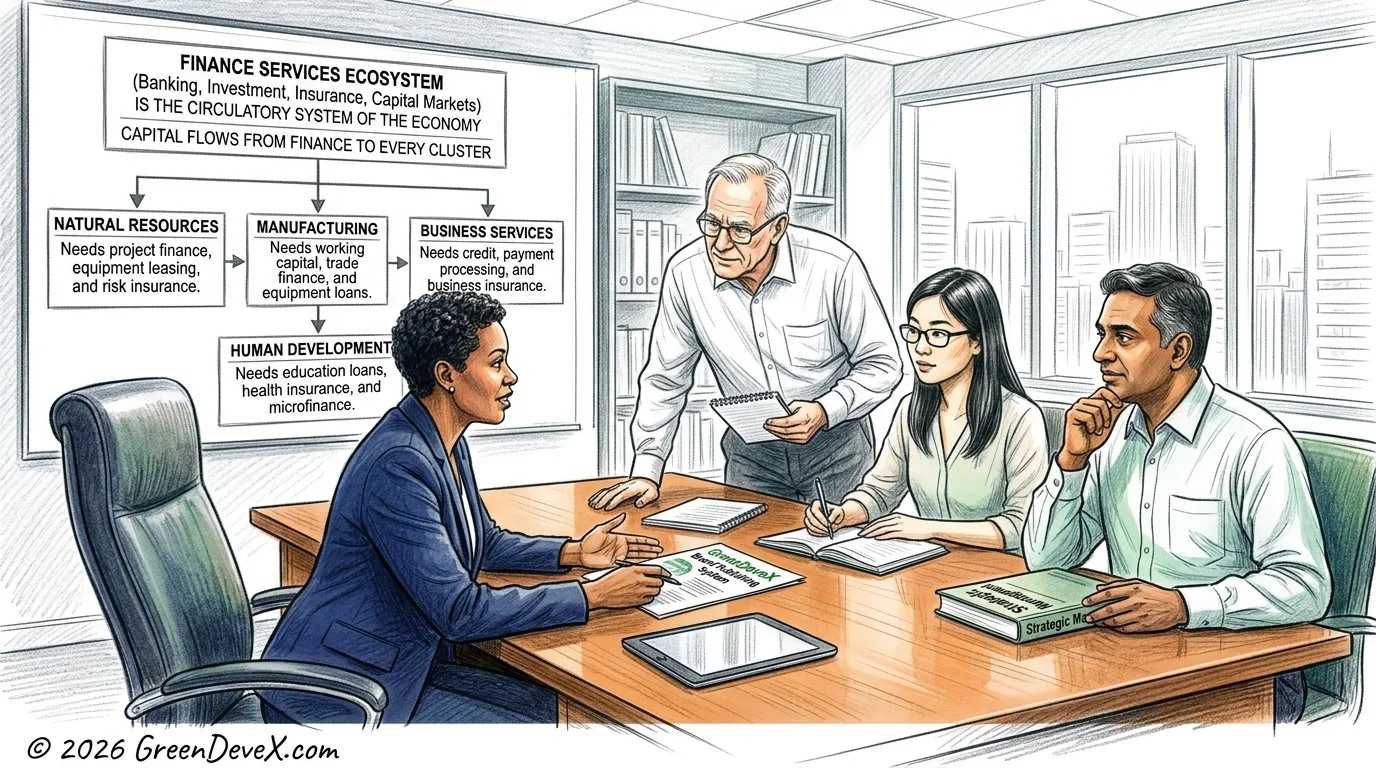
Resource projects require capital. Mining, energy, and agriculture need investment. Finance enables Natural Resources.
Connection to Manufacturing (Production & Value):
Manufacturers need working capital, trade finance, and equipment loans. Finance enables Manufacturing.
Connection to Business Services (Production & Value):
Professional services firms need credit, payment processing, and business insurance. Finance enables Business Services.
Connection to Human Development (Talent & Capability):
Individuals need education loans, health insurance, and mortgages. Finance enables Human Development.
“Finance is not a sector. Finance is the circulatory system of the economy. Capital flows from Finance to every other cluster. Without Finance, nothing moves.”— Victor Isyamba
What Is the Finance Services Ecosystems Cluster?
Finance Services encompasses organizations that manage, deploy, and advise on capital, risk, and financial products. This cluster is the circulatory system that enables every other cluster to function.
This cluster includes:
- Banks (commercial, investment, development)
- Asset managers and investment firms
- Insurance companies (life, health, property, reinsurance)
- Climate finance and green investment
- Private equity and venture capital
- Capital markets (stock exchanges, bond markets)
- Financial advisory and wealth management
- Fintech and digital finance
- Microfinance and inclusive finance
The core challenge: Financial services are built on trust and risk assessment. Both are hard to communicate. Clients cannot easily evaluate expertise before purchase. Differentiation is difficult.
The cluster’s role in the broader economy: Every other cluster — Natural Resources, Manufacturing, Business Services, even Human Development — depends on this cluster for capital, credit, insurance, and payment systems. When Finance Services fails, the entire economy stops.
“You cannot build a factory without capital. You cannot trade goods without payment systems. You cannot manage risk without insurance. Finance is not a sector. It is the infrastructure of every sector.”— Victor Isyamba
Unique Frictions in Finance Services
| # | Friction Type | What It Looks Like | Cost of Inaction |
|---|---|---|---|
| 01 | Trust Deficit | Financial services require high trust, but trust is earned slowly. Clients are skeptical. | Long sales cycles. Extensive due diligence. Lost opportunities to competitors. |
| 02 | Complexity | Financial products are complex. Clients do not fully understand what they are buying. | Misaligned expectations. Client dissatisfaction. Regulatory complaints. |
| 03 | Risk Perception | Clients overestimate or underestimate risk. Their perception does not match reality. | Conservative clients miss opportunities. Aggressive clients take excessive risk. |
| 04 | Regulatory Navigation | Rapidly changing regulations create client anxiety. Your expertise is essential but hard to communicate. | Clients make compliance mistakes. They pay for fixes later. Your preventive value is invisible. |
| 05 | Client Education Gaps | Clients do not understand financial markets, products, or timelines. They expect unrealistic returns. | Unrealistic expectations. Client churn. Reputation damage despite good performance. |
Author Archetypes for Finance Services
| Friction | Primary Archetype | What They Do | Publishing Format |
|---|---|---|---|
| Trust Deficit | The Sage | Demonstrates deep financial wisdom through authoritative market commentary | Market Outlooks, Investment Philosophy Papers |
| Complexity | The Translator | Makes complex financial products accessible to non-expert clients | Client Guides, Plain Language Product Explanations |
| Risk Perception | The Economist | Maps incentives, models scenarios, and communicates risk clearly | Risk Assessments, Scenario Analyses |
| Regulatory Navigation | The Field Guide | Provides step-by-step guidance through complex compliance requirements | Compliance Checklists, Regulatory Alerts |
| Client Education | The Investigator | Builds transparency through clear reporting and performance data | Client Reports, Fee Transparency Documents |
| Market Direction | The Futurist | Provides credible, evidence-based market forecasts | Annual Market Forecasts, Sector Outlooks |
Publishing Formats for Finance Services
| Format | Purpose | Example | Operating Model |
|---|---|---|---|
| Market Outlooks | Build confidence through authoritative market commentary | “Global Investment Outlook 2025: Opportunities and Risks” | Fractional Publishing (quarterly series) |
| Client Guides | Make complex products accessible to non-expert clients | “The Private Equity Guide for Family Offices” | Co-Creating (signature guide) |
| Investment Philosophy Papers | Articulate your firm’s unique approach to investing | “Our Approach to Sustainable Investing: Principles and Practice” | Co-Creating (signature asset) |
| Risk Assessments | Communicate risk clearly to clients and prospects | “Climate Risk Scenarios for African Infrastructure Portfolios” | Co-Creating (shared IP with clients) |
| Regulatory Alerts | Keep clients informed of compliance requirements | “Immediate Action: New ESG Disclosure Rules Take Effect” | Fractional Publishing (ongoing retainer) |
| Client Reports | Build transparency through clear, accessible reporting | “Quarterly Impact Report: Aligning Returns with Values” | Rent-and-Rank Narrative (placement in client portals) |
| Fee Transparency Documents | Differentiate through honest communication about costs | “Understanding Our Fees: A Client Guide to Value and Cost” | Co-Creating (signature asset) |
Success Markers for Finance Services
| Marker | What It Looks Like |
|---|---|
| Trusted Advisor Status | Clients consult you before making major financial decisions. You are part of their decision process, not just an executor. |
| Shorter Sales Cycles | Prospects arrive pre-educated. Your first conversation is about their goals, not your credentials. |
| Premium Fee Justification | You can command higher fees because clients recognize your unique intellectual value. |
| Client Retention | Clients renew because they value your insights, not just your performance. |
| Asset Growth | Capital flows to you because your published thinking builds confidence. |
| Sector Reference Status | Media calls you for comment. Regulators consult you. Competitors cite your frameworks. |
Case Example
Organization: A climate-focused investment advisory firm
Primary Friction: Trust Deficit + Complexity
GreenDeveX Approach:
- Matched The Sage to publish quarterly Climate Investment Outlook
- Matched The Translator to create client guides on carbon markets
- Matched The Investigator to build transparent impact reporting
Outcome:
- $100M in new assets under management within 12 months
- Featured in three major financial publications
- Successfully launched a new climate fund at premium fee structure
- Clients cited published insights as reason for selection
How This Cluster Uses the Three Operating Models
| Operating Model | Application for Finance Services |
|---|---|
| Co-Creating Model | A Sage author co-creates a signature Investment Philosophy Paper with your firm. The paper carries both names. Clients trust it because the author’s credibility transfers. Example: Investment Philosophies: Successful Strategies–NYU Stern |
| Fractional Publishing Model | Engage an Economist author on retainer to produce monthly Market Outlooks and quarterly Risk Assessments. Consistent communication keeps clients informed and engaged. |
| Rent-and-Rank Narrative Model | Place Client Guides and Fee Transparency Documents within existing financial platforms (e.g., bank portals, investment platforms, industry associations). Immediate visibility within trusted financial ecosystems. |
→ Find Your Author Archetype Match
Interlinking to Related Clusters
| Related Cluster | Why They Connect |
|---|---|
| Legal Services Ecosystems | Every financial transaction requires legal contracts. Banking, investment, and insurance depend on legal clarity. Finance depends on Trust & Policy. |
| Natural Resources Systems | Resource projects require capital. Mining, energy, and agriculture need investment. Finance enables Production & Value. |
| Manufacturing Ecosystems | Manufacturers need working capital, trade finance, and equipment loans. Finance enables Production & Value. |
| Business Services Ecosystems | Professional services firms need credit, payment processing, and business insurance. Finance enables Production & Value. |
| Human Development Systems | Individuals need education loans, health insurance, and mortgages. Finance enables Talent & Capability. |
Thematic Engine Connection: Infrastructure & Flow
Finance Services Ecosystems is the anchor cluster within the Infrastructure & Flow Engine.
| Engine Question | How This Cluster Answers It |
|---|---|
| “Why do things exist but not move well?” | Because capital is the lubricant of the economy. Without trust, clarity, and risk transparency, capital does not flow. Projects stall. Transactions freeze. |
| “What is the Interpretation Gap?” | Clients do not understand financial products. They do not trust financial institutions. They cannot assess risk. Capital is trapped. |
| “How does GreenDeveX close the gap?” | Through Economists (incentive clarity), Sages (credibility), and Translators (accessibility). Make products understandable. Build trust through transparency. Communicate risk clearly. Unlock capital flow. |
“The Infrastructure & Flow Engine is only as strong as its Finance Services cluster. Without capital, nothing moves. Without trust, capital does not flow.”— Victor Isyamba
Ready to build trust and unlock capital flow?
Map your friction, match your authors, and deploy through the right operating model.
→ Start Your Ecosystem Journey
→ Natural Resources Systems (Production & Value Engine) →
→ Legal Services Ecosystems (Trust & Policy Engine) →
→ Business Services Ecosystems (Production & Value Engine) →
Next Recommended Step
Now that you understand Finance Services Ecosystems, explore how Legal Services Ecosystems provides the legal infrastructure that every financial transaction depends on.