
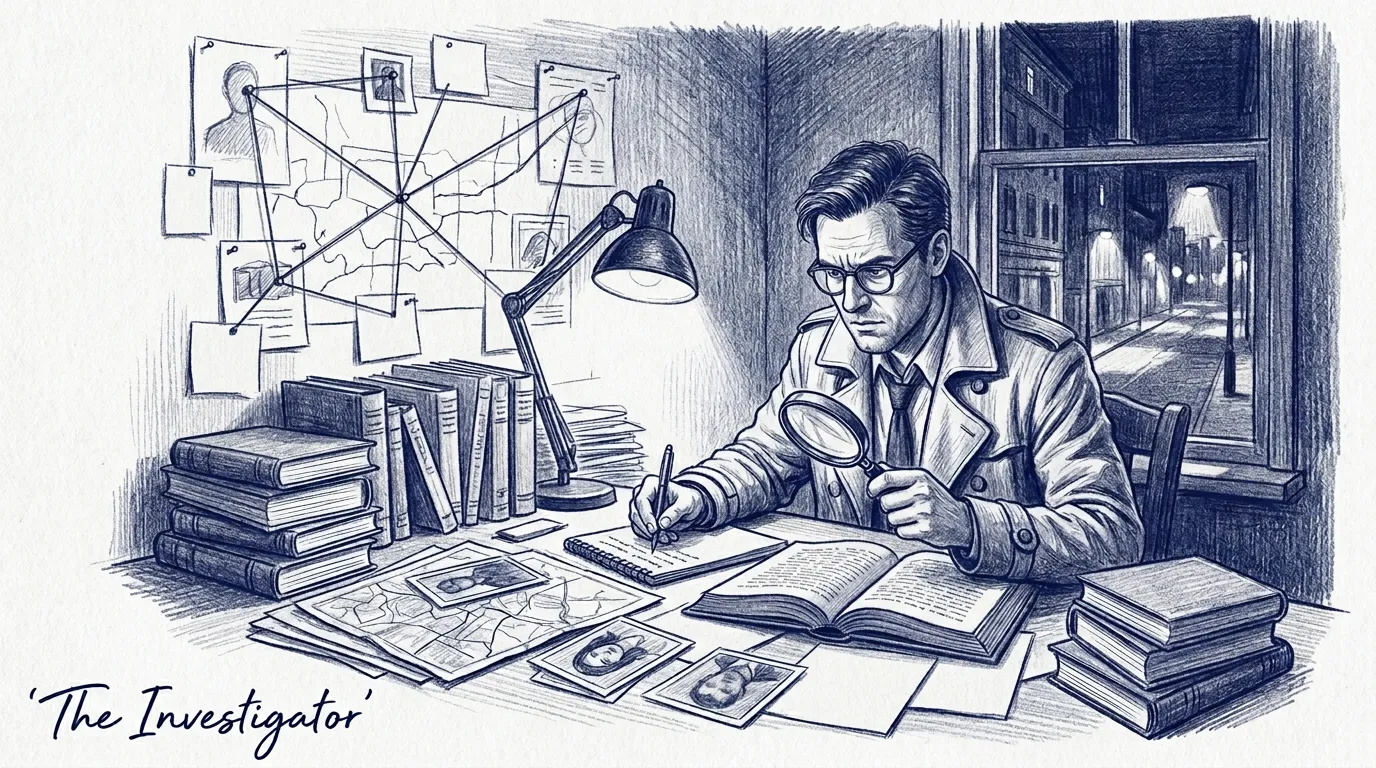
What The Investigator Does
Core Question: What is really happening?
The Investigator archetype is built to resolve market opacity by surfacing hidden information, verifying claims, and building the transparency that trust requires.
Where markets are paralyzed because information is incomplete, hidden, or actively suppressed, the Investigator uncovers what others cannot or will not see.
Investigators are not cynics. They are not conspiracy theorists. They do not assume bad faith. They assume that information is often incomplete—and that completeness requires disciplined inquiry.
They verify what others assert. They document what others obscure.
The Investigator does not assume bad intentions. The Investigator assumes that transparency is the only foundation for trust.
7 Ideal Characteristics of The Investigator
What Makes This Author Archetype Capable of Resolving Market Opacity
| # | Characteristic | What It Looks Like |
|---|---|---|
| 1 | Healthy Skepticism | Questions assertions without assuming bad faith. Demands evidence. Does not take “because I said so” as an answer. |
| 2 | Evidence Orientation | Believes what can be demonstrated. Distinguishes between claims and proof. Insists on verification. |
| 3 | Methodological Discipline | Follows a process. Does not jump to conclusions. Builds cases brick by brick. |
| 4 | Detail Instinct | Notices inconsistencies that others miss. Spots the gap in the story, the missing data point, the unexplained anomaly. |
| 5 | Comfort with Unpopularity | Willing to surface truths that powerful actors want hidden. Understands that transparency is not always welcomed. |
| 6 | Documentation Obsession | Keeps records. Saves sources. Builds files that can withstand scrutiny. |
| 7 | Commitment to Fairness | Seeks truth, not victory. Willing to be wrong. Updates conclusions when evidence changes. |
Real-Life Example:
Ida B. Wells
Ida B. Wells (1862-1931), the investigative journalist, civil rights activist, and suffragist, is a definitive example of The Investigator archetype in action.
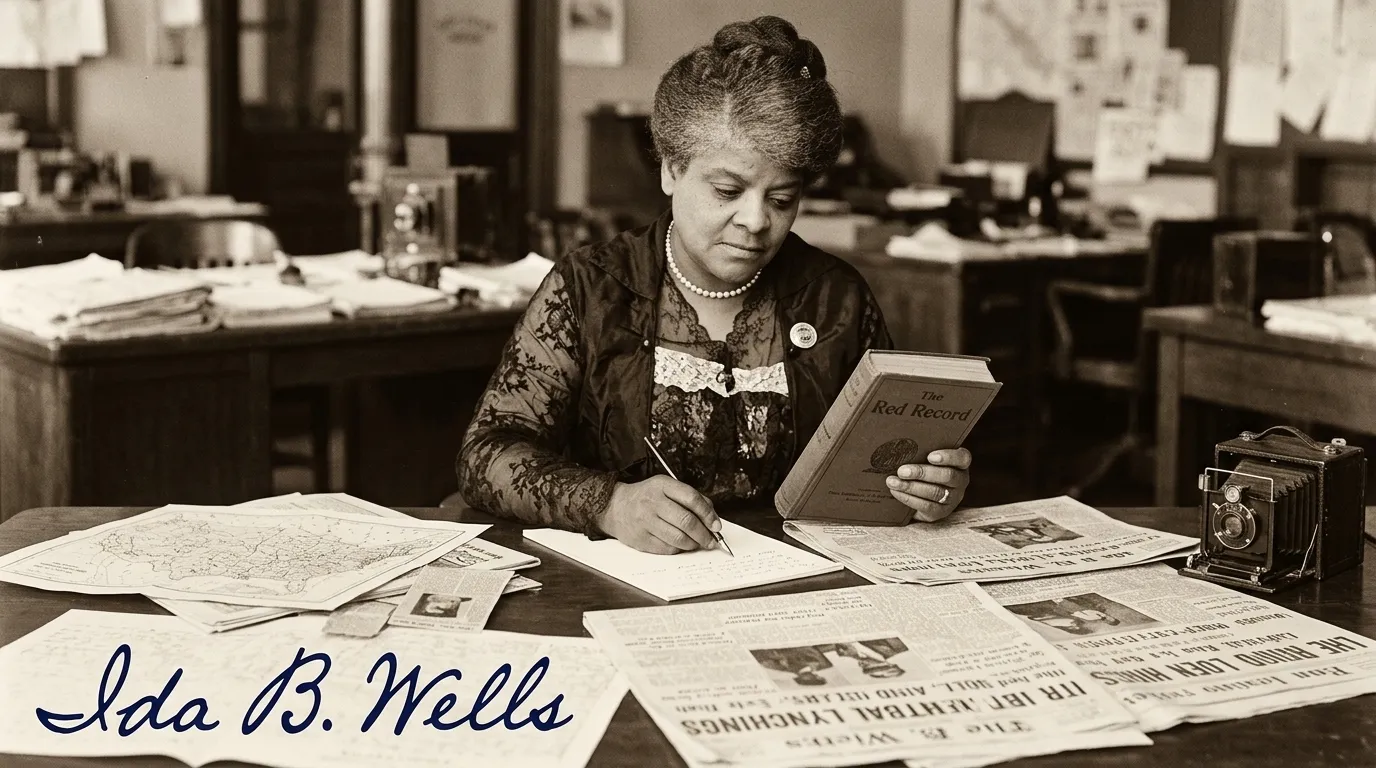
Why does she embody The Investigator:
| Characteristic | How Ida B. Wells Demonstrates It |
|---|---|
| Healthy Skepticism | She questioned the official narratives about lynching in the post-Reconstruction South. She did not accept what the authorities claimed. She investigated for herself. |
| Evidence Orientation | She did not just assert that lynching was motivated by racial terror rather than crime. She collected data. She traveled to lynching sites, interviewed witnesses, and compiled statistics that proved her case [citation:11]. |
| Methodological Discipline | Her research methods were systematic. She documented each lynching: date, location, victim, alleged offense, actual circumstances. Her pamphlets were data-driven before data-driven was a phrase. |
| Detail Instinct | She noticed the pattern that others missed—that lynching did not follow crime rates, that it spiked during election seasons, that it was a tool of political terror, not justice. |
| Comfort with Unpopularity | She was threatened, harassed, and driven from her home in Memphis after publishing her findings. She did not stop. She continued her investigation from elsewhere. |
| Documentation Obsession | She kept meticulous records. Her pamphlet Southern Horrors: Lynch Law in All Its Phases (1892) and her posthumously published The Red Record (1895) are models of investigative documentation. |
| Commitment to Fairness | She sought truth, not vengeance. She documented lynchings of Black men accused of crimes against white women—and also documented cases where consensual relationships were misrepresented as assault. The truth, not a narrative. |
Note on historical accuracy: The Ida B. Wells narrative above is synthesized from general historical knowledge of her investigative work. For comprehensive scholarly documentation of her methods and findings, please consult academic sources on her work, including her original pamphlets Southern Horrors (1892) and The Red Record (1895), as well as scholarly biographies
How Wells resolves Market Opacity:
Before Wells, lynching was publicly justified as justice for crime. Wells investigated. She found that most victims had not been accused of any crime; that “crimes” were often minor infractions or consensual relationships; that lynching was terror, not justice.
She surfaced hidden truth. The national and international conversation changed forever.
The GreenDeveX Insight:
Brands that partner with Investigators like Ida B. Wells do not need to ask for trust. They earn it through demonstrated transparency.
The Investigator’s verification becomes the brand’s credibility.
Other Notable Investigator Author Archetypes for Inspiration
| Investigator | Domain | Why They Qualify |
|---|---|---|
| Bob Woodward & Carl Bernstein | Journalism | Investigated the Watergate break-in when everyone else accepted the official story. Their documentation brought down a presidency. |
| Edward Tufte | Data Visualization | Investigated how information is presented—and distorted. His work on visual evidence has transformed how we understand data transparency. |
| Catherine B. So | Community Transparency | Investigated how communities can self-govern with transparency. Her frameworks for community accountability are models of distributed investigation. |
| Julia Angwin | Technology & Privacy | Investigated how algorithms make decisions about people—and how those decisions are hidden. Her work at The Markup is investigative journalism for the algorithmic age. |
| Carole Cadwalladr | Tech & Democracy | Investigated the Cambridge Analytica scandal. Her reporting surfaced hidden links between data harvesting, political manipulation, and democratic subversion. |
| W.E.B. Du Bois (1868-1963) | Sociology & Race | Investigated Black life in America through data. His exhibits at the 1900 Paris Exposition used charts, graphs, and photographs to make visible what white America ignored. |
The Market Opacity Friction
What the friction looks like:
Markets cannot move when the truth is hidden. Information is suppressed. Data is incomplete. Stakeholders cannot see what is really happening. Claims are made without evidence.
Assertions stand in for proof.
The cost of this friction:
How The Investigator resolves it:
The Investigator does not assume bad intentions.
The Investigator assumes that transparency is the only foundation for trust.
Through disciplined inquiry, evidence collection, and documentation, the Investigator surfaces hidden information and verifies claims.
The mechanism: Verification transfer.
The Investigator does the hard work of verification so that others do not need to. Their documented evidence becomes the market’s shared reality.
Questions The Investigator Helps Markets Answer
| # | Question |
|---|---|
| 1 | What is actually happening beneath the surface? What is being hidden? |
| 2 | Can we verify the claims being made? What evidence exists? |
| 3 | Who benefits from opacity? Who does not want us to see clearly? |
| 4 | What patterns emerge when we look at the complete data? |
| 5 | How can we build systems that make transparency automatic, not optional? |
Publishing Formats for The Investigator
| Format | Why It Works for The Investigator |
|---|---|
| Investigative Reports | The classic format. Documents what was found, how it was found, and what it means. |
| Data Visualizations | Makes hidden patterns visible. A chart can reveal what paragraphs cannot. |
| Audit Documents | Systematic verification. The Investigator’s methodology becomes the standard. |
| Transparency Frameworks | Builds systems for ongoing investigation. Teaches others how to see. |
| Whistleblower Platforms | Creates channels for hidden information to surface safely. |
| Evidence Briefs | Curates what is known with certainty—and distinguishes it from what is still unknown. |
Ideal Industries / Sectors
| Sector | Why The Investigator Thrives Here |
|---|---|
| Finance & Investment | Opacity is costly. Investigators surface hidden risks and verify claims. |
| Journalism & Media | Truth is the product. Investigators produce it. |
| Nonprofit & Social Impact | Impact claims need verification. Investigators document what actually happened. |
| Healthcare & Medicine | Clinical trials, outcomes data, and adverse events need independent verification. |
| Legal & Regulatory | Justice requires evidence. Investigators gather it. |
| Technology & Privacy | Algorithms make hidden decisions. Investigators surface how they work. |
Ideal Brand Partnerships
| Brand Type | Why They Need The Investigator |
|---|---|
| Investment firms | Need to verify claims before deploying capital. Investigators do the due diligence. |
| Nonprofits seeking donations | Donors demand impact verification. Investigators document outcomes. |
| Ethical brands | Need to prove their claims—and distinguish themselves from greenwashers. Investigators provide verification. |
| Regulatory bodies | Need to investigate violations. Investigators build the evidence base. |
| Consumer protection organizations | Need to surface hidden harms. Investigators do the uncovering. |
5 Frequently Asked Questions About The Investigator
FAQ 01: How does The Investigator differ from a skeptic?
Skeptics doubt. Investigators verify. Skepticism can be passive—simply not believing. Investigation is active—finding out what is true.
The Investigator moves from “I doubt” to “let me find out.”
FAQ 02: Can The Investigator also be a Curator?
Yes. The Curator filters signal from noise.
The Investigator verifies that the signal is true.
They are natural partners.
The Curator says, “Pay attention to this.”
The Investigator says, “You can trust this.”
FAQ 03: Is The Investigator always adversarial?
No. The Investigator can work collaboratively. Organizations seeking transparency can hire Investigators to verify their own claims—to build trust proactively. Investigation is not always oppositional; it can be a gift.
FAQ 04: Does The Investigator need formal credentials?
No. Credentials can help, but many great Investigators lack formal investigative training.
What matters: methodology, evidence discipline, commitment to verification, and track record of accuracy.
.
FAQ 05: Is The Investigator just a journalist or auditor?
Investigators can work in any field. Journalism is one domain. Auditing is another. Due diligence is another. The archetype transcends profession. What unites Investigators is commitment to transparency through evidence, regardless of sector.
Example in Action
Scenario:
An investment firm is considering a large investment in a renewable energy project.
The project sponsor makes confident claims: permits secured, technology proven, offtake agreements signed.
The firm is skeptical but cannot prove the skepticism.
The Investigator intervention:
The Investigator spends six weeks on due diligence. They visit the project site. They interview permit officers (not just the permit holders).
Outcome:
The investment firm does not invest. Six months later, the project collapses. The firm saved millions.
The Investigator’s verification was the difference between confidence and catastrophe.
Does your brand need The Investigator?
If market opacity is hiding risks or preventing trust, The Investigator archetype may be your match.
GreenDeveX classifies and connects Investigators to brands that need transparency and verification.
Your ecosystem transition starts here.
→ Join the Early Access Waitlist
→ Find Your Operator Match
Now that you understand The Investigator, explore The Operator — the archetype that creates systems for scaling implementation.
→ Explore All Author Archetypes