
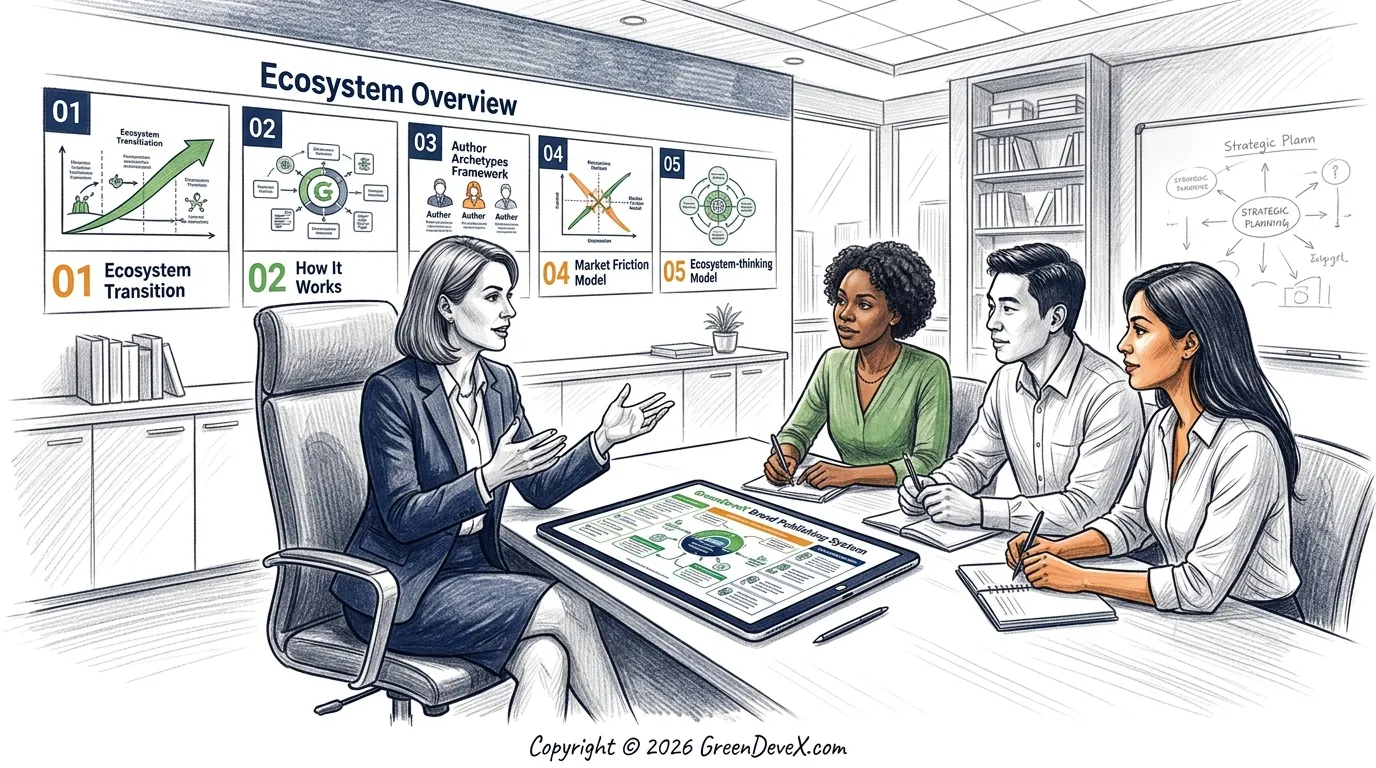
Dashboard to the GreenDeveX Operating System
GreenDeveX is a Brand Publishing Operating System. We deploy 18 Author Archetypes as structural levers to eliminate market friction. We move brands from loud advertisers to permanent market infrastructure.
| Section | Jump to |
|---|---|
| The Operating System | ↓ Overview |
| Market Friction Diagnostic | ↓ Friction |
| 18 Author Archetypes | ↓ Archetypes |
| 5 Performance Engines | ↓ Engines |
| Editorial Opportunity Matrix | ↓ Matrix |
| Onboarding | ↓ Onboarding |
The Operating System
Value flows through 5 Economic Points. Friction blocks value at each point. This is the Interpretation Gap.
| Economic Point | What Happens Here |
|---|---|
| Creation | Ideas are born. R&D happens. |
| Distribution | Value is packaged and positioned. |
| Exchange | Trust enables transaction. |
| Consumption | Adoption and behaviour change. |
| Preservation | Retention and asset compounding. |
The OS Flow:
5 Economic Points → 10 Ecosystem Clusters → 18 Author Archetypes → 5 Performance Engines
Market Friction Diagnostic
Select your primary organizational bottleneck. Our Friction Intelligence Engines will deploy the exact author levers required to clear the block.
| Interpretation Gap | What You Experience | Intelligence Engine | Author Levers |
|---|---|---|---|
| Trust Deficit | Customers hesitate. Deals stall. | Trust Intelligence | The Sage, The Evangelist, The Historian |
| Implementation Fear | Customers love ideas but cannot execute. | Adoption Intelligence | The Field Guide, The Translator, The Operator |
| Audience Disconnection | Your message lands flat. | Influence Intelligence | The Storyteller, The Community Builder, The Investigator |
| Horizon Blindness | Markets cannot see what comes next. | Market Intelligence | The Futurist, The Curator, The Cultural Decoder, The Economist |
| Category Sameness | No one can tell you apart. | Positioning Intelligence | The Contrarian, The Philosopher, The Antagonist |
| Ecosystem Fragmentation | Stakeholders are disconnected. | Ecosystem Intelligence | The Cartographer, The Diplomat |
18 Author Archetypes
Each archetype is a structural lever that destroys a specific market friction.
| # | Archetype | Destroys This Friction | Economic Point |
|---|---|---|---|
| 01 | The Sage | Trust Deficit | Exchange |
| 02 | The Field Guide | Execution Gap | Consumption |
| 03 | The Futurist | Future Uncertainty | Preservation |
| 04 | The Translator | Complexity | Distribution |
| 05 | The Storyteller | Low Engagement | Distribution |
| 06 | The Evangelist | Skepticism | Exchange |
| 07 | The Contrarian | Market Stagnation | Creation |
| 08 | The Historian | Historical Blindness | Preservation |
| 09 | The Curator | Information Overload | Preservation |
| 10 | The Community Builder | Isolation | Consumption |
| 11 | The Investigator | Opacity | Creation |
| 12 | The Operator | Operational Complexity | Consumption |
| 13 | The Cultural Decoder | Cultural Blindness | Distribution |
| 14 | The Economist | Economic Complexity | Exchange |
| 15 | The Philosopher | Moral Uncertainty | Creation |
| 16 | The Cartographer | Fragmentation | Consumption |
| 17 | The Diplomat | Misalignment | Exchange |
| 18 | The Antagonist | Complacency | Creation |
5 Performance Engines
Each engine governs a layer of economic performance.
| Engine | Function | Primary Friction | Key Archetypes |
|---|---|---|---|
| Trust & Policy | Legal clarity, institutional credibility | Trust Deficit, Regulatory Complexity | The Sage, The Diplomat, The Investigator |
| Infrastructure & Flow | Capital movement, payment systems | Financial Friction | The Cartographer, The Economist, The Operator |
| Talent & Capability | Skills, education, workforce | Skills-Opportunity Gap | The Storyteller, The Philosopher, The Community Builder |
| Production & Value | Operations, quality, innovation | Operational Complexity | The Operator, The Economist, The Futurist |
| Identity & Influence | Narrative, media, culture | Narrative Fragmentation | The Cultural Decoder, The Storyteller, The Curator |
Editorial Opportunity Matrix
12 Commercial Information Assets by Archetype
| Asset Class | Archetypes | Commercial Format |
|---|---|---|
| Authority Anchor | Sage, Historian, Investigator | Whitepapers, Standards, Audits |
| Framework Builder | Field Guide, Operator, Cartographer | Playbooks, Manuals, Maps |
| Clarity Engine | Translator, Curator, Cultural Decoder | Guides, Briefings, Roundups |
| Narrative Architect | Storyteller, Contrarian, Evangelist, Antagonist | Case Studies, Manifestos, Briefs |
| Alignment Architect | Diplomat, Philosopher, Economist, Futurist | Frameworks, Models, Forecasts |
| Community Catalyst | Community Builder | Playbooks, Guides, Frameworks |
Onboarding
Gate A: For Enterprise Brands
Secure Your Infrastructure Status
Stop buying vanity advertising. Deploy publishing assets that permanently alter how your economic cluster transacts.
→ Onboard Your Brand
Gate B: For Domain Experts & Authors
Become an Economic Lever
Apply your specialized domain mastery to heal global structural bottlenecks.
→ Apply as an Archetype
Get in Touch
Email: info@greendevex.comPhone: (254) 798 3861 37
Who This Overview Is For
You are ready for the Ecosystem Transition if:
What You Gain
| Benefit | What It Means |
|---|---|
| Lower CAC | Prospects arrive pre-educated |
| Shorter sales cycles | Less explanation, more closing |
| Premium pricing | Trust reduces price sensitivity |
| Competitive moat | Reference status cannot be copied |
| Predictable growth | Assets work consistently, not sporadically |
| Durable authority | Influence compounds over time |
Ready to start your Ecosystem Transition?
Explore the full Ecosystem Transition model and begin your journey from category leader to market shaper.
→ Explore Ecosystem Transition
Or dive deeper into a specific subpage:
→ How It Works
→ Author Archetypes Framework
→ Market Friction Model
→ Ecosystem-thinking Model