
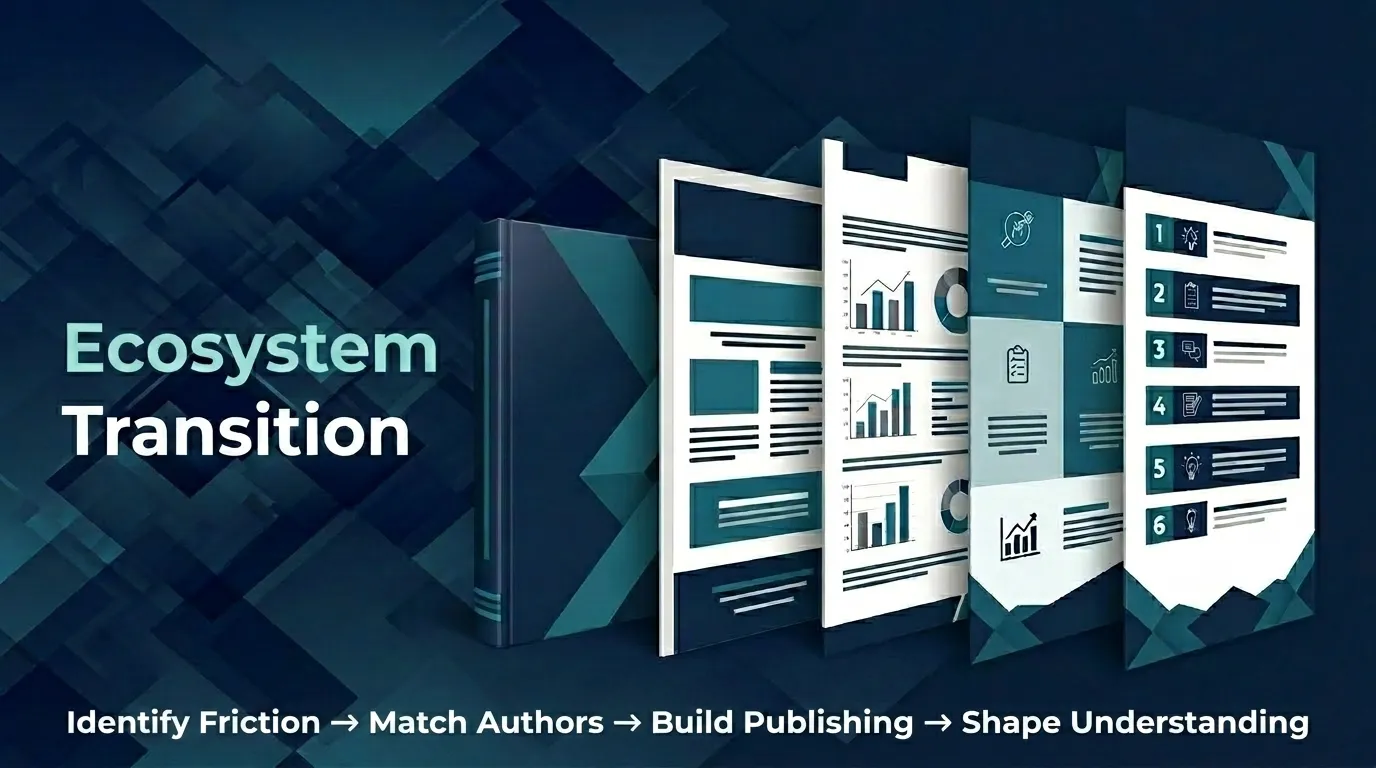
Ecosystem Transition helps brands move from attention-seeking to understanding-building. Four steps. 18 archetypes. Compound authority.
Most organizations compete for market share within a category they already understand.
A smaller number actively reshape how their category — and the ecosystem around it — thinks, decides, and moves.
The Ecosystem Transition is the infrastructure that makes the second path possible.
The Mindset Shift
Why Market-Shaping Brands Think Differently
“Most brands ask: how do we get more attention? Market-shaping brands ask: how do we help the market understand?”
That single question reframes everything.
It shifts the strategy from visibility-seeking to understanding-building — and the compounding effects are fundamentally different.
| Category-Leader Thinking | Market-Shaper Thinking |
|---|---|
| Optimize for attention — more reach, more impressions, more clicks | Build understanding — help the ecosystem interpret, trust, and decide faster |
| Campaigns and content volume — activity is the metric | Publishing infrastructure — systems that compound without constant input |
| Authority stays transactional — influence resets each cycle | Authority compounds — each asset builds on the last |
| Friction is a sales problem — addressed downstream, not upstream | Friction is a system problem — mapped and removed structurally, upstream |
Brands that invest in being visible must keep investing to stay visible.
Brands that invest in being understood build compounding authority that reduces friction over time, lowers acquisition costs, and creates durable market trust.
Why GreenDeveX Exists
Two Gaps. One Platform.
Brands produce output. Authors produce ideas. Yet markets often take too long to understand either.
GreenDeveX exists to close that gap — structurally, not incidentally.
The Brand Gap
Brands produce output. Markets still don’t understand them fast enough.
The result: Slow decisions, delayed partnerships, higher acquisition costs, and missed stakeholder alignment.
The fix: Interpretation infrastructure, not more output.
→ Fix interpretation before scaling visibility
The Author Gap
Authors produce ideas. Markets still don’t convert them into durable authority fast enough.
Influence stays shallow — audience-dependent rather than ecosystem-embedded.
The fix: Author classification and publishing infrastructure, not more content.
→ Build authority systems, not content volume
The Timing Problem
Even excellent brands and exceptional authors experience delayed market traction.
Not because they lack quality, but because understanding arrives too late — after the investor meeting, after the policy window, after the consumer decision moment.
→ When trust arrives earlier, opportunities move faster
The Four-Step Model
Different stages require different systems. Each step builds on the last to move a brand from friction-burdened category leader to compounding market shaper.
| Step | Action | Outcome |
|---|---|---|
| 01 | Identify Friction — Map what slows the market | A precise friction map telling you which market questions remain unanswered |
| 02 | Match Authors — Classify the right archetypes | A matched author ecosystem — each archetype deployed against its specific friction |
| 03 | Build Publishing — Create the infrastructure | A publishing layer that converts author intelligence into accessible understanding |
| 04 | Shape Understanding — Deploy for market authority | A market that understands your value before you need to explain it |
Step One: Identify the Market Friction
Every market has forces that slow its ability to understand, trust, and adopt.
Before building anything, GreenDeveX maps the specific frictions that are costing your brand velocity — not generic challenges, but the precise interpretation gaps your market faces.
What you do:
Step Outcome: A precise friction map that tells you which market questions remain unanswered and why growth is slower than it should be.
Step Two: Match the Right Author Archetypes
Not every author addresses every friction.
GreenDeveX’s 18-archetype classification framework maps each author type to the specific market questions they are built to answer. The match between friction and archetype is the engine of the ecosystem.
What you do:
- Classify authors against the 18-archetype framework
- Match archetype capabilities to identified frictions
- Assess ecosystem fit: industry, audience, publishing format
- Build a curated author shortlist for each friction layer
Step Outcome: A matched author ecosystem — each archetype deployed against the specific friction it was designed to resolve.
Step Three: Build the Publishing Assets
Understanding travels through formats.
GreenDeveX designs the publishing infrastructure — the intellectual property, assets, and distribution systems — that carry author intelligence to the specific decision-makers your market needs to move.
What you build:
- Research reports and field guides
- Ecosystem maps and intelligence briefings
- Executive interview series and thought leadership content
- Author network publishing and distribution architecture
Step Outcome: A publishing layer that converts author intelligence into accessible, decision-ready market understanding — systematically, not sporadically.
→ Explore Publishing Infrastructure
Step Four: Shape Market Understanding
When the right author ecosystem is deployed through the right publishing infrastructure, influence compounds.
Each asset reinforces the next. Stakeholders begin to associate your brand with understanding, not just products, and market decisions accelerate.
What you do:
Step Outcome: A market that understands your value before you need to explain it — and an authority position that becomes harder to displace over time.
Who Qualifies
Is the Ecosystem Transition Right for You?
For Market-Shaping Brands
You are ready for the Ecosystem Transition if your brand has outgrown visibility and is ready to build the infrastructure for compound authority.
- You have a clear market position, but the market doesn’t fully understand your value yet
- Growth slows when marketing activity slows — you lack a compounding system
- Investors, partners, or customers take longer to trust your story than the evidence warrants
- You want to shape how the market thinks, not just respond to how it currently does
- You are ready to invest in publishing infrastructure as a long-term authority asset
For Market-Moving Authors
You are ready for the Ecosystem Transition if you have domain expertise, a clear point of view, and a desire to connect your knowledge to ecosystem-level outcomes.
- You have deep expertise in one or more of the five ecosystem domains
- Your influence feels limited to your existing audience — not yet ecosystem-embedded
- You want brand partnerships that align with your intellectual positioning, not just your platform size
- You want to be classified — to understand which archetype you are and how to build on that
- You want your knowledge to drive market outcomes, not just personal brand metrics
Author Classification System
The 18 Author Archetypes
Every market question has an author archetype designed to answer it. The 18-archetype framework is the intelligence layer at the heart of every Ecosystem Transition.
Trust Intelligence
Trust reduces acquisition costs, increases conversion rates, and improves stakeholder confidence.
| Archetype | Solves | Inspiring Example |
|---|---|---|
| Sage | Trust Deficit | Oprah Winfrey |
| Historian | Short-Term Thinking | David McCullough (1933-2022) |
| Investigator | Public Skepticism | Ida B. Wells (1862-1931 |
Adoption Intelligence
Adoption determines whether ideas, products, and systems become useful.
| Archetype | Solves | Inspiring Example |
|---|---|---|
| Field Guide | Implementation Fear | Mike Rowe |
| Translator | Complexity | Neil deGrasse Tyson |
| Operator | Execution Waste | Frances Frei |
Influence Intelligence
Influence shapes loyalty, retention, memory, and participation.
| Archetype | Solves | Inspiring Example |
|---|---|---|
| Storyteller | Emotional Distance | Maya Angelou (1928-2014) |
| Evangelist | Weak Loyalty | Tony Robbins |
| Community Builder | Isolation | Priya Parker |
Market Intelligence
Markets change before most organizations notice.
These archetypes help brands understand what is happening.
| Archetype | Solves | Inspiring Example |
|---|---|---|
| Futurist | Fear of Irrelevance | James Cameron |
| Cultural Decoder | Cultural Disconnect | Chimama Ngozi |
| Economist | Market Misunderstanding | Michael Lewis |
| Curator | Information Overload | Maria Popova |
Strategic Positioning Intelligence
Positioning determines how markets perceive a brand.
| Archetype | Solves | Inspiring Example |
|---|---|---|
| Contrarian | Category Sameness | Niall Ferguson |
| Philosopher | Purpose Ambiguity | Cornel West |
| Antagonist | Strategic Blind Spots | George Orwell |
Ecosystem Intelligence
Organizations increasingly compete as ecosystems rather than individual companies.
| Archetype | Solves | Inspiring Example |
|---|---|---|
| Cartographer | Ecosystem Fragmentation | Jane Jacobs (1916-2006) |
| Diplomat | Stakeholder Misalignment | Kofi Annan |
The Model at a Glance
| Component | Description |
|---|---|
| 4-Step Architecture | Identify Friction → Match Authors → Build Publishing → Shape Understanding |
| 18 Author Types | Complete classification system for ecosystem authors |
| 8 Friction Types | Taxonomy of market friction requiring different archetypes |
| 5 Ecosystem Domains | Clusters where ecosystem thinking applies |
Ready for Your Ecosystem Transition?
Whether you are a brand seeking to gain market influence or an author establishing market authority, the Ecosystem Transition begins with a single decision: to help your market understand.
Your ecosystem transition starts here.
→ Join the Early Access Waitlist
→ Explore Brand–Author Ecosystems
→ Explore Author Archetypes
Frequently Asked Questions
FAQ-01: What is the Ecosystem Transition?
The infrastructure that helps brands move from competing for attention to building compound authority through author ecosystems.
FAQ-02: Why do market-shaping brands think differently?
They understand that attention is rented and unstable, while understanding builds durable trust that compounds over time.
FAQ-03: How long does the Ecosystem Transition take?
Timeline varies by starting point, but most brands see friction reduction within 3-6 months and compound authority within 12-18 months.
FAQ-04: Who qualifies for the Ecosystem Transition?
Brands that show readiness to invest in publishing infrastructure as a long-term asset, and authors with deep domain expertise seeking ecosystem-level influence.
FAQ-05: What is the difference between ecosystem thinking and content marketing?
Content marketing optimizes for volume and reach. Ecosystem thinking optimizes for friction removal and understanding. One is activity. The other is infrastructure.
Now that you understand the model, explore the Author Intelligence System — the classification layer that matches expertise to friction and powers every Ecosystem Transition.